 The evolution of altruism has been a hot topic for decades.
Here is my summary of the explanations for why humans are altruistic and cooperate:
- Kin selection - humans cooperate with percieved kin;
- Reciprocity - humans cooperate with other agents who have previously helped them;
- Virtue signalling - humans are nice in order to signal to others how nice they are;
- Manipulation - humans may have altruism induced in them by other humans - or by symbionts;
- Overgeneralisation - "niceness" heuristics may be over-generalised;
- Cultural kin selection - cultural symbionts cooperate with their percieved kin;
- Cultural reciprocity - cultural symbionts are nice to other agents who have previously helped them;
- Cultural manipulation - humans may be manipulated into being nice by cultural symbionts;
Lastly a couple of "catch-all" categories - which can be invoked to explain a few altruistic acts:
- Maladaptions - being nice can be non-adaptive - a simple evolutionary mistake;
- Adaptive in ancestral environment - some nice behaviours might have once been adaptive in ancestral environments;
- Virtue signalling: this includes:
- Courtship - humans are nice to impress prospective mates;
- Reputations - humans are nice to improve their reputations;
- Business - humans are nice to initiate reciprocal business relationships;
- Friendships - humans are nice to initiate reciprocal business relationships;
- Overgeneralisation: Some of the most common problems here are:
- Overgeneralising the general strategy of being nice;
- Overgeneralising niceness to kin - to include cultural kin (sometimes called "fictive kin");
- Gratitude sometimes results in altruism which is wildly out of proportion, or given to other people besides the original altruist;
- Manipulation: this is a very important category - and it is one which most writers on the topic omit.
Humans manipulate other humans for their own benefit, for the benefit of friends and relatives. Parasites manipulate humans into being nice - since many parasistes require human contact to facilitate their own reproduction. Mutualists do so too - though most are in a relatively poor position to control human behaviour.
Lastly memes manipulate humans - in cultural manipulation. They use cultural kin groups, pornography, promises, misinformation and numerous other tricks to manipulate humans into being nice. The memes may be engineered to do this (e.g. by prospective recipients), or they may do it for the same reason as parasites and mutualists do - because human contact assists their spread.
Altruism resulting from manipulation is often described as being "induced altruism".
- Cultural kin selection: this is another important category. Again, most writers omit it. One exception is Balkin, J. M. (2003), who offers a fine treatment of the topic. I have a page on the topic here.
Cultural kin selection is conceptually linked to the idea of cultural tag-based cooperation. Literature on that topic starts with a 2001 paper by Riolo, Cohen and Axelrod titled "Evolution of cooperation without reciprocity" - and there have been a raft of follow-up papers which cite it. Cultural tags have advantages over genetic ones - since they can be dynamically switched around - as a defense against exploitation.
It is interesting to note how the areas which are commonly conceptually omitted are the ones which are to do with memetics. Through a lack of memetics, science in this interesting area is being systematicallly distorted.
Other factors are sometimes invoked to explain cooperation:
- Group selection - humans are nice because nice groups do well;
- Cultural group selection - humans are nice because of group selection acting on memes;
I haven't seen very much evidence to suggest that interdemic selection is a significant force for genes - or memes. However,interdemic selection of memes is more plausible than interdemic selection of humans.
There's also an alternative meaning of "group selection" - which makes the term apply to places where the Price equation indicates that there's a significant group-level component. This is the type of group selection promoted by D. S. Wilson and E. O. Wilson. It includes kin selection and reciprocal altruism. That kind of "group selection" is an important force, but it should not be mixed up with "interdemic selection". It is, in fact widely regarded as being equivalent to inclusive fitness theory. As such, it is fine, but about the only thing new about it is the proposed name.
Links
References
- Axelrod, Robert (1984) The Evolution of Cooperation.
- Axelrod, Robert (1997) The Complexity of Cooperation: Agent-Based Models of Competition and Collaboration.
- Balkin, J. M. (2003) Cultural Software: A Theory of Ideology.
- Ridley, Matt (1998) The Origins of Virtue: Human Instincts and the Evolution of Cooperation
- Sigmund, Karl (2011) The Calculus of Selfishness
- Tomasello, Michael (2009) Why We Cooperate
- Nowak, Martin and Highfield, Roger (2011) SuperCooperators: Altruism, Evolution, and Why We Need Each Other to Succeed
- Bowles, Samuel and Gintis, Herbert (2011) A Cooperative Species: Human Reciprocity and Its Evolution
- Wright, Robert (1995) The Moral Animal: Why We Are, the Way We Are: The New Science of Evolutionary Psychology
- Martin Nowak (2010) SuperCooperators
 It does appear that some people have become confused about the role of high-fidelity copying in evolutionary processes - much as Henrich and Boyd (2002) claim.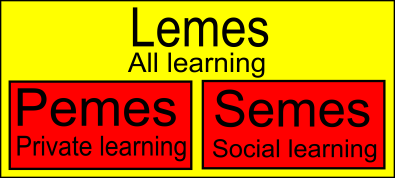
 Memetics is deeply based on the science of symbiosis. However, sometimes the study of symbiosis seems to be in almost as much of a muddle as the evolution of culture.






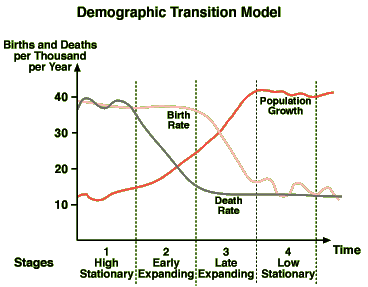 Education level is negatively correlated with the number of births. The effect is seen in both men and women: the more educated you are the fewer children you have. The more memes a country has, the fewer babies people tend to have. The effect is known as the "demographic transition". Japan illustrates this principle taken to an extreme.
 The "
The " Cecilia's work concerns the evolution of cognition. She is especially interested in social cognition, and imitation.
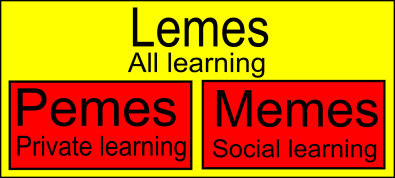
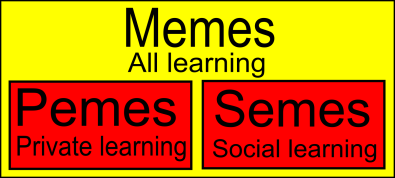
 From time to time, I have pondered whether memetics could best dispense with its baggage by rebranding itself.
 Many modern academic students of cultural evolution seem to share a common problem with understanding how cultural evolution operates. Though some pay lip service to the idea, they don't seem to fully appreciate that culture's relationship with human hosts is a symbiosis.
 Mesoudi and Jensen (2010) offer a four-point summary of the evidence for cultural group selection. It doesn't seem terribly impressive.