 According to some famous folk:
Understanding the evolution of language requires evidence regarding origins and processes that led to change. In the last 40 years, there has been an explosion of research on this problem as well as a sense that considerable progress has been made. We argue instead that the richness of ideas is accompanied by a poverty of evidence, with essentially no explanation of how and why our linguistic computations and representations evolved. We show that, to date, 1) studies of nonhuman animals provide virtually no relevant parallels to human linguistic communication, and none to the underlying biological capacity; 2) the fossil and archaeological evidence does not inform our understanding of the computations and representations of our earliest ancestors, leaving details of origins and selective pressure unresolved; 3) our understanding of the genetics of language is so impoverished that there is little hope of connecting genes to linguistic processes any time soon; 4) all modeling attempts have made unfounded assumptions, and have provided no empirical tests, thus leaving any insights into language’s origins unverifiable. Based on the current state of evidence, we submit that the most fundamental questions about the origins and evolution of our linguistic capacity remain as mysterious as ever, with considerable uncertainty about the discovery of either relevant or conclusive evidence that can adjudicate among the many open hypotheses.
This seems like a statement of confusion. The story of language evolution is primarily a story of cultural evolution. Languages evolved by adapting themselves to the human mind and human physiology. Expects should be looking primarily to memetics - not genetics - for their understanding of this topic. Human genes will have changed in response to the culture - but the usual story with cultural evolution is that the memes race on ahead and host genes are dragged along behind. We do, in fact, know quite a lot about how languages evolve - since we can see them doing it in real time, from pidgins through creoles to mature languages.
The paper starts out by saying:
In this paper, we are interested in biological as opposed to cultural evolution.
Alas, that's simply not a permissible move when studying language evolution. Memes and genes coevolve, with the memes leading and the genes following. If you don't start from there, you've dismissed all the correct solutions to this issue. Also, cultural evolution is biological. No wonder these experts appear to be confused: they are doing things all wrong.
H/T to Replicated Typo for this one.
 John Wilkins takes on Max Tegmark and Richard Dawkins - for claiming that
their subject matter is informational - in his recent article
John Wilkins takes on Max Tegmark and Richard Dawkins - for claiming that
their subject matter is informational - in his recent article
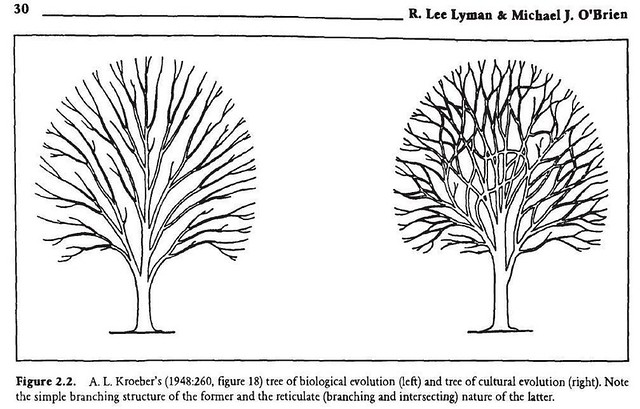 One of the things which I associate with the symbiology revolution of the 1960s and 1980s is
a much bigger emphasis on the significance of merging and joining
in evolution. If you look at the modern synthesis of the 1930/40s, merging and joining were
missing pieces of the puzzle back then.
One of the things which I associate with the symbiology revolution of the 1960s and 1980s is
a much bigger emphasis on the significance of merging and joining
in evolution. If you look at the modern synthesis of the 1930/40s, merging and joining were
missing pieces of the puzzle back then. Practically every

 I looked at what memetics-related stories have made
  Critics of memetics have characterised it as a type of "Darwinian paranoia".
 It was once claimed that Marijuana was a "
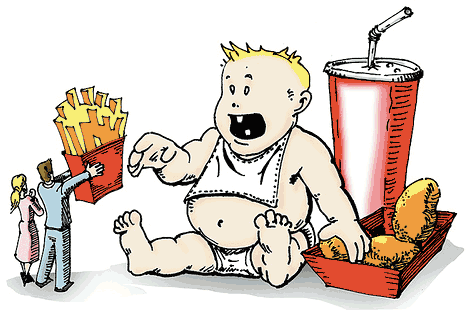 Until recently I had considered the obesity epidemic to be primarily a cultural epidemic -
an epidemic of memes. Fast food companies spread their obesity-promoting memes throughout
the population using advertising (which consists of more memes) - and so manipulate people into eating more of their food, thus making the companies richer and financing the production of more obesity-promoting memes.
Until recently I had considered the obesity epidemic to be primarily a cultural epidemic -
an epidemic of memes. Fast food companies spread their obesity-promoting memes throughout
the population using advertising (which consists of more memes) - and so manipulate people into eating more of their food, thus making the companies richer and financing the production of more obesity-promoting memes. One approach for parasites seeking to evade the host's immune system is to attack it and disable it. This approach is famously taken by the HIV virus - the virus which produces AIDS. However the result is typically a weakened immune system, and a collection of
  Joint phenotypes arise when multple individuals contribute to a trait. For example, an oak apple (see photograph on right) is the joint phenotype of an oak tree and a gall wasp. Similarly, a placenta as the joint phenotype of a mother and their offspring. The idea of a joint phenotype is an important concept in
  In the organic realm some creatures undergo radical metamorphosis during their own lifetimes. Probably the most famous example is the way that caterpillar turning into a butterfly. Tadpoles turning into frogs represents another example of
  Memes - on average - have historically been good for their human hosts.
 For decades, machine intelligence researchers have considered the human brain to
be their target - the thing whose functionality they need to inexpensively duplicate
in order to automate much human labour and compete with human beings in the marketplace.
For decades, machine intelligence researchers have considered the human brain to
be their target - the thing whose functionality they need to inexpensively duplicate
in order to automate much human labour and compete with human beings in the marketplace. At the level of individual organisms, mutual attraction, mutual repulsion and
the type of "one-sided" attraction - where A is attracted to B but B is repelled from A -
are familiar phenomena.
At the level of individual organisms, mutual attraction, mutual repulsion and
the type of "one-sided" attraction - where A is attracted to B but B is repelled from A -
are familiar phenomena.