Features Dawkins 16 minutes in, Blackmore 18 minutes in and others.
Update: video was taken down. Perhaps try here.
Friday, 5 April 2019How to Go Viral The Art of the Meme (2019)Features Dawkins 16 minutes in, Blackmore 18 minutes in and others. Update: video was taken down. Perhaps try here.
Monday, 4 March 2019Dawkins: memes are even more important than I dreamed
Here's the recent quote from Dawkins on Twitter:
I am increasingly persuaded, eg by Sue Blackmore (The Meme Machine) & @DanielDennett (all his recent books) that memes are even more important than I dreamed. Meme/gene coevolution probably explains human brain enlargement, origin of language + much else that makes us human. This is, I think a turn around for Dawkins. Here he is at the 180 point, in 2008:
Although Darwin's theory can be applied to much beyond the evolution of organic life, I want to counsel against a different sense of Universal Darwinism. This is the uncritical dragging of some garbled version of natural selection into every available field of human discourse, whether it is appropriate or not. Maybe the "fittest" firms survive in the marketplace of commerce, or the fittest theories survive in the scientific marketplace, but we should at very least be cautious before we get carried away. And of course there was Social Darwinism, culminating in the obscenity of Hitlerism. Apparently Dawkins has recently re-read The Meme Machine (source). He also commented: "What’s the memetic equivalent of kin-selected altruism? Who are my memekin? Memekin selection should make me work towards helping my students (grandstudents, readers of my books) to become meme fountains" (source) and "Why did we evolve bipedalism? Here’s my memetic theory. Temporary bipedalism is sporadic in primates: an eminently imitable trick, conspicuous demonstration of enviable skill. I think bipedal fashion meme spread culturally, sparking meme/gene (inc sexual selection) coevolution" (source). These are well-trodden topics for this blog - e.g. see Walking made us human and Cultural kin selection. Dawkins also tweeted about how he missed giving words as examples of memes - in 1976.
ReferencesFriday, 23 November 2018What happened to the cultural intelligence hypothesis?
I read a bit more about the "cultural intelligence hypothesis" in academia recently. Here is a quote from 2007:
Humans have many cognitive skills not possessed by their nearest primate relatives. The cultural intelligence hypothesis argues that this is mainly due to a species-specific set of social-cognitive skills, emerging early in ontogeny, for participating and exchanging knowledge in cultural groups. - http://science.sciencemag.org/content/317/5843/1360 IMO, something has gone wrong here. The cultural intelligence hypothesis should be a cultural counterpart to the social intelligence hypothesis - which argues that complex social lives led to big brains and advanced cognition over evolutionary time. The cultural intelligence hypothesis ought to be the cultural version: culture led to big brains and advanced intelligence over evolutionary time. It does so in many other papers on the topic. I don't know how the term "cultural intelligence hypothesis" came to refer to such a watered-down hypothesis. The 2007 paper cited above is an early use of the term which is often cited by later work. It seems lamentable that the more interesting version of the hypothesis is getting diluted by this inferior version. Other researchers seem to have abandoned the term in favor of the Cultural Brain Hypothesis (2018).
Sunday, 18 November 2018Self selection, other selection Biologists like to classify selective events. Natural selection, artificial selection, sexual selection, kin selection, group selection and observation selection are all examples of selective categories. This post is about two more categories - self selection, and other selection. These are classification categories which mainly apply to individual decisions. Biologists like to classify selective events. Natural selection, artificial selection, sexual selection, kin selection, group selection and observation selection are all examples of selective categories. This post is about two more categories - self selection, and other selection. These are classification categories which mainly apply to individual decisions.
The terms can also be applied at the level of the gene. That's an interesting level because there, other selection is not "polluted" by cases of kin selection. However, it if often polluted by cases of linkage instead - genes can affect the fitness of other genes via linkage. The other selection is most useful when these "polluted" areas are not involved. I said that these forms of selection "mainly apply to individual decisions". What does it mean for a gene to "make a decision". It means it affects some behavioural outcome, relative to its alleles. I've looked into the history of these terms a little. A common use of "self selection" is via self-selection bias. That usage doesn't seem very closely related because it makes no mention of fitness.
Saturday, 10 November 2018David. S. Wilson: This View Of Life Davis S. Wilson's new book looks set to be about about cultural evolution. It is called This View Of Life: Completing the Darwinian Revolution. Amazon link. Google books. It is coming out early in 2019. Davis S. Wilson's new book looks set to be about about cultural evolution. It is called This View Of Life: Completing the Darwinian Revolution. Amazon link. Google books. It is coming out early in 2019.David has a reasonable understanding of cultural evolution as far as I can tell. He has't supported memes very much - perhaps due to his conflicts with Richard Dawkins - but that issue is just terminology, right? No big deal. David is perhaps best known (at least among evolutionary biologists) for his championing of group selection. I have previously found this to be a bit grating. Like many evolutionists, I generally favor kin selection over group selection. The two ideas seem broadly equivalent in their modern formulations - though there is an ongoing spat about which approach is more intuitive and which causes more confusion. David's group selection advocacy seems a bit foaming at the mouth to me. He argues, for example, that many kin selection enthusiasts missed the 1970s conversion to group selection by Price and Hamilton and are stuck in a 1960s timewarp. That seems ridiculous to me. Recently David's books have focused more on the topic of this web site - the expansion of the domain of Darwinism into the social sciences. Not just via "evolutionary psychology" and the idea that human nature evolved - but also via the direct application of Darwinian evolutionary theory to cultural variation - the subject area closely associated with memetics. I generally applaud any and all contributions to this area. David has certainly brought eyes, energy and enthusiasm to the topic. He appears to be good at social networking with other researchers. However to my eyes, there are a few problems with his contributions - things that I don't really like. He seems very focused on the social sciences. Darwinism also needs extending to psychology - with the natural selection of ideas, nerve impulses and synapses. I think David realizes this, but it rarely gets mentioned. Darwinism also needs extending to physics - something I don't think I have ever heard David discuss. David doesn't seem to be expanding the domain of Darwinism anywhere near far enough for my tastes. Then there's the issues of religion. David, though technically an atheist seems to be a fan of religion. He not only argues that it is adaptive, but has written a whole book about the topic. I tend to regard the Abrahamic religions as ridiculous nonsense - and agents of the forces of darkness and ignorance. Yes it was important to have the "right" religion during the crusades, but times change, and so does what is adaptive. I can't share David's enthusiasm for religion. An associated issue is Templeton foundation money. David seems happy to take it, and spend it on worthy scientific endeavours. In some respects, I would rather David manage this money than most of the other people in the queue for it. However, the Templeton foundation is on a religious crusade. They seem to far gone in the direction of the afore-mentioned forces of darkness and ignorance. Much of the research they sponsor is biased nonsense. Scientists who take their money inevitably risk being tarred by their sponsor's agenda. In common with many scientists, I am irritated by the influence of a large religious organization on my field of study. The multiple billions of dollars involved has the power to seriously distort small fields of science. One of the ways I can help by pushing back is ignoring the papers they help produce - and to some extent researchers who take their money. That - as it turns out - is a lot of cultural evolution research and a lot of cultural evolution researchers. They have themselves to blame for this. I appreciate that scientists need to eat too. I can't stop people from taking the money, but the influence of religion on science is a serious business. Scientists can fight back with criticism, but ignoring the work in question and outright reputational damage are among the other available approaches. It is fairly common to dismiss science on the grounds of its funding source - I'm not sure that Templeton-funded research is getting enough of this.
Friday, 9 November 2018Symbionts and temporal discounting
In a now-famous paper, Alan Rogers once
argued that sexual recombination was largely responsible for temporal discounting via kin selection. If people have, on average,
around two kids each of which share half their genes, then at a similar point in their lives, investments in those kids are around
half as valuable to a parent as investments in themselves. In the case of the kids, half of any investment by a parent would go
to a bunch of unrelated genes from somebody else. If a generation is around 25 years (for women) and 30 years (for men).
That results in around 2% temporal discount annually.
Much the same effect likely also resopnsible for the rate of senescence. The future losing half its value in every generation is not an unreasonable description of senescence. The net effect is that parents are disinclined to invest in their future selves (as well as their kids) - because they will be old people in the future. This post is about the effects of cultural, microbial and other symbiosis on this result. Four points:
Since direct theoretical analysis is a bit muddy, can we get a handle on the result we are interested in by proxy - e.g. by looking at how microbes affect lifespan? Faster senescence equates broadly to more future discounting. I think that approach is more promising. Culture fairly clearly reduces the rate of senescence. Highly encultured countries clearly have retarded senescence. With microbes we typically see the reverse result - fewer microbes are associated with longer lives. These results come mostly from cross-country comparisons rather than controlled experiments - so they mostly have the status of associations, rather than causal influences. Culture looks good today, but theory suggests that it might turn against us if horizontal transfer continues to rise in importance. "Vertically" transmitted culture tends to be aligned with the interests of the hosts. "Horizontally" transmitted culture - not so much. Culture has become increasingly horizontally transmitted over time. Perhaps soon it too will be treating humans as disposable recepticles - shortening our lives in the process. Looking at effects on lifespan allows us to quantify the effects of microbes and culture on temporal discounting. The effects might have been bigger in the past before microbes and culture could spread internationally so much - but cross-country comparisons show around a 30% variation in life expectancy at birth today. It is probably fair to assume that that is mostly down to microbes and culture - rather than variation in the human genome. Microbes and culture probably do matter - but they are probably not a huge factor. Update: I should say that the Alan Rogers paper is not really right and senescence explains discounting better than kin selection does. Asexual creatures also discount.
Tuesday, 6 November 2018How culture leads to hairlessness I recently wrote a summary article about why humans are hairless. The content is broadly similar to my much longer 2011 article on the topic, "Memes and the evolution of human hairlessness". Please refer to that article for references. I recently wrote a summary article about why humans are hairless. The content is broadly similar to my much longer 2011 article on the topic, "Memes and the evolution of human hairlessness". Please refer to that article for references.Why do humans differ from other great apes? They have stable and open-ended cross-generational cultural inheritance - in addition to the more common DNA-based inheritance. Apes have cumulative cultural evolution too, but with a low complexity ceiling. This cultural difference leads to most of the other differences, from walking and swimming to talking, large brains and ultrasociality. How does culture affect hairlessness? In three types of ways:
Sunday, 4 November 2018No age of post-intelligent design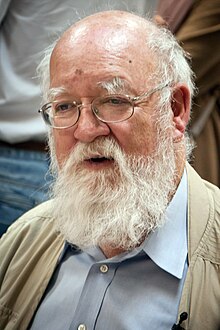 Here is Dennett, introducing his idea of an age of post-intelligent design: Here is Dennett, introducing his idea of an age of post-intelligent design:
The age of intelligent design is only a few thousand years old ... We're now entering the age of post-intelligent design. Because what we've learned as intelligent designers is that evolution is cleverer than we are at some things. The problem with the idea of an era of post-intelligent design, is that it's likely nonsense. Evolution is characterised by increasing intelligence (give or take the occasional meteorite strike). The only way that there will be an age of post-intelligent design is if there's a massive disaster that wipes out all the intelligent agents. Machine intelligence isn't a regression to an earlier era of Darwinian design as Dennett claims. If scientists use a black box which they don't understand that doesn't mean there's no comprehension in the whole system - the machine could understand what is going on. Machine intelligence is an example of more and better intelligence. The proposed age of post-intelligent design doesn't make any sense. It is just wrong.
Tuesday, 30 October 2018Memetic mass extinction
I've previously discussed the idea of a cultural-cambrian-explosion - i.e. a rapid explosion of diversity followed by competitive winnowing.
I've also talked about the role of memes in the Holocene extinction event. That there's a large-scale extinction event of DNA creatures is widely recognized. However this is also a good time to see memes going extinct - and that seems to be a less well recognized phenomenon. Some modern memes are spectacularly successful. For example, the many memes that compose the english language are all doing pretty well. However typically, whenever a very successful creature arises, numerous rivals are forced to give up their niches. There must be many languages that are losing their speakers and going extinct. Religious memes also look as though they are probably dropping like flies. Hunter gatherer tribes have been dwindling for a long time. They often take many of their memes with them. This modern memetic extinction is best seen as part of the Holocene extinction event. Rapid cultural evolution causes environmental disruption, many entities can't adapt fast enough and so go extinct.
Sunday, 28 October 2018Susan Blackmore - Artificial Intelligence - What is Our Role in the Future?Susan speculates about machine intelligence and the future. Thanks to Adam Ford for the video. I don't disagree with very much here. Susan seems a bit more pessimistic than me. Also, it seems to me that she exaggerates the extent to which machines are currently creating themselves. At the moment, I would emphasize that humans are still in the loop. Machines creating themselves will be a reality one day, but today the idea is a bit of a cartoon caricature. I also suspect that I spend less time than Susan thinking about whether the internet is conscious.
Subscribe to:
Posts (Atom)
|
 Lists of all postsChronological | AlphabeticalMemetics linksBook | References | Glossary | FAQQuotes | Videos | Criticisms | Links Memetics book listsMemetics | Symbiosis | AltruismApplications | Criticisms Author 
Author linksHome | FacebookMemetics book
Popular posts
Subscribe To
 Posts
All Comments
Posts
All Comments
|


