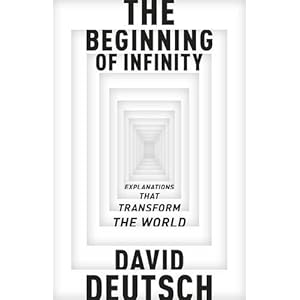
 David Deutsch's new book is about the philosophy of science - and it reputedly has a section all about memes.
The book is called The Beginning of Infinity - and it is due to be published in mid 2011.
The blurb says:
It looks at the philosophy of science from an uncompromising perspective and reaches startling new conclusions about the nature of human choice, scientific explanation and the evolution of culture.Update: The book is now out. An Amazon review says:
Deutsch's development (in Chapters 15,16) of Dawkins and Blackmores' theory of memes is seminal stuff, and takes us into politics and sociology. The classification of memes into rational/anti-rational is novel and fascinating. Together with a careful investigation into the logic of the transition from pre-humans to humans, it leads to yet another extraordinary claim: that human creativity evolved because it promoted, not innovation, but conformity to the norms of static societies.Another update: I read the chapter on memes and the chapter on creativity. It has its moment, though I also found some flaws. Deutsch says:
The whole of biological evolution was but a preface to the main story of evolution, the evolution of memes.Indeed.
Deutsch emphasises the differences between the organic and cultural realms in a way that I find to be rather distasteful. He also seems to have agendas to do with rationality and escaping from "static societies".
Deutsch supports a bizarre Popperian philosophy - so in some sections we have Popper meets memetics - resulting in passages like this:
Meme replication is often characterized (for example by Blackmore) as imitation. But that cannot be so. A meme is an idea, and we cannot observe ideas inside other people’s brains. [...] Meme replication always follows this pattern: one observes the holders’ behaviour, directly or indirectly. Then, later – sometimes immediately, sometimes after years of such observation – memes from the holders’ brains are present in one’s own brain. How do they get there? It looks a bit like induction, does it not? But induction is impossible. [...] So there is no such thing as ‘just imitating the behaviour’ – still less, therefore, can one discover those ideas by imitating it. One needs to know the ideas before one can imitate the behaviour. So imitating behaviour cannot be how we acquire memes.I don't have much patience with this kind of Popperian thinking, I'm afraid.
Deutsch offers this summary of his "creativity" chapter:
On the face of it, creativity cannot have been useful during the evolution of humans, because knowledge was growing much too slowly for the more creative individuals to have had any selective advantage. This is a puzzle. A second puzzle is: how can complex memes even exist, given that brains have no mechanism to download them from other brains? Complex memes do not mandate specific bodily actions, but rules. We can see the actions, but not the rules, so how do we replicate them? We replicate them by creativity. That solves both problems, for replicating memes unchanged is the function for which creativity evolved. And that is why our species exists.So: it is strange stuff. I think you have to be fairly keen on Popper or Deutsch to appreciate such material.
Update: I read the book - and, alas, the philosophy of science is outdated, bad and dogmatic.


 College humour has produced a meme song. It is a song about a lady whose bad day winds up all over the internet. The song has lots of "meme" in-jokes. It is by based on a song by Taylor Swift - a country music singer.
 Internet meme repositories are pretty common. Memebase seems to be a fairly major one, though. It's from the
  I've compiled some
  Congratulations to Dan and Alsion Zarella on the launch of
 If you are having any trouble creating





 Posts
Posts

