Saturday, 14 January 2012

Who first realised that ideas have sex?

These days, "ideas having sex" has been popularised, but it wasn't always so. I've been looking at which cultural evolution pioneers realised that ideas have sex. Some of the earliest references I found were:
  • 1970 - Jacques Monod, in the book Chance and Necessity wrote: "For a biologist it is tempting to draw a parallel between the evolution of ideas and that of the biosphere. For while the abstract kingdom stands at a yet greater distance above the biosphere than the latter does above the nonliving universe, ideas have retained some of the properties of organisms. Like them, they tend to perpetuate their structure and to breed; they too can fuse, recombine, segregate their content; indeed they too can evolve, and in this evolution selection must surely play an important role."
  • 1987 - K. Eric Drexler - Engines of Creation: The Coming Era of Nanotechnology "Like genes, ideas split, combine, and take multiple forms (genes can be transcribed from DNA to RNA and back again; ideas can be translated from language to language)"- page 30.
  • 1989 - Lynch et al A model of cultural evolution of chaffinch song derived with the meme concept covered the concept.
In the 1990s, the idea became more common - appearing explicitly in Lynch's Thought Contagion (1996), for example. However, I didn't find too many other mentions of sexual recombination of ideas in the 1970s and 1980s. The idea doesn't seem to be present in Dawkins 1976, 1982 or 1986. Indeed in 2005 (page 192), Dawkins wrote:
One respect in which [memes] are not like genes is that there is nothing obviously corresponding to chromosomes or loci or alleles or sexual recombination.
...suggesting that he hadn't grasped the concept of sexual recombination among ideas then.

The idea isn't in Cavalli-Sforza & Feldman (1981), it isn't in Lumsden & Wilson (1981) and it isn't in Boyd & Richerson (1985). The latter do mention "cultural mating" - but they use the term to refer to individuals acquiring ideas from multiple parents - and not "ideas having sex". I didn't see it in Hull (1988), Brodie (1995) or Boyd & Richerson (2005) either.

Darwin (1871) gave us:

Languages, like organic beings, can be classed in groups under groups; and they can be classed either naturally according to descent, or artificially by other characters. Dominant languages and dialects spread widely, and lead to the gradual extinction of other tongues. A language, like a species, when once extinct, never, as Sir C. Lyell remarks, reappears. The same language never has two birth-places. Distinct languages may be crossed or blended together.
...though that isn't quite the same. Words having sex would have captured the idea.

Recombination is a fairly fundamental evolutionary idea - but it apparently took a while to sink in - in the domain of cultural evolution.

David Krakauer - resources

David Krakauer is interested in intelligence, how it evolved, and where it's going next.

He has a home page at The SantaFe Institute. His home page says:

The big question that many of us are asking is what will evolutionary theory look like once it has become integrated with the sciences of adaptive information, and of course, what will these sciences then look like?

Videos


Cognitive Ubiquity: The Evolution of Intelligence on Earth Part One: The Adversarial Quartet


Cognitive Ubiquity: The Evolution of Intelligence on Earth Part Two: Invasion of the Inferential Cell


Cognitive Ubiquity: The Evolution of Intelligence on Earth Part Three: All Watched Over by Machines of Loving Grace

Samuel Bowles - resources

Samuel Bowles is an economist who is interested in the evolution of cooperative behaviour.

He has a home page at The SantaFe Institute.

Videos


The Nature of Wealth and the Dynamics of Inequality


Machiavelli's Mistake: Why Good Laws are No Substitute for Good Citizens.


Lecture I: A Cooperative Species (or are we just afraid someone may be looking?)


Lecture II: Altruism, Parochialism, and War: Rambo Meets Mother Teresa.


Lecture III: Machiavelli’s Mistake: Why Policies Designed for “Wicked Men” Fail.

Friday, 13 January 2012

Robert Frank - resources

Robert Frank is the author of The Darwin Economy - and many other books on macroeconomics and microeconomics.


Darwin Explains Our Economy, Says Robert Frank


Was Charles Darwin the Father of Economics as Well?


David Sloan Wilson talks with economist Robert Frank about his new book, The Darwin Economy


David Sloan Wilson talks with economist Robert Frank about his new book, The Darwin Economy


Demos' Robert Frank on MSNBC's UP w/Chris Hayes: The Darwin Economy


Robert Frank on the Darwin Economy

Thursday, 12 January 2012

Daniel Dennett: Wild and Domesticated Religions: How the Machinery of Religion Evolved


Daniel Dennett on religions. Daniel starts about 6 minutes in. Memes start about 20 minutes in.

Daniel Dennett: Miller Fellow Interview


Interview with Miller Fellow, Daniel Dennett

Daniel Dennett talks about his gig at the SantaFe Institute. Not many memes (sorry about that!)

Alex Bentley - resources

Alex Bentley is one of the authors of a recent book: I'll Have What She's Having: Mapping Social Behavior.

He was at Durham university until recently. His home page there.

Videos


I'll Have What She's Having: Mapping social behaviour


Social Influence and Drift in Collective Behavior


Social Influence and Drift in Collective Behavior


Dr. Alex Bentley.

Kenyatta and Elspeth interview (Know Your Meme)

Watch Co-creators, Know Your Meme on PBS. See more from Interview.

A quick 1.5-minute video interview with Kenyatta and Elspeth.

Wednesday, 11 January 2012

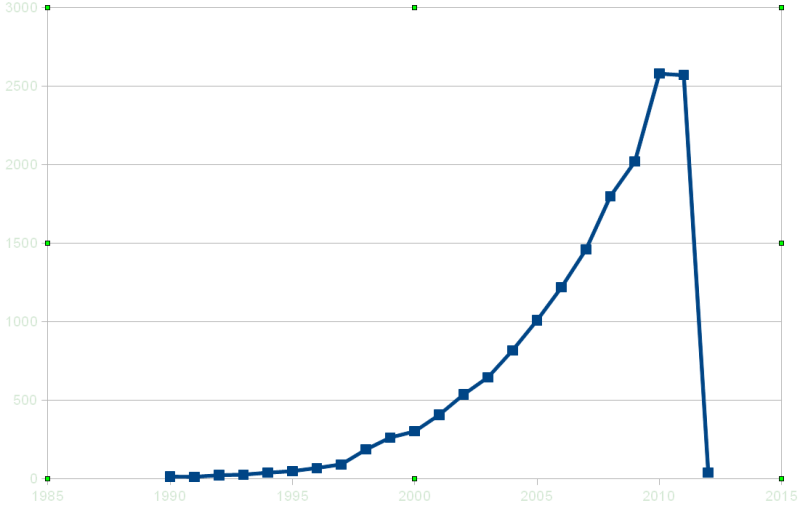
Graph of memetics articles on Google Scholar

Richard Dawkins proposed tracking the health of memetics by tracking citations of the idea in learned journals - in the second edition of The Selfish Gene.

I plotted such references in a 2008 article titled: Memetics death report exaggerated.

I revisited Google Scholar and made another plot today. This time I used "memetic OR memetics" as my search term, which seems to be the most reasonable thing to search for to me.

Here are the results:

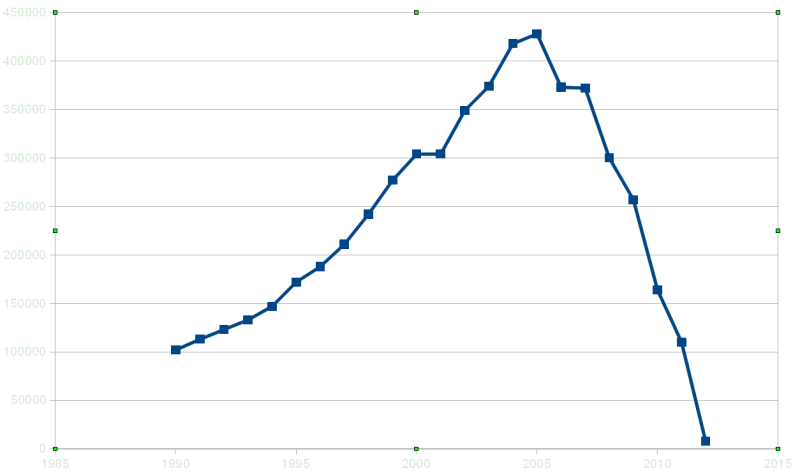
As before, it is best to ignore the last couple of years: Google hasn't indexed all the papers from those years yet.

This time I also did a "control" plot: I searched for "gold":

Here's my raw data:

YearMemetics
199015
199114
199224
199328
199440
199550
199670
199793
1998187
1999264
2000303
2001408
2002538
2003648
2004819
20051010
20061220
20071460
20081800
20092020
20102580
20112570
201242
YearGold
1990 102000
1991 113000
1992 123000
1993 133000
1994 147000
1995 172000
1996 188000
1997 211000
1998 242000
1999 277000
2000 304000
2001 304000
2002 349000
2003 374000
2004 418000
2005 428000
2006 373000
2007 372000
2008 300000
2009 257000
2010 164000
2011 110000
2012 7660

Others on the internet seem to be noticing downturns in recent years too. For example, this guy appears to have concluded that we are at "peak haplotype" - on similarly flimsy evidence.

Sunday, 8 January 2012

Susan Blackmore interview on memes (2009)

Here's a Susan Blackmore interview relating to memes and memetics.

It's followed by some rather amateur and uninformed criticsm of memetics.

The theist presenter says: "I can't see how the theory of memes can be true".

This footage was taken from the documentary "Did Darwin Kill God" - from 2009.