Monday, 7 December 2015

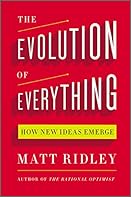
My review of The Evolution of Everything is up

My review of The Evolution of Everything is up. It is titled: "A demonization of intelligent design". Check it out.

Rather to my surprise, I found quite a bit to disagree with in Matt's book. In my humble opinion, the basic problem is that Matt didn't take on the ideas described in Keeping Darwin in Mind. This leads him to regard intelligent design by human designers as a form of creationism - making it a foe to be vanquished. I don't think that this is a very well-balanced perspective.

I have long thought that the idea of incorporating intelligent design into Darwinism might cause some people to choke. So far, to the best of my knowledge, only Matt Ridley and Daniel Dennett seem to have got into problems in this area. Ridley seems to be having more problems than Dennett did.

If you liked this one, feel free to check out my other book reviews.

Saturday, 5 December 2015

The teaching first hypothesis

Most accounts of the origin of human cultural evolution focus on imitation or social learning. However there's another possibility - that the most relevant changes were in teaching ability - or inclination to teach.

The scenario I favor relating to the origin of social learning in humans involves walking. This scenario is described in my essay walking made us human. Walking is a socially-transmitted trait. Learning it promptly is extremely important for modern humans. Walking is also widely taught to offspring by their parents. This observation suggests another scenario for the early cultural evolution of humans - in which changes in teaching ability are more significant than changes in learning ability.

Teaching ability is easier to change via cultural evolution than infant learning ability is. It is probably easier to change via DNA gene evolution too. Since the trait looks as though it is probably easier to modify, there's at least a fair chance that the main difference between the early walkers and the non-walkers was that the walkers put more effort into teaching their offspring.

Teaching is not involved in all types of cultural transmission. However it is involved in transmission of walking. Acceptance of the scenario described in Walking made us human makes this "teaching first" hypothesis more likely.

The focus on learning seems fairly ubiquitous among students of cultural evolution to me. Susan Blackmore in The Meme Machine promoted the importance of imitation. Lee Alan Dugatkin reviewed Susan's book and then went on to write The Imitation Factor. While both books are excellent, if the teaching first hypothesis is correct then an emphasis on imitation may be misplaced.

Can we test the idea? The detailed history is probably lost in he mists of time. However, we can probably test the idea that teaching ability is easier for cultural and genetic evolution to produce. If so, the teaching first hypothesis becomes favored by Occam's razor - conditional on the ideas described in walking made us human.

More meme denialism

There are still a lot of people who are totally confused about cultural evolution. Whether due to ignorance, stupidity, bad teaching, or whatever, there are still lots of people who just don't get it. They are still on the wrong side of the meme paradigm shift.

We can say these people lack meme literacy. Or we can describe them as being meme challenged. However, sometimes, a bit more of a verbal kick in the ass seems desirable. If people are particularly ignorant of the literature, seem to think they are entitled to spout nonsense on the topic, and fail to update on evidence, the term 'meme denialism' may be appropriate.

I think the term should be reserved for the worst offenders. So, I'm thinking that Steven Pinker and Massimo Pigliucci are in denial about memes, while Peter Richerson and Rob Boyd are more in the 'minor misunderstandings' zone.

When Helena Cronin says:

There's culture; there's history; there's change; there's progress; there's technological innovation; there's growth of knowledge; there's social learning; and there's lots more. But there's no cultural evolution.

That's a nice example of what I'm talking about: complete denial of the whole field of study.

Another example comes from John Gray, writing:

There is no general theory of evolution.

Another case is Jonathan Marks (2000):

Now unlike genes, memes have the decided disadvantage of not actually existing.
This is what meme denialism looks like.

Update: I previously wrote about meme denialism here.

Thursday, 3 December 2015

Matt Ridley: How New Ideas Emerge

The blurb says: "Streamed live on Dec 3, 2015". You may want to fast-forwards to get to Matt's talk.

One notable moment is where Matt receives an audience question about whether his ideas are falsifiable at around 1:20:00. Note that the YouTube user involved edited and re-uploaded the video after I watched it - so you may find that the relevant section of the Q&A session has been moved or is missing.

Matt was also interviewed recently by CNBC's Rick Santelli here.

Matt answers questions about The Evolution of the USA here.

Wednesday, 2 December 2015

Creative destruction

It is easier to destroy than it is to create. If similar efforts expended on creation and destruction, the destructive change is often are bigger - sometimes much bigger. So: those who seek leverage should seriously consider destruction as an option.

I've written about the possibility of positive destruction - in my 2010 positive destruction article.

In the context of cultural evolution, creative destruction typically involves destroying memes, preferably bad memes.

This is partly the job of promoters of skepticism and rationality. As an example, both Dawkins and Dennett have had a go at sabotaging religious memes. I have often expressed puzzlement at this behaviour - since religious though has been widely discredited by scientists. Scientists attacking Abrahamic religions in modern times look a bit strange - since those religions have not been scientifically credible for a long time now. Scientifically, they are a dead issue. However, maybe, by taking advantage of the power of destruction, they are still doing some good.

I identified some other bad causes in my 2010 'bad causes' video. However, I didn't really link my conclusions up with those of the positive destruction essay. Top of my list at the time was climate change. Reviewing the topic five years later, climate change is still my number one bad cause. I don't think I have ever seen so many resources and time frittered away on such a worthless and ineffectual cause. Experts on cause prioritization seem to fairly uniformly agree that climate change is not a high priority. How then to explain the wasted billions?

One of the most obvious explanations is that fear sells. Global warming alarmists are fear-mongering. I also think that virtue signaling explains a lot about the irrational global warming hysteria. The cause offers people a chance to save the world - a well-known superstimulus to do-gooders. Trying to save the world shows that you care a lot.

Maybe global warming alarmism has enough detractors for it to no longer be low hanging fruit for critics. However it is still pretty fat - and fat targets are often attractive.

If so, the efforts of Matt Ridley and Bjorn Lomborg (among others) may prove to have been especially welcome.

I am especially disappointed with the role that many scientists have played in the fiasco. Like Matt Ridley, I see the climate wars especially indicative of scientific funding bias. Ridley explains the problem in What the climate wars did to science. Scientists should be the first to speak up in a situation like this. A few scientists have done this = but overall, this is not what we have seen. It is a big embarrassment to those who want to proudly call themselves scientists.

Sunday, 29 November 2015

Nemes

There are only twenty six letters in the English alphabet. There are also many more types of copied entity than are dreamed of in dual inheritance theory. It follows that those who would continue with terminology along the lines of genes and memes should choose their letters carefully.

I've previously - rather half-heartedly - proposed that we use lemes for learned entities. 'Lemes' cover individual and social learning (by contrast to memes which are normally defined in such a way that they are confined to social learning.

Another proposal which covers similar ground is 'nemes'. The 'n' is short for 'nervous' or 'neural'.

Paul Gilchrist proposed the term 'neme' in 2014 here and here.

A good thing about 'neme' is that it is potentially more inclusive. Not all copying within brains is learning. For example, some is forecasting based on existing models. 'Neme' could plausibly be used as an umbrella term that covers all within-brain copying.

A bad thing about 'neme' is that it is rather closely associated with wetware. Computers also have individual and social learning. However, it seems like quite a stretch to apply the terms 'nervous' or 'neural' to computers.

Another problem is that Paul Gilchrist and I don't seem to agree on what the term should mean. I would want to expand the term to cover copying inside computers and copying of high level structures inside brains - such as ideas. By contrast, Paul says:

I use the term neme to apply to the nerve impulse that is the fundamental element in the operation of the nervous system.

I see where Paul is coming from - but then we need more names to cover all that other stuff that goes on inside brains. We do have 26 letters - but we should use them sparingly and make sure that we don't squander them.

Overall, I quite like the 'neme' term. The surrounding definitional debates show that it needs some more work, though.

Tuesday, 24 November 2015

Evolutionary frameworks

Some say evolution is a theory, others say it is a fact. I tend to regard evolution as a framework. It is OK to regard evolution as a theory - but as theories go, evolution has a lot of holes in it. On its own, evolutionary theory doesn't make all that many predictions. It is largely reliant on other theories to help it to make useful predictions.

It's possible to make a map of the holes in evolutionary theory - to see where other theories can be attached in order to provide support. That's the main function of this post.

The biggest hole in vanilla evolutionary theory is that it generally lacks a predictive theory explaining which creatures are fitter. For birds, the additional theories of aerodynamics are required; for bats, a theory of echolocation is needed - and so on. These other theories are more closely associated with developmental biology than they are with evolutionary theory. In general, additional theories that map from genomes to expected fitnesses are required.

Evolutionary theory includes or interfaces to genetics. Genetics also has some holes - or at least permits other modular theories to be attached to it. Genetics needs theories of mutation, merging and error correction. There are various types of mutation: point mutations, frameshift mutations, insertions, deletions and so on; mutational theories describe what can happen, when it can happen and how likely it is to happen. "Merging" theories cover recombination, symbiosis and rarer cases where genomes fuse or assimilate each other. A full theory theory must deal with mate selection - and the choice of symbiotic partners - since these factors determine which genomes merge. Error correction theories affect both mutation and merging. Genome modifications are post-processed by error detection and correction processes. These bias the results of these processes. Some modifications are permitted, others are rejected, and others are modified further. Error correction results in an adaptive bias to mutations - since the most deleterious mutations are selected against the most strongly by these mechanisms.

Some of the more vocal proponents of the basic idea in this post - that evolutionary theory contains holes - are Geoffrey Hodgson and Thorbjørn Knudsen. For example, in the paper: Why we need a generalized Darwinism, and why generalized Darwinism is not enough, these authors explain how evolutionary theories do not stand alone and depend on other bodies of knowledge. I agree with their perspective on this issue.

Saturday, 21 November 2015

Hodgson's habits and routines

In 2003, Geoffrey Hodgson proposed that we use the terms "habit" and "routine" as replacements for the term "meme". As with most other meme synonyms, this suggestion doesn't seem to have been very popular. Retrospectively, it appears to me that this proposal has critical technical limitations that put it out of the running.

Hodgson says that "habits" represent individual transmission while "routines" represent group-level transmission. The dictionary seems to think that individuals can have routines as well, muddying this proposed distinction. Hodgson defends the idea that these entities can act as units of cultural transmission. What he fails to defend is the idea that all cultural transmission is mediated by habits or routines. This claim seems straightforwardly incorrect. For example, the Bible is a bunch of memes, but it isn't a bunch of habits. Habits are associated with individuals, but no individual counts the bible as being among their habits. Nor is the bible a bunch of routines.

This makes Hodgson's proposal incomplete basis of a theory of cultural evolution. If adopting his terminology, we would need one theory for the evolution of habits and routines, and another theory for the evolution of other aspects of culture. Or we would need to redefine these terms and give them counter-intuitive technical meanings. Can we patch up Hodgson's proposal by finding another term (apart from 'habits' and 'routines') to represent other inherited aspects of culture? Maybe - but it looks like a dustbin category to me.

The other issue with Hodgson's proposal is that "habits" and "routines" are not necessarily socially transmitted. We already have terms for mental content that isn't necessarily socially transmitted: 'ideas' and 'concepts'. Part of the reason that term 'meme' found its niche is that it expressed a different idea from the terms 'idea' and 'concept'. If 'meme' had been another synonym for 'idea' and 'concept', it would have failed.

I think Hodgson's proposal is now dead. This post is a post-mortem that attempts to explain where it went wrong.

Friday, 20 November 2015

Darwin meets Turing

A cryptic title - but this post is about applying models of universal computation to universal Darwinism.

Most versions of universal Darwinism agree that evolutionary theory applies to brains and thinking. This idea was pioneered by B. F. Skinner and D. T. Campbell and promoted by W. H. Calvin, G. Cziko and G. Eldeman among others. Evolutionary theory explains all goodness of fit and all knowledge gain.

If evolution explains the operation of brains, it ought also to explain the operation of computers - since both are general purpose input-transformation-output learning systems. We have some nice, simple models of computation. Can universal computation illuminate Universal Darwinism? In this post we will find out.

We will use the NAND gate + interconnect model of parallel computation and see how it relates to evolutionary models. Copying is a primitive operation in Darwinism: in NAND land it corresponds to signal branching. Selection is another primitive operation in Darwinism: in NAND land, it corresponds to signal termination. That just leaves the NAND gate itself. The NAND gate takes two inputs and produces one output. There are two ways of looking at the NAND operation from a Darwinian perspective. One is as a conditional selection operation. A NAND gate obliterates or inverts one of its inputs depending on the value of the other one. The other way is as a merging or joining operation between two signals. That completes the relationship between these two models.

What did we learn from this exercise? Merging or joining operations turned out to be fundamental. Mutation was not fundamental. It turns out that you can model mutations using copying, selection and merging - if necessary.

Intuitively, the products of evolution include brains - so it is not surprising that some models of evolution are capable of computing partial recursive functions.

However, a universal model has some negative aspects. There's a sense in which universal models are capable of producing any output - and notoriously, models which predict everything are not very useful. We can take some consolation in the idea that there can be all kinds of differences between different universal systems - they differ in speed, degree of parallelism, memory to compute ratio, relative component costs, brittleness, support for synchronous operation - and so on.

One thing I learned from building this model is that my usual reply to critics who allege some Darwinian models lack predictive power is not completely satisfactory. I usually say that constraining the scope of the mutation operator is enough to limit the resulting predictions. However, if there's a recombination operator, that can also lead to universality - and produce a model that is compatible with a lot of observations. It looks as though mutation and recombination both need limiting.

This post presents a model on the level of the bit. Another way of building evolutionary models of computational processes is to rise above the level of the bit. Conventionally, most mutation and recombination takes place between genes - rather than bits - and genes are conventionally quite a bit bigger than bits. This path produces a range of interesting models which have already been well explored in some detail by genetic algorithm and genetic programming enthusiasts.

Monday, 16 November 2015

Future fertility

I think that most models of the demographic transition have human fertility continuing to fall globally - for some time to come. Recently I read a prediction - posted by Jason Collins - that fertility would rise. Here is Jason's post linking to his article: Fertility is going to go up.

I am pretty sceptical. At one point Jason confesses that he might be wrong, writing:

I’m the first to admit we could be wrong in the prediction of a fertility increase. What other shocks are still to come? Will the continually changing environment drown out the underlying evolutionary dynamics? Our instinct is that most of the shocks that can affect fertility have played out in the developed world – increased incomes, effective contraception, female choice and so on. But what further shocks could reduce fertility?
Here's my attempt at a list of the big fertility-reducing factors that currently still lie largely in the future:

  • More engaging games;
  • More engaging pornography;
  • Sex with robots;
  • Economic competition with machines;
  • Chemically-induced orgasms;
Basically, memes have run rings around genes, reducing human fertility. IMO, this process shows no sign of stopping - or even slowing down. The argument that parasites rarely kill their hosts doesn't help much here - parasites can kill their hosts if they have multiple host types and aren't dependent on one particular host type. That will be the situation with intelligent machines - memes won't be dependent on human hosts any more - so they won't be forced to keep them around.

Overall, based on our current understanding of cultural evolution, it seems quite reasonable to model future human fertility as falling to zero. Fertility is going to go down. Jason's argument for the opposite conclusion seems to be based on DNA evolution. However, this is slow - by comparison with cultural evolution. You have to model cultural evolution to have much hope of predicting future changes.