Monday, 28 April 2014

Experts appear confused about language evolution

According to some famous folk:

Understanding the evolution of language requires evidence regarding origins and processes that led to change. In the last 40 years, there has been an explosion of research on this problem as well as a sense that considerable progress has been made. We argue instead that the richness of ideas is accompanied by a poverty of evidence, with essentially no explanation of how and why our linguistic computations and representations evolved. We show that, to date, 1) studies of nonhuman animals provide virtually no relevant parallels to human linguistic communication, and none to the underlying biological capacity; 2) the fossil and archaeological evidence does not inform our understanding of the computations and representations of our earliest ancestors, leaving details of origins and selective pressure unresolved; 3) our understanding of the genetics of language is so impoverished that there is little hope of connecting genes to linguistic processes any time soon; 4) all modeling attempts have made unfounded assumptions, and have provided no empirical tests, thus leaving any insights into language’s origins unverifiable. Based on the current state of evidence, we submit that the most fundamental questions about the origins and evolution of our linguistic capacity remain as mysterious as ever, with considerable uncertainty about the discovery of either relevant or conclusive evidence that can adjudicate among the many open hypotheses.

This seems like a statement of confusion. The story of language evolution is primarily a story of cultural evolution. Languages evolved by adapting themselves to the human mind and human physiology. Expects should be looking primarily to memetics - not genetics - for their understanding of this topic. Human genes will have changed in response to the culture - but the usual story with cultural evolution is that the memes race on ahead and host genes are dragged along behind. We do, in fact, know quite a lot about how languages evolve - since we can see them doing it in real time, from pidgins through creoles to mature languages.

The paper starts out by saying:

In this paper, we are interested in biological as opposed to cultural evolution.

Alas, that's simply not a permissible move when studying language evolution. Memes and genes coevolve, with the memes leading and the genes following. If you don't start from there, you've dismissed all the correct solutions to this issue. Also, cultural evolution is biological. No wonder these experts appear to be confused: they are doing things all wrong.

H/T to Replicated Typo for this one.

Wilkins vs Tegmark and Dawkins

John Wilkins takes on Max Tegmark and Richard Dawkins - for claiming that their subject matter is informational - in his recent article Information is the new Aristotelianism.
As a fan and proponent informational views of heredity, I take exception to this sort of material.

Wilkins writes:

When physicists or philosophers say that we are living in the Matrix, or equivalent statements like the properties of atomic and subatomic objects are merely mathematical, they make a classical mistake, even worse than getting involved in a land war in Asia. They are mistaking the representation of a thing for the thing. The late medieval scholastics like Lombard knew this error and named it long before Saussure: the sign is not the thing signified. The word is not the world. If we are living in the Matrix, what does the Matrix live in? We know of no information processing system that is not, itself, physical.

I am sceptical. I don't think any physicist is making this mistake.

Wilkins also claims that Dawkins' informational views of heredity arose as a misunderstanding of a quote from Francis Crick. Really? This is wild speculation, IMO. I see little sign of supporting evidence.

Massimo Pigliucci picked Max Tegmark up on the same issue as Wilkins:

Could it be that theories like [Mathematical Universe Hypothesis] are actually based on a category mistake? Obviously, I’m not suggesting that people like Tegmark make the elementary mistake of confusing the normal meaning of words like “objects” and “properties,” or of “physical” and “mathematical.” But perhaps they are making precisely that mistake in a metaphysical sense?
I find this sort of thing tedious. It is pretty-much part of the physicist's remit that the universe is isomorphic to some mathematical object. Their job is to find out which one. Philosophers might worry that mathematics only exists inside intelligent agents - and worry that the physicists are implicitly invoking god. The physicists will just shrug at this, though: it's not what they meant - and who cares what the philosophers think anyway?

Sunday, 27 April 2014

Merging and joining

One of the things which I associate with the symbiology revolution of the 1960s and 1980s is a much bigger emphasis on the significance of merging and joining in evolution. If you look at the modern synthesis of the 1930/40s, merging and joining were missing pieces of the puzzle back then.

Symbiology brought with it a flood of understanding of the significance of evolution via aggregation. Now we know that merging and joining are large and important aspects of organic and cultural evolution. Merging and joining are fundamental in sexual recombination and parasitism - both of which are extremely widespread in both the organic and cultural realms.

Merging and joining between species are not evolutionary phenomena which are confined to microorganisms. Current estimates are that around 8% of human DNA comes from viruses - rather than from our ancestors. This gives some indication of how significant between-species joining is in the evolution of multicellular eucaryotes.

The idea of splitting-only evolution still persists in some areas - like an hangover. Evolution is still sometimes characterised as "descent with modification". Or people say that evolution consists of "inheritance with variation and selection". These are splitting-only descriptions of evolution. The idea of a "tree of life" is common, but not very accurate. Life is web-like - much more so than most trees are.

It's true that splitting is more common than merging and joining. However, merging and joining are pretty significant. They are how living things combine their solutions to environmental problems.

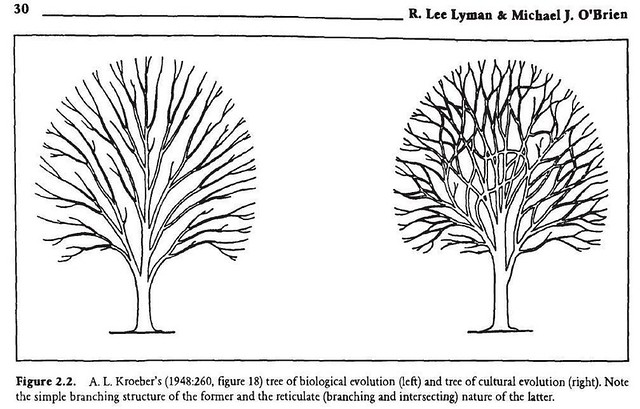
The issue relates to cultural evolution. Krobner (1948) argued that organic evolution was tree-like while cultural evolution was web-like. He used the diagram associated with this post to illustrate his point.

However, we now know that both the organic and cultural realms exhibit web-like evolution. The picture of organic evolution as consisting of splitting without merging or joining has proved to be a mistaken one. Instead, merging and joining have turned out to be ubiquitous evolutionary phenomena - present in both realms.

References

Reticulation in phylomemetics

Practically every phylomemetic tree I have ever seen has illustrated branching - but not joining. However, it is well known that cultural evolution shows a considerable amount of joining. The result is part tree, part reticulated network - rather like the image associated with this post.

Should we be concerned that most phylomemetic trees paint an inaccurate picture of how cultural evolution operates? That most phylomemetic trees are inaccurate - through inheriting this systematic distortion?

On one hand, the fact that most evolution involves joining as well as splitting is an important issue which is poorly understood - and most phylomemetic trees reinforce the idea that evolution equals splitting - when they could be combating it. On the other hand, splitting-only trees are simpler than partially-reticulated ones - and this simplification is often a permissible one.

References

The YouTube trends team on memes

One of YouTube's 2014 April fools jokes involved memes. Their associated article comes with the title:

Analysis Shows 2014 Could Be Huge Year for New Memes

I've attached the associated humorous video:

Saturday, 26 April 2014

Seth Godin: How to get your ideas to spread

This is a Seth Godin video from 2007 titled: "How to get your ideas to spread".

Seth Godin wrote the well-known book "Unleashing the Ideavirus".

Epic phylomemetic tree of world religions

Impressive work:


Version 2.0.


Version 1.0.

For the full-size image I recommend that you click here for version 1 and here for version 2.

I've included both versions to illustrate the point that not only are the worlds' religons evolving, but even the diagram of the worlds' relgions is evolving.

I was pleased to see that the second version included some horizontal meme transfer - something that was largely missing fro the first version.

For the source, visit the Human Odyssey site on Facebook.

Thanks to Alexander Kruel for bringing this one to my attention.

For a (possibly) even more epic effort along similar lines, see the zoomable phylomemetic tree here.

Memetics on slashdot

I looked at what memetics-related stories have made slashdot in 2014. There's:

It's nice to see that memes are making it into the tech news once again. These articles - and the studies they refer to - seem likely to be a side effect of the 2011 internet meme explosion.

Thursday, 24 April 2014

On Darwinian paranoia

Critics of memetics have characterised it as a type of "Darwinian paranoia".

Here's Peter Godfrey Smith:

How did the gene’s eye view acquire such apparent power as a foundational description? I conjecture that this is because the gene’s eye view of evolution is a special kind of agential narrative.

Two explanatory schemata can be distinguished, within the general agent-positing category, which have a special psychological potency. The first is a paternalist schema. Here we posit a large, benevolent agent, who intends that all is ultimately for the best. This category includes various gods, includes the Hegelian “World Spirit” in philosophy, and includes stronger forms of the “Gala” hypothesis, according to which the whole earth is a living organism. The second schema is a paranoid one. Now we posit a hidden collection of agents pursuing agendas that cross—cut or oppose our interests. Examples include demonic possession narratives, the sub-personal creatures of Freud's psychology (super-ego, ego, id}, and selfish genes and memes.

Like me, Godfrey Smith links memetics to demonology and posession. However, while I see this link as validating some aspects of early superstitious thought, Godfrey Smith plainly intends it as a criticism of memetics.

Darwinian paranoia is a conceptual waste of space. It isn't paranoia if they really are out to get you. In the case of selfish genes and selfish memes there are plenty of cases where they are plainly out to get you. Should you give that AIDS virus the benefit of the doubt? What about that malaria protozoan? Or perhaps you would like to adopt some misunderstood smoking memes? Or maybe some memes from fast-food vendors, or memes from suicide bombers?

These "agents with agendas that cross—cut or oppose our interests" are not a paranoid fantasy. They are perfectly real - and perfectly hostile. It's public misinformation to brand negative reactions to them as "Darwinian paranoia". The associated threats are real, and people are perfectly correct to be concerned about them.

What's the opposite of paranoia? Foolhardiness. Humans are naturally on the paranoid end of the spectrum - and that's because natural selection built us that way. As Andy Grove put it "Only the paranoid survive". Foolhardiness is foolishness - and it's relatively rare in the world - for good survivalist reasons. My council is to avoid being foolhardy on this topic.

Wednesday, 23 April 2014

Gateway memes

It was once claimed that Marijuana was a "gateway drug".

Scientists seem to have mixed feelings about this claim - but there are certainly cases of a "gateway" effect in the world of drugs - where associations with drug dealers tend to make a range of illegal drugs more accessible.

Memes tend to pack-hunt - and it is quite common for acceptance of one meme to be followed by the assimilation of a range of associated memes. For example:

  • If you accept the virgin birth meme, that tends to open you up to christian memes about resurrection, the afterlife, the garden of eden and original sin.

  • Similarly, those who assimilate Linux memes are subsequently more likely to adopt memes related to vi, grep, gimp and git.

The term "gateway meme" can be used in cases where one meme commonly leads to exposure to a range of other associated memes.

The term works best when it's often the same meme that acts as a hook. For example, it is often Lady Gaga's "Bad Romance" song that acts as a gateway to her back catalog.

The term also works best when the memes in question are undesirable or addictive. The association is with gateway drugs - which is a negative term used by opponents of drug use.