"Epigenetic" is a word that has been sabotaged recently by some biologists.
Conrad Waddington is usually credited with coining the term "epigenetics" - in 1942 - meaning:
The branch of biology which studies the causal interactions between genes and their products, which bring the phenotype into being.
I think this usage is fine.
However, these days, the term "epigenetic" has been hijacked by a bunch of ignorant biologists who think it should mean this:
Epigenetics is the study of heritable changes in phenotype caused by mechanisms other than changes in the underlying DNA sequence.
I think this usage is absolutely awful.
Definition of the words "gene" or "genetic" that specify nucleic acids seem terrible to me. Genetics is - or should be - the basic science of heredity in biology. If we make creatures with non-nucleic-acid inheritance media, or find creatures with non-nucleic-acid inheritance, or consider our distant non-nucleic-acid-based ancestors, we really do not want to have to redefine the basic terms of genetics to be able to discuss how they inherit things. This is a problem we should be smart enough to be able to see coming.
So: please boycott the "new" epigenetics. It hijacks a perfectly acceptable piece of terminology, and turns it into an awful stinking mess.
If anyone ever starts talking to you about "epigenetic inheritance", well, please refer them to this page.
 One way of modelling human culture is as an extension of human biology. If you do that then one way of modelling cultural information is as part of a human extended genotype. The products of culture would then be modelled as being part of the phenotype of that extended genotype. This type of model is, alas, common in academic studies of cultural evolution. As Mesoudi (2011) puts it:
In a typical cultural evolution model, a population is assumed to be composed of a set of individuals, each of whom posseses a particular set of cultural traits. A set of microevolutionary processes is specified that changes the variation of those traits over time.
An "extended genotype" would make reasonable sense as a model if culture was only transmitted vertically. However, in fact only a few traits are only transmitted vertically. If you introduce "oblique" and "horizontal" transmission the result is more like multiple genotypes than a single genotype - and the "microevolutionary processes" involved can get complicated. Using this type of model, you can approximately reproduce the same dynamics that are actually exhibited by cultural evolution - if you are prepared to model sufficiently complex micro-evolutionary transmission processes. However, this type of model is philosophically unsatisfactory. As with symbiotic gut bacteria and foodstuffs, it is best to just classify cultural entities as belonging to different species. They have their own lifecycles and inheritance mechanisms and interests. They usually spend some of their lifecycle outside the human body, where they may be destroyed or copied. Modelling them as extensions of the human genotype runs contrary to Occam's razor and makes no sense at all. It leads to byzantine models, which are specific to cultural evolution processes. The correct approach is to use the existing perfectly conventional models of symbiosis. That is the approach taken by memetics. The extended genotype is sometimes codified in the form of the phenogenotype - as in this 1992 paper.
Alas, "phenogenotype" is very messy terminology, which is best forgotten about. As Herbert Gintis once said: Durham uses the term 'meme' for a unit of cultural inheritance. I think his defense of this is one of the strongest points in this great book. He shows that culture cannot be identified with phenotype or behavior. It follows that we must drop the term 'geno-phenotype'. In its place we can use the term 'geno-memotype.'
Phenogenotypes were an awful messed-up concept - but in memetics, there is no 'geno-memotype' to replace it. That is pretty-much an unnecessary concept. Instead there is symbiosis. Evan Louis Sheehan has a nice way of explaining the problem with "extended genotype" models in his book: The Laughing Genes. He says: Perhaps the ideas that aided in early human survival should be considered as some sorts of extensions to the genes. Then, just as good genes yielded good biological attributes such as strong muscles, good ideas yielded good extensions to biology in the form of such things as clubs and spears. Indeed, this is the way I used to think of cultural ideas, as extensions to the genes that underwent evolutionary development in parallel to the genes. Ideas that provided survival advantage were passed down vertically from generation to generation, and persisted simply because they provided survival advantage, just as some genetically inspired valuable traits, such as keen eyesight or strong muscles might do. I now see this as an incomplete picture of the ways that ideas are able to evolve. I must thank Dawkins once again for the revelation that allowed me to see this.
The most comprehensive treatment of this academic folly is probably
Ben Cullen's book: Contagious Ideas: On Evolution, Culture, Archaeology and Cultural Virus Theory. He calls the idea by the term "inclusive phenotype" - since the academic researchers involved bundle cultural and genetic influences into one human phenotype - in what Ben refers to as a "bio-cultural muddle".
References
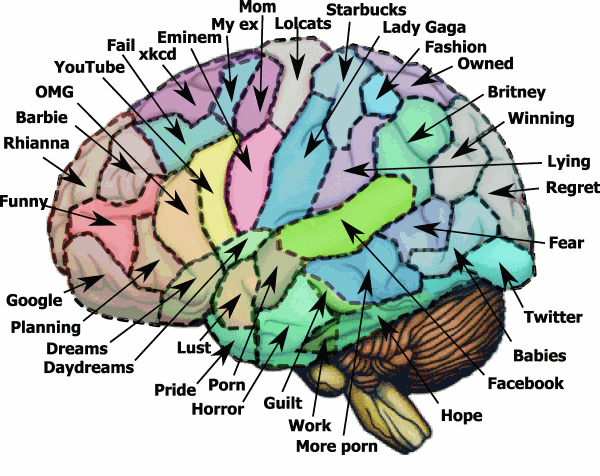 Susan Blackmore pioneered the hypothesis that the human big brain is actually an adaptation for storing large quantities of memes. She has a whole chapter (called "The big brain") on this hypothesis in her 1999 book The Meme Machine. The basic ideaThe idea that the enlarged human cranium might be an adaptation for housing our mutualist symbiont visitors is an astonishing and counter-intuitive one. However, culture and co-evolution with culture has resulted in most of the main ways in which we differ from chimpanzees. It really makes a lot of sense for our large brain to be an adaptation to human culture. Other ideasTo see how plausible the idea is, one has to consider its merits relative to other theories that purport to explain the same observations: - Probably the leading theory is the Machiavellian intelligence hypothesis - also known as The Social Brain Hypothesis. This states that humans became as smart as they did as a result of an arms race involving social skills - lying, cheating, manipulation - and the detection of these things in others.
- There is also the idea that sexual selection was involved. That some aspect of being smart was sexy - and that selection by members of the opposite sex (probably mostly females) resulted in large brains being favoured. This makes the brain the human equivalent of a peacock tail. This idea - along with the Machiavellian intelligence hypothesis - is discussed at length in a fine book: The Runaway Brain.
- Another idea is that neoteny was responsible. Young infants have disproportionately large heads compared to adult forms. Human evolution features neoteny. So, our large heads could be a side effect of neoteny.
- Another idea is that our large craniums resulted from the tendency toward bipedality in our species. Bipedality, in turn, forced a narrowing of the pelvic region making it more difficult for females to give birth. Selection would have then favoured females who gave birth to premature, less developed, and, therefore, smaller infants. Being born premature allows human babies to come into the world while their brains are still developing. Human brains continue to grow at rapid, fetal rates after birth - allowing a greater eventual size to be attained. This hypothesis is covered in Lynch and Granger (2008).
- Another idea is that omega-3 fats represented a nutritional constraint that got lifted by dietary changes. That hypothesis is laid out in the book The Driving Force.
- Early hypotheses suggested that environmental challenges and tool use drove the evolution of big brains. Such ideas have now mostly been superseded by more social hypotheses.
Many of these ideas are not mutually exclusive. It is possible that each of them contributed something to the enlargement of the human brain. However, it also seems likely that some of these hypotheses are more important than other ones. The place of the meme hypothesisThe idea that our big brains are meme nests is broadly compatible with the idea that runaway sexual selection is responsible. It suggests a sexually-selected arms race where what was sexy was a good sense of humour, being able to sing love songs, the ability to dance the latest dance - and other products of cultural evolution. The Machiavellian intelligence hypothesis no doubt has some truth to it as well. It doesn't really explain why our brains blew up, while chimpanzee brains did not. What humans have that chimpanzees mostly don't is language and culture.
CostThe cost of a large brain in enormous. Brains must be providing a huge benefit to allow them to pay for themselves in the way that they did among our ancestors. Since the effects of culture are enormous, the meme theory shows promising signs of being able to account for the magnitude of the observed benefits.
TimingThe oldest archaeological sites containing tools are dated to 2.6-2.55 million years ago - around the beginning of the stone age - which is an excellent match for when the human brain first really started to inflate. Timing considerations provide significant support to the meme theory.
DomatiaSince memes are typically beneficial cultural symbionts, cranial meme nests are a lot like ant domatia. My pages on domatia videos and domatia corridors have more information about this.
TestingOf course, to qualify as being genuine science, hypotheses need to be testable, and one obvious weakness of these ideas is they they relate to events millions of years ago - and so are not trivial to test. I won't go into the experimental possibilities here - except to say that there are some. Both skulls and some aspects of culture fossilize. We will probably have access to enough evidence on the issue to get to the bottom of it in due course.
Academia
The idea of big brains as meme nests has been taken up by academia recently - with the cultural intelligence hypothesis and the cultural brain hypothesis and the Vygotskian intelligence hypothesis. Blackmore and the other memetic pioneers don't get mentioned.
Check it outFor the moment, I just want to point at this hypothesis, and make some noise to help draw people's attention to it. It is one of the more radical proposals of meme theory, one that has a good chance of being correct, and one that has so far received very little attention. Some of Sue's other proposals - for example, the origins of human ultrasociality - have been showing good signs of panning out in recent years. The "big brain" hypothesis she pioneered is also deserving of attention.
References - culture hypothesis
- Blackmore, Susan (1997) The power of the meme meme;
- Blackmore, Susan (1999) The Meme Machine;
- Tyler, T. (2011) The big brain as a meme nest;
- Van Schaik, Carel P., Isler, K., Burkart, Judith M. (2012) Explaining brain size variation: from social to cultural brain.
- Van Schaik, Carel P. and Burkart, Judith M. (2011) Social learning and evolution: the cultural intelligence hypothesis;
- Henrich, Joeseph (2012) HOW CULTURE DROVE HUMAN EVOLUTION - A Conversation with Joseph Henrich
- Dawkins, Richard (1998) Unweaving the Rainbow: Science, Delusion and the Appetite for Wonder
- Dawkins, Richard (2005) The Ancestor's tale
- Herrmann, Esther; Call, Josep; Hernández-Lloreda, María Victoria; Hare, Brian and Tomasello, Michael (2007) Cognition: The Cultural Intelligence Hypothesis
- Moll, Henrike and Tomasello, Michael (2006) Cooperation and human cognition: the Vygotskian intelligence hypothesis
- Rendell, Luke, Fogarty, Laurel, Laland, Kevin N. (2011) Runaway cultural niche construction. Philosophical Transactions of the Royal Society of London - Series B: Biological Sciences.
References - other hypotheses
- Dunbar, Robin (1998) The Social Brain Hypothesis;
- Crawford, Michael and Marsh, David (1989) The Driving Force: Food, Evolution and the Future;
- Binns, Corey (2006) Something Fishy: How Humans Got So Smart;
- Lynch, Gary and Granger, Richard (2008) Big Brain: The Origins and Future of Human Intelligence ;
- Whiten, Andrew and Byrne, Richard W. (1997) Machiavellian Intelligence: Social Expertise and the Evolution of Intellect in Monkeys, Apes, and Humans - Book 1
- Whiten, Andrew and Byrne, Richard W. (1997) Machiavellian Intelligence: Extensions and Evaluations - Book 2
- Whiten, Andrew and Byrne, Richard W. (1988) Machiavellian intelligence: social expertise and the evolution of intellect
- Bjorklund, D. F. (1997) The role of immaturity in human development;
 We can be pretty sure that memes were adaptive among our ancestors since we
have meme-spreading adaptations - our incessant babbling, our ultrasociality
and the huge meme libraries we carry around everywhere on our shoulders.
It seems likely that memes are adaptive today - at least up to a point - since
meme-free humans are like primitive cave men, and most such creatures would not do very well in the modern world.
However, neither of these sets of observations really explains the reasons why memes are adaptive.
Part of the explanation probably seems obvious. Memes allow individuals to:
- Reduce the costly errors associated with trial and error learning;
- Acquire useful ideas much more quickly than trial and error would permit;
- Acquire better quality ideas than they would have been likely to produce themselves;
Boyd and Richerson have looked into the issue of why culture is adaptive -
presenting their results in Richerson and Boyd (1995) and their 2005 book on
the topic, Not by Genes Alone.
They give more-or-less the above analysis. However, in Not by Genes
Alone (2005, p.127) they then go on to give what they themselves describe
as a just-so story about the circumstances under which culture is adaptive.
The title of their section on the topic is: "Culture is adaptive because it
provides information about variable environments". It argues that memes are
adaptive because they allow humans to adapt better to local conditions. They
give plenty of examples over four pages. It is certainly true that culture
helps humans to adapt to local environments. However, the whole theme is really a
misleading and inaccurate one.
The reason memes are adaptive is because they let you obtain good quality
ideas quickly, and at low cost. Some of those ideas are no-doubt
contain information about how to adapt to local environments. However, others
are more universal. For example, fire, love songs, levers and hammers are useful in a wide range of conditions and environments.
Why transmit these ideas culturally, rather than wiring them into the genome,
then? The answer is essentially because the genome is full, and can't really
accomodate all the universal cultural knowledge. Even if evoultion could
somehow find a way to wire a fire-starting instinct into the genome, the results
would not be much better than transmitting the knowledge by cultural
means. So, this is a challenging task for evolution with a pretty minimal
payoff.
So, my council is to forget about the benefit of memes being enhancing the ability to adapt to local environments. The bottom line is that memes benefit people by allowing them to obtain lots of good quality ideas quickly, and at low personal cost.
References
- Richerson, P. J. and Boyd, R. (1995) Why Does Culture Increase Human Adaptability? Ethology and Sociobiology. 16: 125–143.
- Richerson, P. J. and Boyd, R. (2005) Not by Genes Alone: How Culture Transformed Human Evolution. University of Chicago Press: Chicago, IL.
 Intracranial memetics Intracranial memetics is the subfield of memetics that deals with the dynamics of ideas and memes inside a single mind. Memes and ideas compete with other memes and ideas inside minds. Intracranial memetics studies these dynamics - and the other forces on memes while they are inside minds. Intercranial memetics is the subfield of memetics that deals with the dynamics of memes between minds. It covers interactions between memes and their environment while the memes are not inside minds. The dynamics of intercranial memetics and intracranial memetics have some differences - because the environments involved are very different. Intracranial memetics Intracranial memetics deals with memes inside a single mind. The memes compete with other memes for space and attention. They also compete with protomemes and other ideas for resources. Intracranial memetics deals with these dynamics. Intercranial memetics Intercranial memetics ideals with memes when they are between minds. Many of the selective forces that act on memes do so while they are not inside human minds. Many memes can be copied without being inside minds. They can also be destroyed, damaged, put into storage and transported around. Intercranial memetics deals with these dynamics. MiscThere's a nice Linus Pauling quote that refers to intracranial memetics: The way to get good ideas, is to get lots of ideas and throw the bad ones away. Martine Rothblatt's idea of "bemes" also relates to intracranial memetics. References
 Protomeme Protomeme
is an abbreviation of prototype meme. It refers to a meme which
is under construction.
Before memes become fully-fledged memes they are protomemes. The definition of a meme
involves social sharing - but before memes can be shared they must first be
created - and often the creation takes place in a single mind. When a
meme is under construction it is called a protomeme.
Protomemes are usually part of what I have called
intracranial memetics -
the area of memetics that deals with memes when they are inside human brains.
Not all memes make it into the annals of history. Some protomemes go on to become failed memes.
As far as I know, the term "protomeme" was first used by Liane Gabora in 1997.
References
 Memetics has access to a plethora of negative words to describe the spread of ideas.
"Viral", "contagion" and "epidemic" are some of the most commonly-used terms.
These draw on the language of epidemiology. There are also words to describe rapid growth sometimes exhibited by these systems: "explosion", "boom", "ignition" and "wildfire". These terms are associated with fires and explosions.
Unfortunately, a lot of these terms are pretty negative. This is unfortunate - since we know that ideas were - on average - positive among our ancestors - since humans have idea-collecting and spreading adaptations.
Marketers would probably prefer not to use such negative terms. After all,
they are typically trying to hook consumers up with producers in win-win deals
- and not trying to infect them with some kind of deadly plague.
So: what positive terms are there out there? Not so many, alas. After
surveying the positive terms for growth: "branching", "budding", "sprouting",
the most appropriate positive term I managed to find was "bloom" - as in
"algal bloom".
So, perhaps in the future, positive marketing campaigns will bloom - and then bear fruit.
 In Daniel Dennett's 1995 book "Darwin's Dangerous Idea" he describes a concept he calls the Tower of Generate-and-Test. This is a kind of model of the evolution of intelligent agents. A summary of the tower, starting from the bottom: - Darwinian creatures - use natural selection as the generate and test mechanism.
- Skinnerian creatures - can learn by simple reinforcement learning.
- Popperian creatures - have a world model, can virtualize sense data and test actions under simulation.
- Gregorian creatures - tool makers including language and culture.
- Scientific creatures - Dennett proposes that the scientific method warrants a further floor of the tower.
The model has been extended by Alan Winfield to include a final category: - Walterian creatures - artificial, engineered creatures, named after W. Grey Walter, robot inventor.
I think this addition is fairly reasonable. I do think this tower needs to get back to its roots a bit more, though! If you consider the class of all optimisation processes, you get a rather different picture. Describing each stage in terms of what it adds to the previous level of the tower - and starting from the bottom: - Stateless search - optimization with no memory - e.g.: random search.
- Serial search - uses one agent - e.g.: Newton-Raphson.
- Parallel search - uses multiple agents - e.g.: simulated-annealing.
- Splitting - uses agents that can divide and reproduce - e.g.: a simple asexual genetic algorithm.
- Merging - uses agents that can merge together - e.g. sexual reproduction and parasitism.
- Learning - uses evolving agents that can additionally learn.
- Virtualisation - uses agents that can perform most evaluations under simulation.
- Culture - uses agents that have developed cultural transmission.
- Artefact symbiosis - the memes start to build tools, minds and bodies for themselves.
- Genetic engineering - the agents apply their tools to their own germ-line.
- All-engineered - uses entirely engineered agents - e.g.: machine intelligence and robots.
At the lowest level, the tower is neatly defined - but higher up, it is more like identifying what the major transitions in evolution are. Various steps which seemed fairly important in our world could be interspersed - for example communal living - and writing. For our ancestors, communal living allowed specialization to get going, and writing also provided a major boost. However, these stages do not really seem critical or universal enough to put in this list.
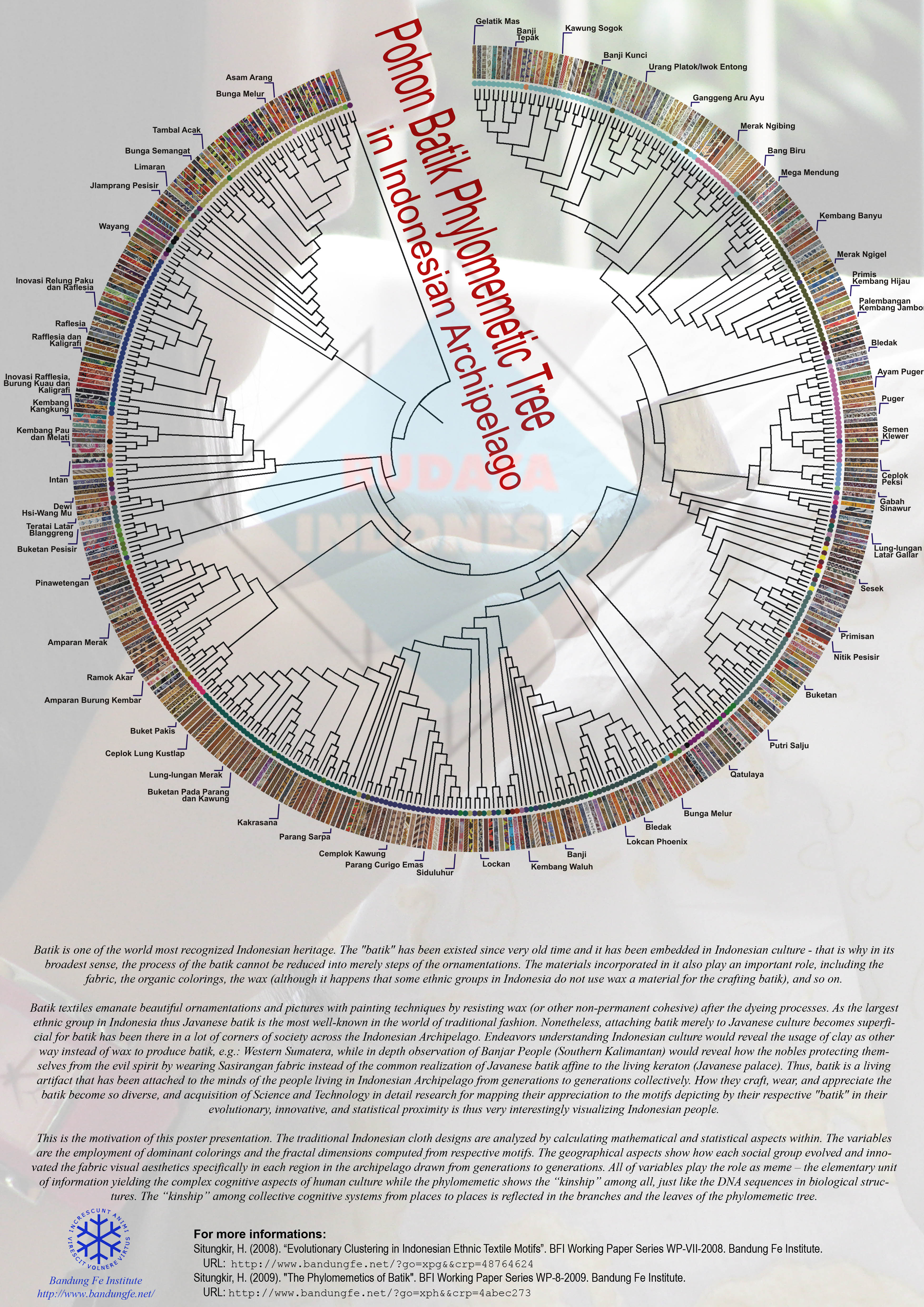
 Phylomemetics Phylomemetics is the name for the study of the historical evolutionary relationships between groups of cultural entities. The results of phylomemetic studies are often expressed partly in the form of phylomemetic trees. Phylomemetics is named by analogy with phylogenetics - which it closely resembles. Phylomemetics typically suffers from more problems derived from horizontal gene transfer than phylogenetics does - but neat trees can nontheless frequently be constructed. The image to the right shows the relationships between Indonesian folk songs. Phylogenetic relationships are often promoted as being some of the best evidence for organic evolution. Similarly, phylomemetic analysis provides excellent evidence for cultural evolution. One area where evidence is abundant comes from the evidence supporting the so-called "tree model" of languages. Phylomemetic relationships between languages were known back in the 1850s - before Darwin wrote The Origin. Darwin actually used the descent with modification of languages to explain his theory of organic evolution. Back then cultural evolution was more widely recognised as being correct than organic evolution was. For a large and beautiful phylomemetic tree of Indonesian batik designs, see here. Also, amateur trees of internet memes are now being constructed - e.g. see here. References- De Winter, Gunnar (2011) Studying Memes With Phylomemetics.
- Howe, C. J. and Windram, H. F. (2011) Phylomemetics – Evolutionary Analysis beyond the Gene. PLoS Biology. 9(5).
- Situngkir, Hokky, Khanafiah, Deni (2004) Innovation as Evolution: Case Study Phylomemetic of Cellphone Designs.
- Situngkir, Hokky, Khanafiah, Deni (2006) Visualizing the Phylomemetic Tree. Innovation as Evolutionary Process. Innovation in the Evolution of Technological Artifacts. Journal of Social Complexity, Vol.2, No.2, 2006, pp. 20-30.
- Situngkir, Hokky (2008) Constructing the Phylomemetic Tree: Indonesian Tradition-Inspired Buildings.
- Situngkir, Hokky (2008) Conjectures to the Memes of Indonesian Songs. Bandung Fe Institute; Indonesian Archipelago Cultural Initiatives (IACI). (BFI Working Paper Series WP-VI-2008).
- Situngkir, Hokky (2008) Evolutionary Clustering in Indonesian Ethnic Textile Motifs.
- Situngkir, Hokky (2009) The Phylomemetics of Batik.
- Eldredge, Niles and Barnet, Belinda (2004) Material Cultural Evolution: An Interview with Niles Eldredge.
- Eldredge, Niles and Ilya Temkin (2007) Phylogenetics and Material Cultural Evolution.
- Greenhill, S.J., Currie, T.E., & Gray, R.D. (2009) Does horizontal transmission invalidate cultural phylogenies? Proc. R. Soc. B, DOI: 10.1098/rspb.2008.1944.
- Wintz (2010) Phylogenetics, cultural evolution and horizontal transmission.
- Lycett, S.J. (2009) Understanding Ancient Hominin Dispersals Using Artefactual Data: A Phylogeographic Analysis of Acheulean Handaxes. PLoS ONE 4(10): e7404. doi:10.1371/journal.pone.0007404.
- Mace, Ruth and Holden, Clare J. (2005) A phylogenetic approach to cultural evolution. TRENDS in Ecology and Evolution Vol.20 No.3 March 2005.
|
|







 Posts
Posts