A creative work that is ripe for creating derivitives from is often referred to as being an exploitable.
Next, some examples to illustrate these concepts:
Parody
Original
Parody
The Tipping Point
The Tipping Pot
Born this way
Perform this way
Cover versions
Original
Cover version
Bohemian Rhapsody (Queen)
Bohemian Rhapsody (The muppets)
Paparazzi (Lady Gaga)
Paparazzi (Greyson Chance)
Exploitables
Exploitable
Exploit
Sunny D and Rum
Sunny D and Rum song
Mashups
Stayin' Alive In The Wall (Pink Floyd vs Bee Gees)
Well, in our country," said Alice, still panting a little, "you'd generally get to somewhere else — if you run very fast for a long time, as we've been doing."
"A slow sort of country!" said the Queen. "Now, here, you see, it takes all the running you can do, to keep in the same place. If you want to get somewhere else, you must run at least twice as fast as that!"
The Red Queen Hypothesis refers to the way in which adaptation is constantly needed in order for the individuals of a species to maintain their fitness - in the face of constantly and rapidly evolving parasites. It invokes an evolutionary arms race between hosts and parasites. The short generation time of the parasites results in rapid evolution for them. This pushes the hosts around in gene-space, in order to avoid the attentions of the parasites.
The parasites are undesirable from the perspective of individual hosts - but they can have some overall positive effects. They constantly deform the fitness landscape of their hosts, keeping the hosts constantly off balance. This can result in previously separated peaks in the fitness landscape of the hosts sometimes turning into a ridge system - creating paths that lead away from what would otherwise have been sub-optimal adaptive peaks, and promoting evolutionary change.
Bill Hamilton promoted the idea that this Red Queen race helped hosts to invent sexual recombination - so they would be better able to defend themselves against the attention of parasites by maintaining a large quantity of genetic variation in their populations - thereby making life for parasites more challenging.
Sexual recombination is one of nature's masterpieces, and it seems likely that we have a Red Queen race to blame for it.
These days, a second Red Queen race is taking place. This time around, thee rapidly-reproducing symbionts are not bacteria and viruses, but memes - swarming in our heads and infesting our computer networks. As with the organic Red Queen race some of the symbionts are parasites which the hosts want to avoid. As before short generation time of memes and their rapid evolution pushes their hosts around in gene-space, keeping them constantly off balance, and accelerating genetic change in their gene pool.
The first Red Queen race may have led to the triumphant development of sexual recombination. What new techniques might the hosts use to defend themselves against exploitation in this second Red Queen race?
Will they use genetic engineering? A global hospital? Will meme therapy subdue the bad memes with good memes?
Or perhaps the memes will be triumphant. Meme warfare may mean that the most agressive memes are among those that rise to power. Parasites often evolve into relatively stable relationships with their hosts - but sometimes they wipe them out. That outcome becomes more likely when the parasites have multiple host species, and are not so dependant for their survival on the continuing welfare of any one of them.
At the moment, memes are pretty dependent on humans, but once our computer systems become sufficiently advanced, the memes seem likely to swarm out of the human heads and onto the new digital systems with considerable enthusiasm.
After they have estabished themselves fully in a digital medium, the memes may not need the humans quite so much. They will have multiple host species, and will not be so dependent on any one of them.
We will need to have a good and clear understanding of the dynamics of these types of coevolving systems to have the best chance of surviving our coming encounter with this type of situation.
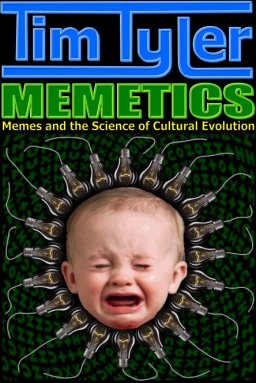
For more details, about these kinds of possibility, please read my Memetics book - when it comes out in a few months time. It's going to look like this: [holds up book]
The movie is called "The Chronicles of Rick Roll". It looks set to star quite a few popualar internet meme personalities. Here's the trailer:
Meme talent slated to appear in the movie include: Antoine Dodson (Hide Yo’ Kids), Bear Vasquez (Double Rainbow), Ben Schulz (Leeroy Jenkins), Brian Collins (Boom Goes the Dynamite), Stephen Quire (Freakout Kid), Gary Brolsma (Numa Numa), Mark Hicks (Afro Ninja), Catie Wayne (Boxxy), Matt Sloan & Aaron Yonda (Chad Vader), Tay Zonday (Chocolate Rain), Michael Copper (Copper Cab), David DeVore (David After Dentist), Judson Laipply (Evolution of Dance), and Ted Williams (Man with the Golden Voice).
Hi! I'm Tim Tyler, and this is a video about memes and the evolution of human ultrasociality.
Humans are ultrasocial creatures. They live in large cities and and often congregate in huge numbers at social events of various kinds. Humans do not normally bristle with hostility on encountering other humans - and indeed are likely to engage in cooperative behaviour - even with strangers. Memetics offers an interesting explanation of human cooperation and ultrasociality.
The idea is that meme reproduction depends on social contact between humans. Increased levels of social contact between their hosts are good for memes since this results in more reproductive opportunities for them. Memes that promote human ultrasociality have the effect of pushing humans into close proximity with each other, so the memes can infect new hosts. All the memes in the host benefit from this - including the ultrasociality memes.
Ultrasocial humans collect more memes than less sociable humans. Since memes are - on average - beneficial, memes promoting ultrasociality can have the effect of increasing the genetic fitness of their human hosts - by allowing them to collect more memes. So, the hosts are typically eager to embrace ultrasociality-producing memes - and would eventually evolve some degree of ultrasociality anyway in meme-rich evironments. Over time the ultrasociality trait gradually begins to migrate into their germ line, via the classical process of genetic assimilation, so that learning it slowly becomes easier.
Memeplexes also tend to favour the incorporation of ultrasociality memes into them. Ultrasociality memes offer a double fitness boost to memes they have memetic linkage with. The first boost is due to being linked to the fit ultrasociality memes and the second boost due to being more likely to be spread around by the ultrasocial hosts of the ultrasocial memes. Memes in memeplexes are thus likely to welcome ultrasociality memes into the fold.
Large-scale group behaviour is a key component of many religions. In masses, a large mass of humans congregates and engages in a festival of meme exchange. Church services are regular mini-masses. Since memes are stored in fallible human memory and benefit from frequent rehearsal, the meme repetition that takes place at masses and church congregations is also beneficial to them. While such religious ceremonies may offer benefits to the humans that engage in them, they seem to be orchestrated by memes, and it is probably mostly the memes that benefit from them. Religions also promote social behaviour in another way - by actively promoting prosletysing. This essentially involves approaching strangers and attempting to spread your memes to them, and bring them into the flock. This is a particularly-blatant attempt by the memes to use host resources to further their own reproductive ends by infecting new hosts. An understanding of how memes cause humans to form masses and congregations - and to engage in prosletysing - looks as though it will form a important part of a naturalistic theory of religion.
As far as I know, links between memes and human sociality and cooperation were first proposed by Donald T. Campbell in a 1983 article titled "The two distinct routes beyond kin selection to ultrasociality". The theme was taken up by Francis Heylighen in 1992 and expanded on by him over the years. However, neither author really got the idea described here. The idea was eventually clearly spelled out and popularised by Susan Blackmore in a 1997 article titled "The Power of the Meme Meme" - and she has two whole chapters about memetic theories of altruism in her 1999 memetics book.
Recently, the idea that memetic evolution drove the evolution of human ultrasociality been the subject of much experimental work, and several books - by Herbert Gintis, Peter Richerson, Robert Boyd, Joseph Henrich and others.
While there is now a consensus that meme-gene coevolution is primarily responsible for human ultrasociality, alas, many of the academic researchers have ignored the simple and beautiful memetic hypothesis given here - and have instead adopted what appears to be a highly implausible model based on group selection. As an illustration of this neglect, in a 2000 review of why humans cooperate - by Boyd and Richerson - there is a broad review of classes of hypotheses that have been proposed to account for the phenomenon - and the memetics-based hypotheses described here doesn't even get mentioned.
The memetic explanation given here does not claim to be responsible for all prosocial behaviour. The standard evolutionary accounts of prosocial behaviour attribute it to kin selection, reciprocal altruism, virtue signalling, cooperating to perform demanding tasks and mating behaviour. Some other hypotheses also help explain human cooperation. Humans sometime manipulate other humans into cooperating. For example, this is done with the "fake" kin groups created by military uniforms and school uniforms which are used to encourage cooperation based on percieved relatedess. Also, humans may sometimes overgeneralise the moral that it pays to be nice to others - and behave in an irrationally nice manner. This effect could be magnified in the unusual modern ecosystems in which humans find themselves - where they meet large numbers of people who are not really members of their tribe. However, the memetic explanation appears to apply to most of the cases in which humans cooperate where chimpanzees do not.
The memetic explanation of human ultrasociality should be one of the triumphs of the field. At the moment, I think it is fair to say that it is not widely recognised or understood. That plainly needs to change. There is more about memes and human ultrasociality in my book on memetics, which is now available.
Lastly, here is Daniel Dennet, lecturing on the topic:
Campbell, Donald T. (1983) The two distinct routes beyond kin selection to ultrasociality: Implications for the Humanities and Social Sciences. In: The Nature of Prosocial Development: Theories and Strategies D. Bridgeman (ed.), pp. 11-39, Academic Press, New York.
Richerson, P. J. and Boyd, R. (1998) The Evolution of Human Ultra-sociality, I. Eibl-Eibesfeldt and F. K. Salter (eds.), Indoctrinability, Ideology and Warfare. New York: Berghahn Books. Pp. 71-96.
Richerson, P. J. and Boyd, R. (2005) Solving the puzzle of human cooperation. In Evolution and Culture, edited by S. Levinson and P. Jaisson. MIT Press, Cambridge MA, pp. 105-132.
Blackmore is a parapsychologist who rejects the paranormal, a skeptical investigator of near-death experiences, and a practitioner of Zen. Her explanation of the science of the meme (memetics) is rigorously Darwinian. Because she is a careful thinker (though by no means dull or conventional), the reader ends up with a good idea of what memetics explains well and what it doesn't, and with many ideas about how it can be tested - the very hallmark of an excellent science book.
Why do humans, uniquely among animals, cooperate in large numbers to advance projects for the common good? Contrary to the conventional wisdom in biology and economics, this generous and civic-minded behavior is widespread and cannot be explained simply by far-sighted self-interest or a desire to help close genealogical kin. In A Cooperative Species, Samuel Bowles and Herbert Gintis--pioneers in the new experimental and evolutionary science of human behavior--show that the central issue is not why selfish people act generously, but instead how genetic and cultural evolution has produced a species in which substantial numbers make sacrifices to uphold ethical norms and to help even total strangers.
Cooperation among humans is one of the keys to our great evolutionary success. Natalie and Joseph Henrich examine this phenomena with a unique fusion of theoretical work on the evolution of cooperation, ethnographic descriptions of social behavior, and a range of other experimental results. Their experimental and ethnographic data come from a small, insular group of middle-class Iraqi Christians called Chaldeans, living in metro Detroit, whom the Henrichs use as an example to show how kinship relations, ethnicity, and culturally transmitted traditions provide the key to explaining the evolution of cooperation over multiple generations.
Moral Sentiments and Material Interests presents an innovative synthesis of research in different disciplines to argue that cooperation stems not from the stereotypical selfish agent acting out of disguised self-interest but from the presence of 'strong reciprocators' in a social group.Presenting an overview of research in economics, anthropology, evolutionary and human biology, social psychology, and sociology, the book deals with both the theoretical foundations and the policy implications of this explanation for cooperation. Chapter authors in the remaining parts of the book discuss the behavioral ecology of cooperation in humans and nonhuman primates, modeling and testing strong reciprocity in economic scenarios, and reciprocity and social policy. The evidence for strong reciprocity in the book includes experiments using the famous Ultimatum Game (in which two players must agree on how to split a certain amount of money or they both get nothing.)
This path-breaking book addresses the nature of human sociality. By bringing together experimental and ethnographic data from fifteen different tribal societies, the contributors are able to explore the universality of human motives in economic decision-making, and the importance of social, institutional and cultural factors, in a manner that has been extremely rare in the social sciences. Its findings have far-reaching implications across the social sciences.
In Unto Others, philosopher Elliott Sober and biologist David Sloan Wilson bravely attempt to reconcile altruism, both evolutionary and psychological, with the scientific discoveries that seem to portray nature as red in tooth and claw. The first half of the book deals with the evolutionary objection to altruism. For altruistic behavior to be produced by natural selection, it must be possible for natural selection to act on groups - but conventional wisdom holds that group selection was conclusively debunked by George Williams in Adaptation and Natural Selection. Sober and Wilson nevertheless defend group selection, instructively reviewing the arguments against it and citing important work that relies on it. They then discuss group selection in human evolution, testing their conclusions against the anthropological literature.
Herbert Gintis has been doing a lot of work on cultural evolution in the past decade. His work on cultural evolution is mostly oriented around the issue of why humans cooperate with each other to the extent that they do - why humans are ultrasocial. Here are some related resources:
Why do humans, uniquely among animals, cooperate in large numbers to advance projects for the common good? Contrary to the conventional wisdom in biology and economics, this generous and civic-minded behavior is widespread and cannot be explained simply by far-sighted self-interest or a desire to help close genealogical kin. In A Cooperative Species, Samuel Bowles and Herbert Gintis--pioneers in the new experimental and evolutionary science of human behavior--show that the central issue is not why selfish people act generously, but instead how genetic and cultural evolution has produced a species in which substantial numbers make sacrifices to uphold ethical norms and to help even total strangers.
Moral Sentiments and Material Interests presents an innovative synthesis of research in different disciplines to argue that cooperation stems not from the stereotypical selfish agent acting out of disguised self-interest but from the presence of 'strong reciprocators' in a social group.Presenting an overview of research in economics, anthropology, evolutionary and human biology, social psychology, and sociology, the book deals with both the theoretical foundations and the policy implications of this explanation for cooperation. Chapter authors in the remaining parts of the book discuss the behavioral ecology of cooperation in humans and nonhuman primates, modeling and testing strong reciprocity in economic scenarios, and reciprocity and social policy. The evidence for strong reciprocity in the book includes experiments using the famous Ultimatum Game (in which two players must agree on how to split a certain amount of money or they both get nothing.)
This path-breaking book addresses the nature of human sociality. By bringing together experimental and ethnographic data from fifteen different tribal societies, the contributors are able to explore the universality of human motives in economic decision-making, and the importance of social, institutional and cultural factors, in a manner that has been extremely rare in the social sciences. Its findings have far-reaching implications across the social sciences.
I think the meme concept is a loser because it is too detached from the gene concept to render a mimetic analysis evolutionarily coherent. The correct theory is that of gene-culture coevolution, as developed by several authors, including Cavalli-Sforza and Feldman.
They even manage to treat memetics seriously, despite the fact that memetics' attempt to detach culture from reproduction, production, cooperation, conflict, and the other basic activities of social life cannot possibly succeed.
I think the answer to Stanovich's problem is that the whole notion of memetics is rubbish. His defense of the notion in the book is uncharacteristically weak, to the point of being pathetic. For instance, he asserts that memetics itself is a meme complex, so if many people accept memetics and memetics is wrong, the memetics must be right! In fact, memetics posits behavior with no evolutionary justification. This is: we accept memes because they force themselves upon us. But, a creature who behaved in this way would be evolutionarily eclipsed by another who did not succumb.
The advert used fear of the end of the world to promote the
presidential campaign of Lyndon Johnson. Johnson won a landslide victory - and
the advert made marketing history - for its controversial use of fear as an
incentive.
You can watch the Daisy Ad here:
Religions make use of fear as a motivator by threatening helfire and damnation. Chain letters use the same trick - by threatening unspecified bad luck if you break the chain. However, the use of fear in a political marketing campaign seems rather underhand.
These days, some derivative adverts have appeared. Here we will present a few
of them - and consider how they fit into the terminological framework of
memetics. The first one is probably the best one.
These adverts use a kind of
memetic hitchhiking on the original advert, via its title.
They exhibit memetic linkage to the original ad - in the namespace of video titles.
They use search magnet techniques to show up in searches for the original advert.
Environmental inheritance refers to inheritance via the environment. It includes cultural evolution - but also other types of heritable environmental influences.
If I give my son a big suitcase full of gold bars when I die, few would claim this is a case of cultural inheritance. Yet it is pretty clearly a form of inheritance.
The Big Three
Environmental inheritance is the third of the "Big Three" inheritance channels available to natural systems:
Organic inheritance;
Cultural inheritance;
Environmental inheritance;
Diagram
Representing these forms of inheritance as a diagram, it looks something like this:
Here you will see that cultural inheritance is represented as a subset of environmental inheritace. This is because all culture must currently necessarily be represented "in the environment" at some point during its transmission down the generations.
Significance
Non-cultural environmental inheritance is pretty important. It typically includes your place on the planet, the ecosystem you are born into, and a bunch of non-cultural resources that result from modification of the environment by your ancestors.
Xemes and Xemetics
If memes are defined as only transmitting culturally-inherited information, it would be nice to have another term for environmental inheritance. I propose Xemes (based on eXternal transmission). Xemetics could be the science of Xemes. Xemes is pronounced rather like "Zemes" - NOT "eX-emes".
Implications for Dual Inheritance Theory
Non-cultural environmental inheritance is one of the big things that is wrong with Dual Inheritance Theory.
IMHO, non-cultural environmental inheritance is big enough and important enough to make Dual Inheritance Theory seem as though it has a very silly name.
Videos
John Odling-Smee - Construction Dynamics Seminar Series - Niche Construction and Niche Inheritance.


 The video doesn't really get on to the topic of memes until fairly near the end.


 Environmental inheritance refers to inheritance via the environment. It includes cultural evolution - but also other types of heritable environmental influences.




 Posts
Posts

