Saturday, 7 January 2012
The King of Internet Buzz: Jonah Peretti
A short interview with Jonah Peretti - founder of The Huffington Post and BuzzFeed - about viral phenomena:


Friday, 6 January 2012
Pinker's cultural angels
Pinker's recent book seems to be popular. It's about why human violence has recently declined. Of course, the reason why violence has declined is because of cultural evolution. Essentially:
Memes push humans into close proximity to facilitate their own reproduction - and to do this, the humans need not to bristle with hostility. So the cultural elements manipulate the humans into exhibiting low levels of hostility.
This is much the same process that has resulted in human ultrasociality - though there, since memes are (on average) beneficial, such traits are gradually getting transferred into the genome via genetic assimilation. This process is currently far from complete.
However, Pinker has - fairly recently - publicly paraded his ignorance of cultural evolution (see also his views in "How The Mind Works" and "The Darwin Debate"). Pinker has previously described some aspects of cultural evolution as "one of the domains that we shouldn't look to evolutionary biology to explain" - and he apparently endorses the idea that "the most interesting things about humans are precisely those that evolutionary theory can't explain". So: how come he is writing a book about a topic which requires explanation in terms of ideas which he doesn't seem to know very much about?
Pinker apparently endorses Robert Wright's argument in NonZero - although NonZero is full of cultural evolution and memes.
According to a recent review by Gintis:
Perhaps the most surprising, and welcome, aspect of Pinker's new work is that it is implicitly a devastating nail-in-the-coffin critique of the brand of evolutionary psychology with which Pinker has identified for many years....and goes on to say that Pinker offers a gene-culture coevolution theory. If so, that might be the beginning of quite a turnaround!
This video has Pinker making his case:
Pinker mostly seems to just assume technological and social development, without presuming to explain how or why that development happens.
Cultural organisms
 In The Beginning Of Infinity, David Deutsch writes:
There is no close cultural analogue of a species, or of an organism, or a cell, or of sexual or asexual reproduction.
I am sceptical. For one thing, I think that there are cultural organisms. It just seems obvious that an iPhone or a CD should count as a cultural organism - in much the same way that a cat is classified as an organic organism.
We could call cultural organisms memeganisms and organic organisms geneganisms.
A number of features have been considered to be defining traits of organisms:
- Components exhibit near-unanimous cooperation;
- Components have a tendency to die together;
- Components are spatially contiguous;
- Components share a single genome;
- Components are mostly alive;
The "near-unanimous cooperation" criterion looks useful - though it raises the issue of exactly how much cooperation is needed. However, here we also need the notion of the "largest cooperating set" - or one risks concluding that the cells in my big toe form an organism. Symbiosis is the other complicating factor here. We probably don't want to rule symbiotic unions out - though there's continuous variation in the degree of cooperation in such unions.
The "tendency to die together" criterion also looks pretty useful - although some groups of creatures regularly die together - for example, groups of nasturtiums die together annually during the first frost. Also, some organs regularly die together - for example the leaves of deciduous trees. Again - symbiosis is a complicating factor, since some symbionts may survive the dissolution of any alliance.
Some writers have observed that the concept of "organism" attempts to combine the concepts of "genetic individual" and "functional individual" - with the result inevitably being a compromise. That sounds about right.
Not that one should not expect completely unambiguous divisions between cultural creatures - since the organic world there are ants, slime molds, corals, lichens, the Portuguese man o' war - and other systems in which the concept of an individual organism becomes fuzzy and ambiguous.
My impression is that - despite the serious handicap of being developed with only the organic realm in mind - the conceptions of the concept of "organism" developed by biologists mostly transfer across to the cultural realm with relatively little modification.
However, it's probably true that the cultural realm comes up with problematical corner cases more regularly.
References
- Wilson, Robert A. (2007) The Biological Notion of Individual. The Stanford Encyclopedia of Philosophy.
- Queller, David C. and Strassmann, Joan E. (2009) Beyond society: the evolution of organismality.
- Folse, Henri J. III and Roughgarden, Joan (2010) What is an Individual Organism? A Multilevel Selection Perspective. The Quarterly Review of Biology, Vol. 85, No. 4.
- Tyler, Tim (2011) Cultural creatures.
- Tyler, Tim (2011) Why no cultural creatures in academia?
- Tyler, Tim (2012) Cultural symbiology bibliography
Thursday, 5 January 2012
Mimes
 George van Driem says some interesting thigs in the paper Symbiosism, Symbiomism and the Leiden definition of the meme. He says some of them on video here.
One of the things that I liked was his proposal that we call the unit of imitation (as proposed by Blackmore) a "mime".
"Mime" is more closely linked etymologically to "mimic" and "mimicry".
It doesn't end with "-eme" the way most units do (e.g. Lexeme, Phoneme, Morpheme, Sememe, Seme, Grapheme) - but a unit of imitation is not that useful scientifically anyway - since it is much more important to have an umbrella category that covers all forms of culture. Since imitation is one component of social learning, mimetics is a subset of memetics.
Others have used the terms "mime" and "mimetics" for similar ideas - in particular see René Girard’s "mimetic theory", and the ideas of Merlin Donald.
The terms "mime" and "mimetics" seem to be a suitable way of symbolically demoting the idea without completely discarding it.
The evolution of supposedly-altruistic punishment
 I am pretty sceptical about many of the proposed applications of cultural group selection. It seems as though most of the features which advocates of cultural group selection propose can be explained more simply in other ways.
For example, the paper entitled The evolution of altruistic punishment explains the origins of human punishment using a model of cultural group selection.
However: there are many individual-level benefits to punishing others - in particlar, punishment is a high-status activity, which increases the punisher's rank at the expense of the rank of the recipient of punishment. Punishing others thus signals high status and improves your reputation - which may produce future benefits.
The finding that some people still expend resources punishing in anonymous one-shot interactions is probably best explained largely by resource-limited cognition - in conjunction with the unnatural nature of such interactions.
References
- Boyd, Robert, Gintis, Herbert, Bowles, Samuel and Richerson, Peter J. (2003) The evolution of altruistic punishment
- dos Santos M, Rankin DJ and Wedekind C. (2011) The evolution of punishment through reputation
- Rockenbach B, Milinski M. (2006) The efficient interaction of indirect reciprocity and costly punishment
- Nicolas Baumard (2012) The evolution of cooperation: from networks to institutions
- Francesco Guala (2012) Reciprocity: Weak or strong? What punishment experiments do (and do not) demonstrate
Tim Tyler: Mesoudi, Cultural evolution (review)
Transcript:
Hi, I'm Tim Tyler, and this is a review of this book: Cultural evolution by Alex Mesoudi.
This is a great book about the important topic of cultural evolution.
Alex Mesoudi is an experimental psychologist working in the field, and has previously published numerous papers and a PhD thesis on the topic.
His book lays out the case for a Darwinian theory of cultural evolution in plain language, in a manner which should be comprehensible to a wide audience.
The preface states his aim with the book - which he says "is to nudge the social sciences along a little". He does this by illustrating the progress that has been made in explaining culture scientifically using Darwinian evolutionary theory.
The book is divided up into introductory material, microevolution, macroevolution, experimental work, field work, evolutionary economics, culture in non-human animals and a chapter about the coming evolutionary synthesis for the social sciences.
The writing is dense, clear and polished. The first three chapters are great - so best to start at the beginning. Much of the second half of the book consists of summarising literature in the field, which Mesoudi does pretty well.
The book does a good job of making its case. Most readers will probably come away convinced that the vast majority of Mesoudi's ideas on the topic are correct.
The book has several themes. One is that cultural evolution is Darwinian. Another is that cultural evolution is not neoDarwinian. That is true, but it probably goes for organic evolution as well.
Mesoudi proposes that we need a Darwinian synthesis for the social sciences - mirroring the neoDarwinian synthesis that took place in the natural sciences in the 1930s and the 1940s. That is true - we do need something a lot like that.
At this stage, it is time for some objections:
The neoDarwinian synthesis that took place in the natural sciences left out symbiosis. The cultural Darwinian synthesis that Mesoudi proposes also apparently leaves out symbiosis. Mesoudi's whole book has no mention of mutualism, parasitism, epidemiology or immunology in a cultural context. This is surely a big mistake. Cultural evolution is dominated by the phenomenon of symbiosis. The models on which modern strains of cultural evolution are based were originally drawn from epidemiology. Mirroring the sutuation in the 1940s, we do have a pioneering theory of cultural symbiosis - due partly to Cloak (1975) which was popularised by Dawkins (1976). However, Mesoudi dismisses this work as being a "fad". Back in the 1940s the neoDarwinian synthesis had an excuse for leaving out symbiosis - because it was very poorly understood at that stage. Now, symbiosis is still poorly understood, but we know at least enough about it to know that we can't leave it out.
On a possibly-related point, Mesoudi's account of culture is incredibly positive. Mesoudi gives an argument for culture being adaptive, and barely mentions any other possibility. After a while I was on the lookout for any mentions at all of cultural traits that were deleterious to their hosts. In the whole book, I found: celibate priests, the small family size norm and suicide bombers. So: some deleterious cultural traits are mentioned - but that is an astoundingly-short list for a 264-page book on this topic. Perhaps Mesoudi's lack of treatment of cultural parasitology and immunology arises partly from an under-appreciation of the significance of deleterious cultural traits. As the obesity and smoking epidemics illustrate, deleterious cultural traits are actually commonplace. Culture is not always there to help its hosts - sometimes it acts to manipulate and sabotage them for the benefit of others. Addictions caused by drugs, pornography and chocolate gaueau typically don't benefit their hosts, but rather benefit the C.E.O.s of companies that push those sorts of product. Organisms need a cultural immune system to help them to weed out these harmful cultural traits. From my perspective, missing out so much of the negative side of culture results in an unbalanced and incomplete treatment.
While Mesoudi's call for a Darwinian synthesis for the social sciences is to be endorsed, the social sciences have repelled biologically-inspired invasions before on multiple occsations. They are well adapted to an ecosystem consisting of regular attempted raids from biologically-inspired theorists. One of the contributors to these failures was that the biology was wrong. While obviously, too much further delay would be undesirable, we should try to make the science as good as we reasonably can this time - or at least give it our best shot. A crippled symbiosis-free version of Darwinism would only bring the social sciences up to the biology of the 1940s. We should be able to manage better than that.
Another complaint is that Mesoudi slams the concept of evolutionary progress - pointing to unilinear progress theories that inspired social Darwinism and claiming the evolution is a ladder - not a bush. However, progress in organic and cultural evolution is just too obvious to deny. Attempts to deny it appear to stem mainly from the notion of political correctness. The idea has been promoted in modern times by the Marxism-inspired theorist Steven J. Gould. I think the political subtext in this case similar to the one in Gould's farcical book about intelligence testing: to promote equality, by making sure that all people and societies are equally evolved. Instead of such nonsense, evolution is better viewed as a giant optimisation process, set up to maximise entropy. As such it is incredibly directional. It is very strange to hear people denying evolutionary progress in modern times, when it is staring us so clearly in the face. I think scientists should unite in pointing out what nonsense progress denialism really is.
Though promoting the role of evolutionary theory, Mesoudi doesn't really go into the game theory, chaos theory, cybernetics, maths - and the recap on the basics of the scientific method - that would also be needed to unite the social sciences. However, given his focus in this book, that seems to be excusable.
A few less-significant criticisms:
Mesoudi dismisses Campbell's Blind Variation with Selective Retention (BVSR) thesis as being neoDarwinian - for insisting on blind variation. However, this criticism appears to be based on a popular misunderstanding of Campbell's idea. Contrary to what the name might suggest, Campbell did not claim that evolutionary variation was "blind". His claim was more like: either variation is blind or it is based on knowledge previously obtained, in which case there should still be some element of blind variation involved. That idea is quite compatible with many kinds of directed variation - so the existence of such variation does not contradict Campbell's idea. I'm not claiming that Campbell was right here - just that variation that is biased towards being adaptive is perfectly consistent with his idea.
Mesoudi discusses the controversy over whether cultural inheritance is Lamarckian. He cites those that claim that it is not - but doesn't really explain their argument - so a reader unfamilar with this topic can't easily make out the details of the case that Mesoudi is arguing against. A common criticism of the claim that cultural inheritance is Lamarckian is that similar arguments usually also classify dogs passing on "acquired" fleas to their offspring as being "Lamarckian inheritance" - which is contrary to common usage of the term "Lamarckian inheritance" in biology. Mesoudi's examples of innovation appear to be vulnerable to this objection - and it is a pretty fatal one - so these examples seem to be wasted.
Mesoudi - correctly - says that Lamarckian inheritance depends on the genotype/phenotype split. Then he then gives an "internalist" statement of that split - which places the cultural genotype in human brains and the cultural phenotype in behaviour and artifacts. Externalists probably won't find an argument based on these premises very convincing. What would be more convincing is the existence of a non-trivial developmental process. For example, if a cake was being baked, there would be no doubt about where to put the phenotype/genotype split. However, Mesoudi doesn't give such an example - leaving the location of the cultural phenotype merely assumed - and so failing to make much of a case for Lamarckian inheritance. I don't disagree with Mesoudi's conclusion - but I think that his supporting argument would only convince other internalists - which doesn't seem to be worth very much.
A few other differences and criticsms:
- Mesoudi apparently thinks that non-cumulative cultural change does not qualify as being a form of Darwinian evolution - while, surely, it does.
- Mesoudi offers a rather sympathetic treatment to cultural group selection - whereas I am more critical. For example, Mesoudi offers competition between firms as a modern example. However employees move between firms constantly, carrying genes and culture with them. It is true that there are non-disclosure agreements - but their effect is limited. When firms go bankrupt, their employees do not die, and much of the corporate culture is carried away by them - or else sold as "intellectual property" assets. With this much flow of genes and culture going on between organisations, it would be very difficult to make any kind of group selection model operate successfully.
- Towards the end of the book Mesoudi attempts to explain why humans have cumulative culture while other animals do not. Accepting this premise for the sake of argument, Mesoudi gives a rather inconclusive analysis that manages to miss out a number of what I consider to be the main candidates.
Enjoy,
Other reviews:
Ted Cloak - resources
 Ted Cloak is a pioneer in the field. He published "Cultural Microevolution" in 1966, "Is a cultural ethology possible?" in 1968 and "Cultural Darwinism: Natural Selection of the Spoked Wood Wheel" in 1968.
His bio. says that he got a degree in cultural anthropology from the University of Wisconsin in 1966. He was among the researchers cited by Dawkins (1976). He has continued pursuing the evolution of culture over the decades since then.
This quote from the 1975 version of "Is a cultural ethology possible?" illustrates what probably inspired Dawkins:
In a human carrier, then, a cultural instruction is more analogous to a viral or bacterial gene than to a gene of the carrier's own genome. It is like an active parasite that controls some behavior of its host. It may be in complete mutual symbiosis with the human host, in which case the behavior it produces has survival value for itself through the value it has for the survival/reproduction of the host. On the other hand, it may be like the gene of a flu or "cold" virus; when the virus makes the host behave, e.g., sneeze, that behavior results in extraorganismic self-replication of the virus gene but not in survival or reproduction of the host or his conspecific. From the organism's point of view, the best that can always be said for cultural instructions, as for parasites of any sort, is that they can't destroy their hosts more quickly than they can propagate. In short, "our" cultural instructions don't work for us organisms; we work for them. At best, we are in symbiosis with them, as we are with our genes. At worst, we are their slavesSee Ted Cloak's home page for downloadable versions of many of his papers and further resources: http://www.tedcloak.com/
Wednesday, 4 January 2012
Tim Tyler: Lumsden and Wilson, Promethian fire (review)
Transcript:
Hi, I'm Tim Tyler, and this is a review of this book: Promethian fire by Chales Lumsden and E. O. Wilson.
I'll try to keep this brief, because this is an old book, which is largely of historical interest these days.
The book was published in 1983. Two years earlier, the pair had published Genes, Mind and Culture, one of the early pioneering work on cultural evolution. This book was intended as more of a popular work. The topic is: the evolution of the human mind. The book contains multiple illustrations, autobiographical passages and narratives concerning the lives of our distant ancestors.
The book is not terribly well written and gets boring in places. The autobiographical bits are about the sociobiological controversy and about how Lumsden and Wilson wrote their last book, and this content is not that great. The narratives about the lives of distant ancestors also get painful. There's a large section about aliens who learn everything and other aliens which have entirely genetically-specified behaviour. There is some science, but it is often fairly loose and references are rare.
Lumsden and Wilson define their notion of a culturegen, go into their idea that genes hold culture on a leash, and discuss gene-culture coevolution. They complain about how difficult the whole subject is.
Their theory boils down to the idea that genes predispose organisms to acquiring particular sorts of culture and culture in turn goes on to affect the genes. This is fine as far as it goes. However, the book only mentions the fact that culture is transmitted once and doesn't mention that it is inherited at all. The book doesn't mention the idea that cultural evolution might resemble organic evolution - the key idea which most subsequent work is based around.
Lumsden and Wilson do cite Dawkins, Cavalli-Sforza, Feldman, Boyd, Richerson, Durham and Campbell. However, their citation doesn't go far beyond listing their names - Lumsden and Wilson don't seem to have grasped that most of these authors had a much more significant and well-developed theory than their own.
The last two chapters are the best. The penultimate one goes into the author's ideas and looks in some detail into the ways that culture might influence genes and the ways that genes might influence culture. The last chapter proposes a unified science of humanity. Perhaps read those chapters first if you want to avoid being put off. Or, perhaps skip this book unless you have a particular interest in the thinking of the authors. This book probably isn't going to teach you much that you couldn't get more easily elsewhere.
Enjoy,
Symbiosis terminology thoughts
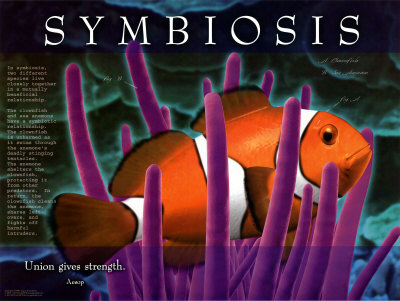 I posted recently on epidemiology. Here are some more
thoughts about the terminology of symbiosis along similar lines.
I posted recently on epidemiology. Here are some more
thoughts about the terminology of symbiosis along similar lines.The term symbiosis needs to more explicitly cover distant relationships - such as between human and strawberry. Predation and some forms of direct competition such as combat should probably be included.
We need a term for the start of a symbiosis. Symbiogenesis should probably be that term. Most attempts at a current definition of that term appear to be a mess.
We need a term for a symbiosis that forms a functional organism - such as a Portuguese Man o'War. I propose "symbiorganism". The term "symbiome" has been previously used in this context - but it doesn't seem up to the job to me.
"Transmissible" and "transmissibility" are quite a mouthful and is even worse. "Infectious"/"infectiousness" and "virulent"/"virulence" are pretty parasite-specific. It isn't clear what to do about this. Perhaps we could use "spreadable" and "spreadability".
If we are having endosymbiosis, exosymbiosis, ectosymbiosis and aposymbiosis, then "exosymbiosis" should probably refer to the union of ectosymbiosis and aposymbiosis.
Tuesday, 3 January 2012
Many Eyes - data visualization tool
IBM's "Many Eyes" can make some pretty cool data visualizations. It's a crowdsourced version of
Information Is Beautiful.
Some examples, oriented towards social media: Facebook visualisations | Twitter visualisations.
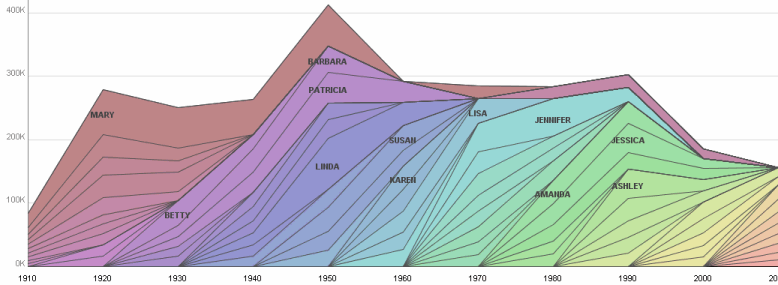
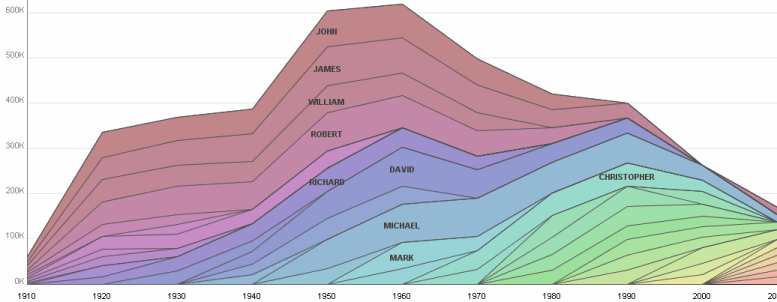
As a visual example, the following graphs show how the top 10 girls names, and the top 10 boys names change over time.
Check out how the girl's names appear to go "out of fashion" more quickly!
Subscribe to:
Posts (Atom)




 Posts
Posts

