 Part of the muddle still surrounding cultural evolution involves the issue of how to make the genotype/phenotype distinction in the cultural realm.
In the organic realm, this distinction is foundational in genetics, dividing an organism's heritable information from its products. The distinction defines the domain of genetics.
Various authors have written on this issue - including Peter Turchin, Susan Blackmore, Bill Benzoin, Alberto Acerbi and Alex Mesoudi.
Here's what it says about the genotype–phenotype split on Wikipedia:
The genotype–phenotype distinction is drawn in genetics. "Genotype" is an organism's full hereditary information. "Phenotype" is an organism's actual observed properties, such as morphology, development, or behavior. This distinction is fundamental in the study of inheritance of traits and their evolution.
Wikipedia has it right. To me, this seems simple, clear and applies equally well to both the organic and cultural realms. I've been applying this distinction consistently from the beginning - and it works well in cultural evolution.
I can't help but see the position of others on this topic as being muddled and confused. This post raises the question of why this confusion exists. For me, this seems like cultural evolution 101. The genotype/phenotype distinction is a basic issue that people ought to be able to grasp fairly easily. Yet it doesn't seem to be the case. Why are so many researchers in such a muddle?
Perhaps one of the better resources on this issue is Peter Turchin's posts on the topic. They are a bit of a brain dump and illustrate his thought processes at work. However, it does seem to me that most of these authors don't seem to have considered the issue very carefully. For one thing, many of them don't seem to understand why the distinction is important, and apparently think they can get along OK without it. I think this probably indicates a weak background in evolutionary thinking.
Perhaps one problem is that academics often try to get by without the concepts of cultural organisms or cultural creatures. They try to shoehorn everything into the host's genotype and phenotype. If that's the cause of the problem, this issue is just another nail in the coffin of the extended genotype and the host-centric approach to cultural evolution.
 I argue in my observation of the observable video that observation selection effects are part of evolutionary theory - and are simply the result of applying selection theory to observers. I notice that not everyone seems to be on the same page as me about this. Both John Campbell and Matt Ridley have recently ridiculed anthropic reasoning. In chapter one of The Evolution Of Everything, Matt Ridley compares the anthropic principle to a 'skyhook' and writes:
anybody outside a small clique of astronomers who had spent too long with their telescopes, the idea of the anthropic principle was either banal or balmy, depending on how seriously you take it. It so obviously confuses cause and effect. Life is adapted to the laws of physics, not visa versa.
John Campbell doesn't like observation selection effects either. Here are my comments on his treatment in Darwin does Physics, from my book review of it:
I agreed with John in most places - but there were a few areas of disagreement. One was the treatment of observation selection effects. I regard these as a key area where the usefulness of selection is already appreciated by physicists. "Observation of the observable" neatly generalizes Spencer's "Survival of the fittest". However, John's perspective is very different. He says that the anthropic principle is anthropocentric and criticises observation selection as being tautological and unscientific. It is true that the term "anthropic" has an anthropocentric name. However, I think that it is best to ignore the use of this stupid terminology and focus on observation selection effects. These are not tautological or unscientific. Indeed, they help support the case for the applicability of Darwinism to physics - since these selection effects are already well recognised by physicists as a source of 'goodness of fit' between physical law and humans. John has no coverage of this in his book - it seems like a fairly major omission to me.
Both Ridley and Campbell quote from the puddle parable of Douglas Adams to support their ideas. Douglas wrote:
Imagine a puddle waking up one morning and thinking, 'This is an interesting world I find myself in — an interesting hole I find myself in — fits me rather neatly, doesn't it? In fact it fits me staggeringly well, must have been made to have me in it!
Douglas is arguing that reasoning from apparent design to the existence of a creator is not sensible. However this isn't an argument against the utility of observation selection effects! Campbell and Ridley both need to rethink their positions.
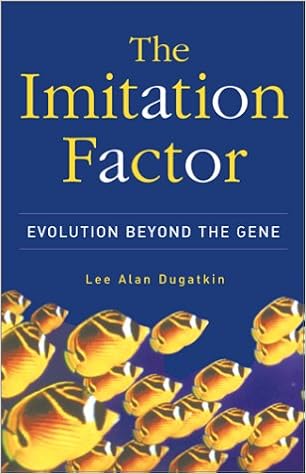 One of the dodgy memes perpetuated by some cultural evolution enthusiasts is that there is more to inheritance than genes. Boyd and Richerson say that human evolution progressed "not by genes alone". Lee Alan Dugatkin calls imitation "evolution beyond the gene". Jablonka and Lamb say that "Genetic" is only one of four dimensions of variation, the others being the "Epigenetic", "Behavioral" and "Symbolic" dimensions. Steven Rose says there is "life beyond the gene". David Sloane Wilson says:
core evolutionary theory needs to expand beyond genetics to include other inheritance systems, such as environmentally induced changes in gene expression (epigenetics), mechanisms of social learning found in many species, and the human capacity for symbolic thought that results in an almost unlimited variety of cognitive constructions, each motivating a suite of behaviors subject to selection (Jablonka & Lamb 2006; Penn et al. 2008).
Expand evolutionary theory without expanding genetics? It makes no sense to me: science needs an expanded genetics too. Expanding the domain of evolutionary theory without expanding the domain of genetics would be a very lop-sided approach.
Memetics pioneered the expansion of genetics to cultural evolution way back in the the 1980s. Efforts to establish a new science of 'replicators' to compete with genetics have gone nowhere - and don't make much sense. The latest attempt to establish a science of non-genetic inheritance - epigenetics - is an absolute joke. What a "dustbin" category that is. It is good for one thing - being an example of how not to do science. Waddington's excellent notion of epigenetics is in the process of being hijacked by foolish and ignorant scientific punks. What we need is a generalized gene and a generalized genetics. When generalizing evolution, scientists should not neglect to generalize genes and genetics! These concepts are absolutely needed for any sensible grounding of evolutionary theory on information theory. Genes should be the units of heredity and genetics should be the study of heredity.
Some say that genetic algorithms are not really "genetic". It is nonsense: genetic algorithms really are genetic. Take genes and genetics seriously, dammit. Don't confine them to the special theory of evolution - that's not where they belong.
Molecular biologists may have appropriated the term "gene" - but it isn't theirs to define. As Steven Pinker puts it:
Molecular biologists have appropriated the term "gene" to refer to stretches of DNA that code for a protein. Unfortunately, this sense differs from the one used in population genetics, behavioral genetics, and evolutionary theory, namely any information carrier that is transmissible across generations and has sustained effects on the phenotype.
If we don't expand genetics now, it will only need doing later. Cultural evolution's scientific lag in academia is large, but forward thinking individuals should still be able to see that the need to generalize genetics is now clear and obvious.
IMO, Boyd, Richerson, Dugatkin, Jablonka and Wilson are not doing scientific progress any favours by dragging their feet on this issue. Get with the program, folks. The 'beyond the gene' meme might look progressive to you - but it looks backwards to me. The best way forwards is to generalize genes and genetics when generalizing evolution. This is scientific evolution, rather than scientific revolution - and evolution is usually less painful and more likely.
Don't tell me that genes and genetics have more inertia and are harder to move. That much is now obvious. The point is that they need to move, and will have to move eventually. So, who is helping? ...and who is not? Which side of this issue are you on?
This one is from November 11th (two days ago). Ridley speaks for the first half, with Ronald Bailey taking over after half an hour.
Matt mentions the "Special" and "General" theories of evolution a few minutes in.
Matt irritates me by repeats]ing an old and ignorant objection to memes by anthropologists. He says (21 minutes in):
You don't have to have particulate information which is what people used to think about cultural evolution that the problem was that you don't have something equivalent to a gene which is a sort of specific, hard object.
The main problem here is the idea that genes are "specific, hard objects". In informational genetics,
genes are informational. They can exist in databases just as well as cells.
My article: Genes are not sections of nucleic-acid goes into more detail.
I feel that the idea that our understanding of cultural evolution has progressed from the idea that culture consisted of "specific, hard objects" to a less "particulate" understanding is a fantasy view of the history of the field which misunderstands and then denigrates the meme enthusiasts.
Memetics is often reductionist - in that it splits cultural inheritance into "bits" of culture. This reductionism is highly productive: a foundational technique in science is splitting complex things into smaller pieces in order to analyse and understand them.
The evolution I would like to see is in people's understanding of genes. Either genes are units of inheritance, or else we need a whole new science of heredity to replace genetics. Keeping genes as units of inheritance is the more conservative and sensible path, I claim. The idea that genes and genetics are confined to the "special theory of evolution" is an awful one. Genetics could be - and should be - quite general. My next post will be all about that topic.
When I got involved with memetics I think that people had previously
used the term "memetics" to refer to the study of memes. It was
more-or-less a synonym for "cultural evolution".
One of the concrete proposals I made was that the split between genetics
and evolutionary theory be extended to cultural evolution - with
memetics mostly studying how memes mutate and recombine. Since
most of the differences between organic and cultural realms
lie in the area, there needs to be a bit of a split between memetics and
genetics - whereas most of the other the areas of evolutionary theory
apply to both domains.
I started promoting the idea that the split between evolution
and genetics should be extended into the cultural domain seriously
in 2013 - with articles like these:
The idea was partly intended as a marketing move for memetics.
Academia has largely opted for the term 'cultural evolution'. However,
according to this terminological scheme, most of the actual
differences between the dynamics of the organic and cultural
realms lie in the genetics/memetics divide. Memetic mutations
and recombination take place inside brains - rather than inside cells -
and so there are expanded opportunities for more complex dynamics.
Most of the alleged difference between the dynamics of the organic
and cultural realms are either differences between memetics and
genetics, fairly direct consequences of those differences, or
are not really differences at all - once symbiology has been
properly taken into account. Differences that turn out to be
insignificant include Lamarckian inheritance, degree of reticulation,
directed mutations and intelligent selection.
This narrative also helps to make sense of the delayed adoption of memetics. In the organic
realm evolutionary theory was discovered in the 1800s, while genetics
didn't really have its own departments until the 1930s. Assuming that
the
study of cultural evolution lags behind the study of evolution
in the organic realm would predict that memetics will similarly
lag behind the study of cultural evolution - an observation that
seems to accord well with the facts.
Another thing I use this narrow version of memetics for is to
disarm critics. For example, critics sometimes assert that
memetics doesn't explain do a good job of predicting why
some memes are fitter than other ones. I sometimes reply to
this that this isn't the job of memetics - any more than it
is the job of genetics to explain why some genes are fitter
than other ones. Just as genetics studies mutation and
recombination, so memetics should study cultural mutation
and recombination. Explaining why one bird's wing works
better than another one would be a job for an aeronautical
expert - not a geneticist. Similarly a memeticist can
reasonably respond that the reason why one bunch of
aeroplane memes has won over another bunch of aeroplane
memes isn't really part of their field of study.
It should be added that some expanded versions of memetics
do get into this topic. Applied memetics, population
memetics and memetic engineering spring to mind as
memetics-related areas that actually do make predictions
concerning meme fitnesses.
Currently I think of the narrow version of memetics
described in this post as being one of my innovations
in the field. However expanding the meme/gene split
into a memetics/genetics split seems like a rather
obvious idea - and I might not be the first one to
take it seriously. In which case my role will have
been to popularize the idea.
I don't have much feedback about the merits of this 'narrow'
version of memetics. Is it the future of memetics? Or is it
a cut-down version of the original vision that just irritates
other practitioners?
References
 This article is a brief commentary on Sylvain Magne's recent article " Objections to Daniel Dennett's informational meme".
Like Dennett, I endorse informational memes. However, Dennett has his own conception of 'information' which differs from that of Shannon. Dennett claims - rather curiously - that there's often no identifiable Shannon channel associated with much hereditary transmission. By contrast, I simply defer to Shannon/Weaver information theory when it comes to the definition of "information". If I want an observer-neutral concept, I simply specify a reference observer.
Sylvain's article rejects the memes-as-information position and proposes Sylvain replace it with memes-as-codes.
I didn't get on with Sylvain's article at all. I have a broader conception of "information" that the one in the paper, and a narrower conception of what constitutes a "code". The term "code" doesn't really have a strict technical definition - but for me a "code" is a collection of symbols - where a "symbol" is something that stands for something else. With the term "code" there's also a pretty strong implication of a symbol-to-symbol mapping. I don't like Sylvain's idea that 'code' is a synonym for 'pattern'. That conflicts too much with common usage. My objection to memes-as-codes is the same as the one Sylvain attributes to a Dennett email in his paper: not all culturally-transmitted phenomena consists of symbols. For example, a wheel is not composed of symbols.
As for my broader conception of "information" - in my defense, my use of the term is the standard one used in information theory used by scientists and engineers everywhere. This is absolutely applicable to heredity - no matter what Daniel Dennett and many other philosophers of biology seem to think.
I point out that academic students of cultural evolution also frequently define their cultural variants in terms of "information". Boyd and Richerson have been doing this pretty consistently since 1985, for example. In fact they even define 'culture' in terms of information. Here's what they said in 1985:
Culture is information capable of affecting individual's phenotypes which they acquire from other conspecifics by teaching or imitation
These days, we would not confine culture to conspecifics or cultural inheritance to teaching and imitation - but that's a rather different topic.
The information-theoretic perspective on heredity has deep roots in evolutionary biology. George Williams pioneered the idea in 1966. He wrote:
In evolutionary theory, a gene could be defined as any hereditary information for which there is a favorable or unfavorable selection bias equal to several or many times the rate of endogenous change
- Williams 1966, page 25 - and later wrote:
A gene is not a DNA molecule; it is the transcribable information coded by the molecule
- Williams 1992, page 11.
An informational memetics thus has strong roots in evolutionary biology and firm foundations in information theory - I claim.
Sylvain mostly critiques Daniel Dennett's conception of "information" - which he says is not clearly specified. That may be so - but I don't think that can be said of my conception of "information". I'm just using the bog-standard scientific and engineering meaning of the term - from Shannon and Weaver.
IMO, if there's a problem with memes-as-information, it is that it is very broad. Saying memes are "cultural" is a lot narrower and confines expectations much more. The idea of informational memes is a rather trivial concept - one which I mostly use to contrast with the position of Aunger - that memes are brain structures. That conception is too narrow to do the work required of it in a theory of cultural evolution.
Appendix
Here is Dennett distinguishing his concept of information from Shannon information (44 minutes in) - as I alluded to earlier in this post.
I'm not talking about bits when I'm talking
about information, I'm talking about information in a more fundamental sense. Shannon information measured in bits is a recent and very important
refinement a one concert with information but it's not the concept I'm
talking about. I'm talking about the concept with
information where when one chimpanzee learns how to
tighten up crack nuts by watching his mother crack
nuts there's information passed from mother to
offspring and that is not in bits that is that is an
informational transfer but has not accomplished in in any
Shannon channel that is worth talking about.
This is a pretty embarrassing quotation from Dennett, IMO. Information which is not measured in bits - pah!
References
Various folk have expressed concern that a
generalized version of Darwinism that covers more
phenomena would be weaker and would constrain expectations
less - and would therefore be less useful.
John Maynard Smith once wrote:
The explanatory power of evolutionary theory
rests largely on three assumptions: that mutation is
non-adaptive, that acquired characters are not inherited,
and that inheritance is Mendelian - that is, it is atomic,
and we inherit the atoms, or genes, equally from our two
parents, and from no one else. In the cultural analogy,
none of these things is true. This must severely limit
the ability of a theory of cultural inheritance to say
what can happen and, more importantly, what cannot happen.
Recently, Alberto Acerbi has expressed a similar concern:
I am not convinced by the way-too-easy claims of “everything evolves!”,
such as here, mainly because it seems to me that broad conceptions of
evolution tend to have less explicative power
I've previously replied to Maynard Smith, writing:
Let's assume for a moment that his conclusion is true -
and that it is harder to make predictions with cultural evolution
than it is with biological evolution.
So what? Theories of cultural evolution are not in competition with
theories of biological evolution - they compete with other theories
of cultural change that are less inspired by Darwinism.
Here I want to offer a different response - which is nonetheless still
based on the idea that theories that cover different domains are not
direct competitors.
Darwinism can be axiomatized. The axioms can be weakened and/or discarded,
resulting in cut-down versions of Darwinism that apply under different
circumstances. For example, conventionally, Darwinism requires copying.
However without copying you can still have selection and goodness of fit -
which are important components of Darwinism. Another common constraint
involves what counts as a mutation. Random mutations constrain expectations
a lot and result in easily falsifiable theories.
However under some circumstances, such a constraint on mutation is
not realistic. In cultural evolution, for example, it can be quite
reasonable to model mental mutations as consisting of practically
any change (short of recombination) that can happen inside an
individual's mind. Mutations are still relatively small - but
since they are the result of multiple generations of copying
and selection within an individual's mind, they can be adaptive.
Other Darwinian axioms can also be usefully weakened.
However, the resulting broad theories aren't in direct competition with the
earlier narrow ones. They are applicable in different domains. As a result
we have an ensemble of more-or-less Darwinian evolutionary theories -
which are applicable under different circumstances. Having these
extra theories in no way weakens the old, narrow versions of Darwinism
from the textbooks. Those still work just as they did before. However the
new, broader theories extend evolution into new realms, such as physics,
chemistry, geology, astronomy and computer science.
Here's a diagram of the ensemble of evolutionary theories:
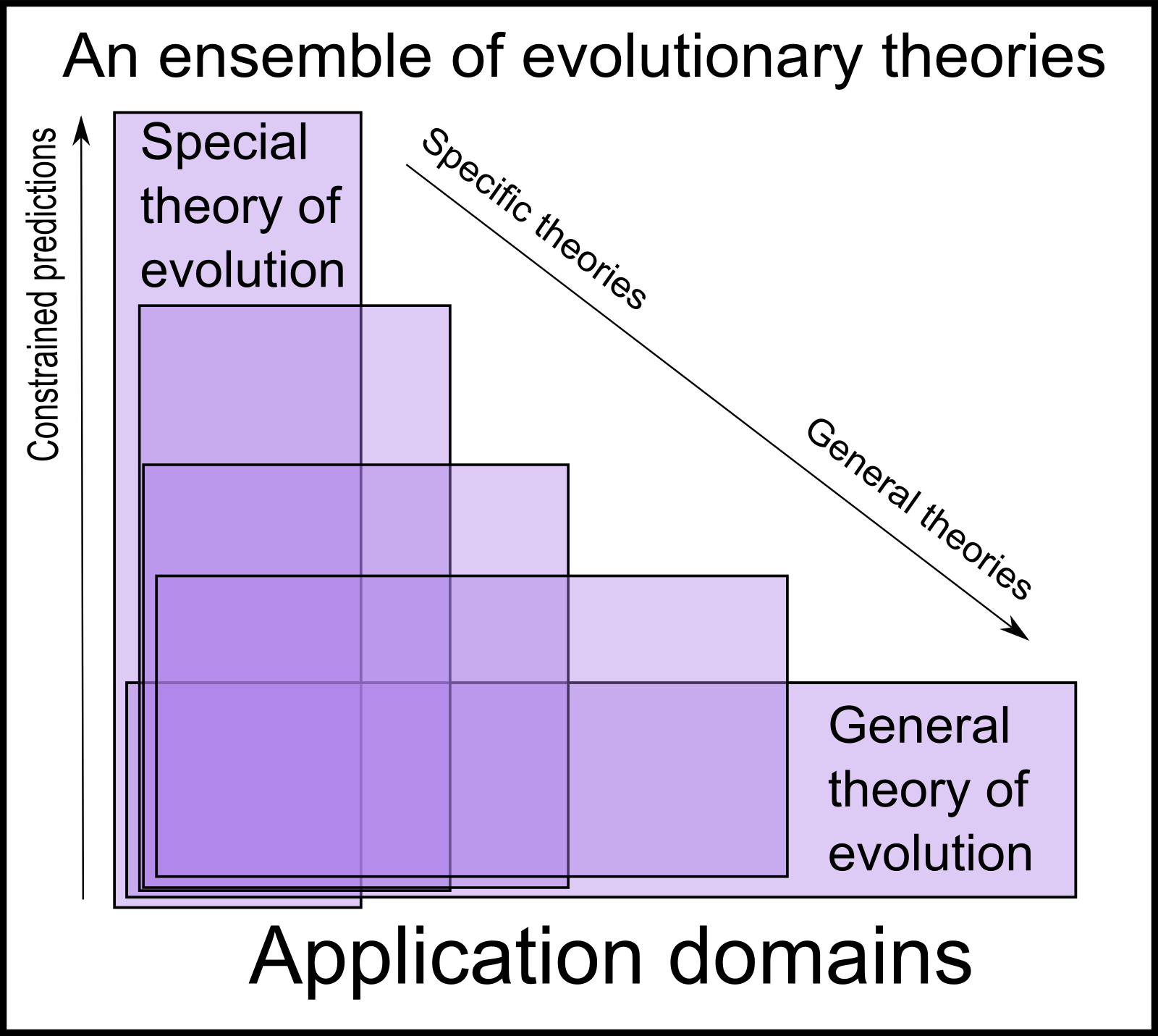
Theories vary along a one-dimension axis from 'specific' to 'general'.
The more general theories are vaguer and constrain expectations
less. However their corresponding advantage is that they are
still applicable in application domains where narrower theories fail completely.
The expanded domain of evolutionary theory represented by
universal
Darwinism is like having a bunch of new tools in your toolbox.
The complaints of John Maynard Smith and Alberto Acerbi are
a bit like complaints that some of the new tools aren't as useful
as one of the old tools was. That's OK - these are new tools that
we didn't have before. You don't have to throw out any of your old
tools in order to make room for the new ones. Instead, take delight
in all the new things the bigger toolbox lets you do.
Of course this doesn't address the terminological debate about what
deserves to be described as being 'evolutionary' or 'Darwinian'.
However that's more of a 'small peanuts' debate, in my humble opinion.
Universal
Darwinism gives us a bunch of shiny new tools. We should try them
out, see what they can do, and learn when best to use them.
 I came up with the term 'virtue signalling' in 2011, and published about it
here.
I made the term up after being irritated with Boyd and Richerson's
term “heart on your sleeve hypothesis" from their "Solving the
Puzzle of Human Cooperation" paper. It is often a bad idea
to allow critics of a hypothesis to name it - and this was
a case in point. Boyd and Richerson mentioned the signalling hypothesis
mainly to criticize it while promoting their own rival ideas about group
selection. By contrast, in my article, I promoted 'virtue signalling' to be
the most significant cause of human cooperation after kin selection and
reciprocity. A few other people have used the phrase before me - but
never very seriously, it seems.
This article was written as part of my work on my 'Memes' book, which
looked in more detail at culturally mediated cooperation than I had managed
in my 2011 'Memetics' book.
Virtue signalling seems to be establishing itself as a popular term. However
there's a foundational issue surrounding it which I haven't previously
publicly addressed:
When I came up with the term I intended "virtue signalling" to refer to
any kind of signalling self-worth - or denigrating of rivals. However,
when I subsequently looked up the term 'virtue' in the dictionary
I found that it had strong connotations of only referring to moral
merit.
Clearly signalling of merit / worth / quality / value is a more general phenomena
that just signalling moral goodness. I originally intended the term
"virtue signalling" to refer to this more general idea. So, one of the examples I
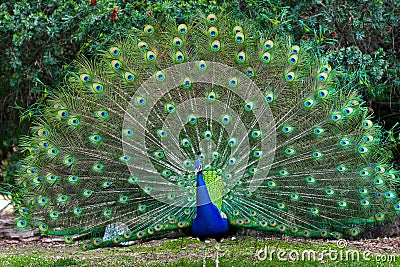
though of was a peacock signalling his 'virtue' to peahens. However,
the dictionary suggests that the term 'virtue' means something more narrow: only moral merit.
One resolution would be to say that "virtue signalling" is a subset of
"value signalling" - and that the latter includes Peacock signals,
while the former does not.
The problem with this is that "value signalling" seems vague and ambiguous
in other ways. It is already losing the popularity contest with "virtue signalling".
I doubt whether this term has legs. Much the same goes for the other
broader umbrella terms.
To deal with this, I'm inclined to double down on my original interpretation
of the word 'virtue'. The dictionary does go on to offer some broader meanings
of the term. Yes, describing a peacock's tail as a 'virtue' is a bit confusing,
but I don't really see a significantly better solution. All signaling targets
behaviour in the end - and what counts as 'moral' behaviour is pretty vague.
So: we could also say that the peacock is signalling that having sex with it would
be a 'good' thing to do.
 Massimo Pigliucci's latest doubts about cultural evolution can be found in the recent article: The Trouble with Cultural Evolution.
Alas, it's the same
long-discredited nonsense as usual. Massimo doesn't know what he is talking about. I think at this stage one has to regard Massimo's writings as a case study in cognitive dissonance. How will Massimo continue to reconcile his doubts about Darwinian cultural evolution with the views of all the scientists who are now taking it seriously?
Massimo cites Lewontin's 1970 article "The Units of Selection. Explaining why he doesn't think the principles it lays down apply to cultural evolution. However, what he neglects to mention is that Lewontin stated himself that the principles did apply to cultural evolution in that very article. Here's what Lewontin said in 1970, on page 1:
It is important to note a certain generality in the principles. No particular
mechanism of inheritance is specified, but only a correlation in fitness between
parent and offspring. The population would evolve whether the correlation
between parent and offspring arose from Mendelian, cytoplasmic, or cultural
inheritance.
If you cite an article to support your position, and the author of the article disagrees
with you in the same article, you should at least point that out.
Massimo's headache reminds me that one thing we haven't seen very much of so
far is people publicly changing their mind on the topic. We clearly have a
new generation of researchers who grew up with memes and understand the
topic - but I've seen very few previous critics turn around and confess
that they were mistaken. If scientists die before they change their minds
on this topic, then we might be in for quite a lot more
Darwinian revolution.
Update 2015-12-03: Massimo gloats over the reception of his paper here. It is all very well bending over backwards trying to find sympathetic interpretations of your opponents perspectives - but it is best not to bend over too far.
|
|






 Posts
Posts

