Tuesday, 16 November 2010

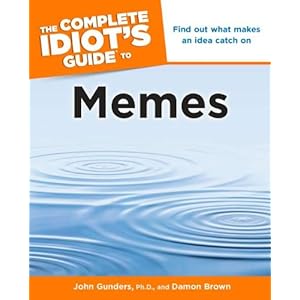
The Complete Idiot's Guide to Memes

A new book - The Complete Idiot's Guide to Memes - by John Gunders and Damon Brown - is out now. Blurb:
Memes are "viruses of the mind"-symbols, ideas, or practices that are transmitted through speech, gestures, and rituals. Understanding how symbols like the peace sign or ad slogans like "Where's the beef?" or viral videos become part of our common culture has become a primary focus of sales and marketing companies across the globe. The Complete Idiot's Guide(r) to Memes explains how memes work, how they spread, and what memes tell us about how we make sense of our world.

  • First book to cover all types of memes, including viral memes in the digital age

  • Features the Most Influential Memes in History and the Ten Biggest Internet Memes
  • The author has a blog: http://thememesofproduction.org/

    There is a review: here.

    I think it is good that there is now an official "Idiot's Guide" to memes. Now, when people ask me particularly stupid questions about memes and memetics, I have somewhere suitably patronising to refer them to.

    Thursday, 11 November 2010

    Darwin's Conjecture - a new book

    A new book: Darwin's Conjecture: The Search for General Principles of Social and Economic Evolution - by Geoffrey M. Hodgson and Thorbjørn Knudsen - is due out soon.

    Amazon page. Author's site.

    Blurb:
    Of paramount importance to the natural sciences, the principles of Darwinism, which involve variation, inheritance, and selection, are increasingly of interest to social scientists as well. But no one has provided a truly rigorous account of how the principles apply to the evolution of human society—until now.

    In Darwin’s Conjecture, Geoffrey Hodgson and Thorbjørn Knudsen reveal how the British naturalist’s core concepts apply to a wide range of phenomena, including business practices, legal systems, technology, and even science itself. They also critique some prominent objections to applying Darwin to social science, arguing that ultimately Darwinism functions as a general theoretical framework for stimulating further inquiry. Social scientists who adopt a Darwinian approach, they contend, can then use it to frame and help develop new explanatory theories and predictive models.

    This truly pathbreaking work at long last makes the powerful conceptual tools of Darwin available to the social sciences and will be welcomed by scholars and students from a range of disciplines.
    It sounds promising.

    The introduction appears to be online here. The author has a web site here.

    Friday, 29 October 2010

    Carl Zimmer & Paul Ehrlich discuss cultural evolution


    Carl Zimmer & Paul Ehrlich discuss cultural evolution on bloggingheads.tv.

    Here, Paul Ehrlich describes what he thinks is wrong with memetics.

    To summarise, he thinks the main problem is that mutations are (more-or-less) random in genetic evolution - while they are directed in cultural evolution.

    Alas, nobody ever thought that mutations were random in memetics.

    That was never a tenent of meme theory in the first place.

    The basic idea of memetics and memetic evolution is that copying with variation and differential reproductive success of culture results in evolution and cumulative adaptations.

    Nobody ever claimed that the variations have to be made at random.

    Alas, Paul has previously rather seriously incriminated himself in this area in print by saying:

    Among humans, genes can only pass unidirectionally from one generation to the next (vertically), normally through intimate contact. But ideas (or “memes”) now regularly pass between individuals distant from each other in space and time, within generations, and even backwards through generations. Through mass media or the Internet, a single individual can influence millions of others within a very short period of time.

    In fact cold virus genes pass between individuals of the same generation and from offspring to parent. Hepatatis B is a hardy virus that can exist on almost any surface for up to one month, and so can be transmitted by mail - and viruses can spread from one person to many - in what is commonly known as a pandemic. So, the while the relationship between the cultural and organic realms looks pretty close in these respects, it is clear that Paul is criticising memetics without being very familiar with its basic concepts.

    Bernie Hogan - The Social Structure of (Memetic) Diffusion


    The Social Structure of (Memetic) Diffusion - by Bernie Hogan.

    This video is from the 2008 conference Memory, Social Networks, and Language: Probing the Meme Hypothesis II.

    Paul Higgs - Is it Good to Share?


    Is it Good to Share? The Parallel between Information Transfer and Horizontal Gene Transfer - by Paul G. Higgs.

    This video is from the 2008 conference Memory, Social Networks, and Language: Probing the Meme Hypothesis II.

    Robert Finkelstein - What is a Meme?


    What is a Meme: A Functional Definition - by Robert Finkelstein.

    This video is from the 2008 conference Memory, Social Networks, and Language: Probing the Meme Hypothesis II.

    Keith Stanovich - Rationality, Evolution, and the Meme Concept


    Rationality, Evolution, and the Meme Concept - by Keith Stanovich.

    This video is from the 2007 conference Imitation, Memory and Cultural Changes: Probing the Meme Hypothesis.

    I disagree with Keith Stanovich about many things - and he says some strange things in this video (memes have no phenotypes, what?!?) - but he speaks articulately and fairly competently slams meme critics here.

    Wednesday, 27 October 2010

    Meme Warfare Centre

    More on the US military's interest in memetics:

    To quote from: MEMETICS - A GROWTH INDUSTRY IN US MILITARY OPERATIONS
    The Meme Warfare Center offers a more complex and intellectually rich capability absent in current IO, PsyOps and SC formations and is specifically designed to combat the enemy’s sophistication as highlighted above. The emerging tools to win the metaphysical fight are memes. Managing, employing and leveraging memetic power is key for the US to shape and win on future battlefields."
    ...and...
    The US must recognize the growing need for emerging disciplines in ideological warfare by ‘weaponeering’ memes. The Meme Warfare Center offers sophisticated and intellectually rich capability absent in current IO, PsyOps and SC formations and is specifically designed to conduct combat inside the mind of the enemy. Memes are key emerging tools to win the ideological metaphysical fight.
    I am reminded of this one:

    Tuesday, 26 October 2010

    Donald T. Campbell papers now online

    Google have kept up with their book scanning. One of the books they scanned contains:


    These papers are both in Evolutionary epistemology, rationality, and the sociology of knowledge - a book by Gerard Radnitzky, William Warren Bartley and Karl Raimund Popper.

    Donald T. Campbell is known as the father of evolutionary epistemology.

    He came up with the idea of Blind Variation and Selective Retention.

    The issue of the significance and applicability of this concept is probably one of the more challenging issues for those attempting to understand cultural evolution.

    These papers are tough going on the reader - but they do have significant historical importance.

    Memetics compendium

    As part of the "military memetics" project, Dr. Robert Finkelstein has apparently used some of the dollars the department of defense sent his way to compile a huge body of existing scientific papers on memetics into an enormous volume, and publish it "for free" on the internet - in the form of the Memetics Compendium.

    It runs to 14Mb - and 1680 pages!!!

    The release notes say:
    The basic purpose of the Compendium is to provide an indication of the prospective value of memetics to the U.S. military for conventional and asymmetric operations, including counter-terrorism.
    Whoah! The next time someone tells me memetics isn't a science - and hasn't produced anything of value - I think I'll tell them to go and read the Memetics Compendium - and to tell me that again when they have finished it.

    The Compendium apparently pays scant attention to international copyright law. For instance it has the entire text of chapter 11 of The Selfish Gene.

    So - it may not stay up forever - but for the moment, you can download your copy now!