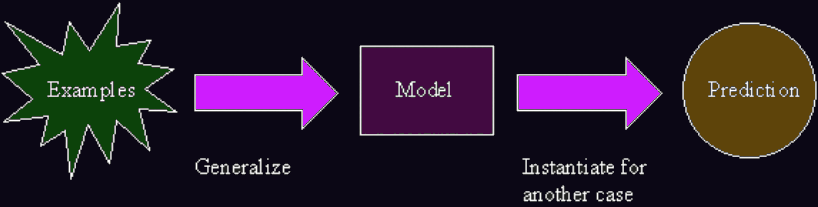
Inductive inference refers to using knowledge to make predictions.
It's the basis of the scientific method. This was once famously
disputed by Karl Popper - but is now widely accepted.
Sequence prediction is a well-known type of induction problem.
For example, what comes next: 3,4,7,11,? Inductive inference
relies on knowledge acquisition - i.e. learning. Inductive
inference is inherently fallible and probabilistic.
It is clear that evolution builds systems capable of performing
inductive inference - namely animal brains. However, there's another
link between evolution and induction - since both processes involve
using knowledge of the past to make predictions about the future.
This is perhaps not obvious, but if you think about it, every organism
represents a kind of prediction about the environmental conditions
it will encounter. The prediction is that the organism will encounter
an environment have allows it to reproduce.
Many have linked evolution and inductive inference in this way. For
example, in Universal Darwinism , John Campbell wrote:
The Darwinian process may be the only physical mechanism known to
science capable of accumulating knowledge from experience.
It performs inference and is a physical analogue of Bayesian updating.
Similarly, in Probably Approximately Correct, Leslie Valiant wrote:
To see evolution as a form of learning, we view the genome in evolution
as corresponding to the hypothesis in learning.
Philosophers of science who view scientific knowledge acquisition as a
form of Darwinian cultural evolution are also implicitly making the
same link between Darwinian evolution and inductive inference.
So: what is the link between evolution and inductive inference? I have a couple of comments to make:
- The claim that Darwinian evolution is a type of learning
(made by Leslie Valiant in Probably Approximately Correct),
isn't really right. Darwinian evolution can also produce genetic drift -
which has little to do with learning. Evolution sometimes results
in knowledge acquisition and successful inferences. Other times it results
in progressive knowledge loss and extinction. It depends.
- It is tempting to link fitness in evolution with scientific truth or
accurate knowledge. However, this association is inferior in practically
every way to linking fitness with popularity.
Phlogiston
and the aether
are popular mistaken ideas. They are kept around to help
show where not to tread. Death in evolution maps poorly on to
falsification in science.
The idea that Darwinian evolution underlies most systems that perform
inductive inference is important and under-appreciated. Those engaged
in creating machines that perform inductive inference tend to associate
Darwinism with genetic algorithms. Those are often seen as being just
one tool in a large toolkit. They are generally used in those cases
where the only thing you know about your solution space is a scalar
quality metric. Knowledge of
memetic algorithms paints
a rather different picture. In fact, evolutionary algorithms are fundamental.
The idea of an evolutionary gene dates back at least to G.C. Williams (1966) - who said:
In this book I use the term gene to mean 'that which segregates and recombines with appreciable frequency'
...and...
In evolutionary theory, a gene could be defined as any hereditary information for which there is a favorable or unfavorable selection bias equal to several or many times the rate of endogenous change
Williams clearly defined genes in information-theoretic terms, saying:
The gene is a package of information, not an object.
...and...
A gene is not a DNA molecule; it is the transcribable information coded by the molecule
I think that the idea of a gene as consisting of heritable information has stood the test of time. However, the idea that genes
are defined in terms of their frequencies seems more suspect. Terms like "appreciable frequency" and
"several or many times" lack scientific rigor. Presumably they were used in order to prevent entities
which are too complex from having 'gene' status. However, there seems to be no compelling reason to
build them into our conception of a gene. Similarly, invoking "selection bias" seems to define unfairly
neutral genes out of existence. Again, this is unnecessary - and can be simply avoided.
Instead of Williams mutually-contradictory definitions, I have proposed defining a gene as:
a small section of heritable information
The definition makes no mention of DNA, nucleic acids - or of living systems. It is a fairly general term - and generality is usually a virtue in science.
Richard Dawkins was another early pioneer of
informational genetics.
Although he initially used the "gene" concept he eventually substituted "replicator" -
suggesting that this concept was more clearly substrate neutral. However, the resulting replicator
revolution has not gone very well - and many years later there's no science of replicators that
can compete with genetics. I don't think we need two sciences of heredity. It seems better to
improve the existing field of genetics than to attempt to create a new scientific field that
competes directly with it.
It is worth noting that the common definition of evolution in terms of
changes in gene frequencies depends critically on the use of
the evolutionary gene. Without the evolutionary gene, the idea
that evolution consists of changes in gene frequencies would exclude
cultural and environmental inheritance - and would make no sense.
In modern times it has become fashionable to claim that evolution is too "gene-centric" -
and pays too little attention to other forms of inheritance. For example, here is Robert Kadar:
We now know genes are sufficient but not necessary for natural selection because 1) genes are the likely product of selection and 2) genes are only one source of heredity among others. The gene-centric view of evolution is crumbling!
Such sentiments make no sense in the context of the evolutionary gene. Genes are the units of inheritance in evolution. All inheritance is mediated by genes - just as all messages can be represented by bits. Defining the term "gene" so that it is stupid and useless is not good scientific practice.
Another group of biologists study what they call "epigenetic inheritance". Again, this whole concept makes no sense in the light of the evolutionary gene. Inheritance is genetic - by definition. The term "epigenetic inheritance" is an oxymoron.
References

 Culture has helped humans conquer the planet - and there are currently over seven billion humans in existence. The average effect of memes on their hosts has generally been pretty positive.
However, memes often have a remarkably negative effect on reproductive output. In what is widely
known as the "demographic transition" women in more developed countries have fewer babies. Roughly,
the richer the country is, the fewer babies are made. The culmination of this effect is seen in Japan -
probably the most meme-rich country in the world.
There, we see sub-replacement fertility
and population decline.
One possible explanation for this involves r/K selection and the idea of a superstimulus. Standard r/K selection theory
suggests that organisms may be adapted to respond to increased wealth with greater investments
in offspring quality relative to offspring quality - more 'K' and less 'r'. It is clear that
r/K selection theory explains some of the reduction in offspring number that is produced by
wealth. However, the sub-replacement fertility seen in the real world is pretty clearly
maladaptive. A possible explanation is that unusually high levels of wealth could result
in a superstimulus and lead to the adaptive mechanism described above operating outside
its normal range and malfunctioning.
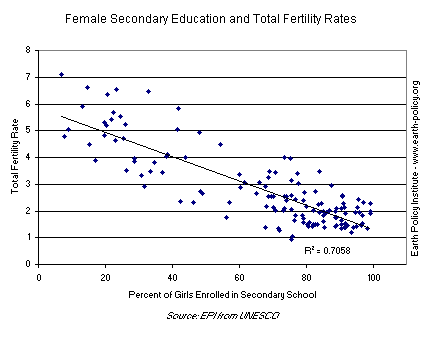
There are also theories based on memetics. The idea that memes are involved is
corroborated by the strong negative correlation between the number of years of
education young women receive and the number of children they have. Few things
stop your eggs from being fertilized as effectively as a college degree.
 In theory, memes can benefit by diverting host resources away from reproduction
of the host germ line and into the production of memes. The classic example of
this is priests. In some denominations, priests have no children. Instead they
devote their lives to spewing out a long string of memes: spreading the word.
Richard Dawkins famously covered this hypothesis in The Selfish Gene,
writing: In theory, memes can benefit by diverting host resources away from reproduction
of the host germ line and into the production of memes. The classic example of
this is priests. In some denominations, priests have no children. Instead they
devote their lives to spewing out a long string of memes: spreading the word.
Richard Dawkins famously covered this hypothesis in The Selfish Gene,
writing:
The meme for celibacy is transmitted by priests to young boys who have not yet decided what they want to do with their lives. The medium of transmission is human influence of various kinds, the spoken and written word, personal example and so on. Suppose, for the sake of argument, it happened to be the case that marriage weakened the power of a priest to influence his flock, say because it occupied a large proportion of his time and attention. This has, indeed, been advanced as an official reason for the enforcement of celibacy among priests. If this were the case, it could follow that the meme for celibacy could have greater survival value than the meme for marriage. Of course, exactly the opposite would be true for a gene for celibacy. If a priest is a survival machine for memes, celibacy is a useful attribute to build into him. Celibacy is just a minor partner in a large complex of mutually-assisting religious memes.
Specific technologies for sterilizing humans have evolved. Barrier contraceptives prevent sperm from
reaching their targets. Chemical contraceptives mess up the female reproductive system, preventing
conception. Abortion has become quick and easy - and there's even a "morning after pill".
Evolution linked the human reproductive drive fairly strongly to the sex drive. Contraceptives
break this link. Men can have sex without investing any resources in parental care. Women can
have sex without going through labour and childbirth. Many men and women apparently
choose to do this.
Memes whose transmission is vertical with respect to the generations of their hosts can be expected
to have interests that are aligned with those of their hosts. Arguably we see such a transmission
pattern with some traditional religious systems - with the Amish springing to mind as an example.
However in the modern world, advances in communications technologies have led to meme transmission
patterns that tend to be horizontal with respect to host generations. In such cases, we can expect
to see more parasitic memes thriving - unless increased efforts are put into preventing their spread.
However, in the case of contraception, the memes involved seem to be largely unopposed. It is true
that some religious factions object to abortion while others discourage use of contraceptives,
however overall, the fertility-reducing memes associated with "family planning" face relatively
little opposition.
As an example of a sterilization meme, consider the essay
Why it is important not to have children
from Richard Stallman's personal site. Stallman is clearly a
memetic hijacking victim.
In his essay he clearly describes the competition between memes and genes and explains why he chose
to propagate his memes - rather than his genes.
Memes are sterilizing humans on a massive scale. They also appear to be getting better at it.
This leads to the obvious question of what the future holds. Will we see human fertility
decline to the point where we see "peak human"?
I think that is the most obvious conclusion - although the supporting reasoning has
relatively little to do with existing fertility trends. Instead it seems clear that
the future dominant organisms
will be engineered. They will, in short, be superintelligent machines. Humans might
persist in such a world, but probably only as a very small piece of it. Perhaps
their main role will eventually be in populating historical simulations. The machines
will trace their ancestry back through us. We will be regarded as their progenitors.
Human DNA will probably survive for a long time to come. However it is challenging to
imagine a realistic distant future with very many "meat bag" humans in it. The current
situation is just a stage the biosphere is going through before the rise of the
superintelligent machines.
 In evolutionary theory, hijacking is an extreme form of manipulation in which one agent winds up performing actions that mostly benefit some other agent.
In order to perform a successful manipulation, the manipulating agent often has to be a close symbiont - in other words, a parasite.
To successfully manipulate its host, the nervous system is an attractive target. mind parasites. It is still possible to manipulate the host without invading their nervous system - and many parasites succeed by other techniques. They might synthesize hormones or neurotransmitters - or maybe make their hosts cough, sneeze or itch. However, these approaches don't really qualify as hijacking. One of the defining characteristic of a hijacking is that the hijacker directs many of the hijackee's actions.
The hijacking metaphor makes the most sense in the context of Richard Dawkins' characterization of the host's phenotype as being a vehicle. A parasitic hijacker may then hijack the host's vehicle and use it to its own ends.
Sometimes the victim's higher mental faculties are compromised during the hijacking - in which case the victim is often referred to as being a "zombie".
Hijacking parasites may be either organic or cultural. Memetic hijacking is a well-known phenomenon. Memetic hijacking illustrates the precise targeting that's available to cultural software. The host's motivational system can be reprogrammed to the point where they want nothing more that the success of the memeplex they are infected with. In some cases, the hosts are even sterilized by their memes - ensuring that resources that might otherwise be invested in childcare are directed into meme propagation.
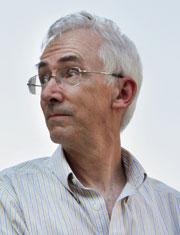 David Sloane Wilson has weighed in on cultural kin selection. It seems as though he's saying that he doesn't understand how it works - and is hoping others will explain it to him. The good news is that I've already published dozens of articles on the topic that explain it from a wide range of angles.
David's article suggests that his problem is that cooperative cultural interactions take place between organisms which "lack genetic relatedness, genealogical or otherwise". This seems like a basic point that is very easy to explain. Much cultural cooperation is based on shared memes. When two individuals have the same money, the same language or the same religion, they are more likely to cooperate. The more shared memes they have, the more likely they are to cooperate (on average). The idea of cultural kin selection is based on cultural evolution, kin selection acting on memes (rather than DNA genes) and symbiology and manipulation.
David says large spatial and temporal scales are part of the problem. I don't understand this problem. Consider the US dollar for example. This exists in billions of identical copies - and produces a lot of cooperation - which is all well explained by cultural kin selection - since the dollar bills are close relatives with r~=1 - and they clearly influence manipulate their hosts. The dollar's reach is global and it has lasted for quite a long time. It is not clear what the supposed problem with large spatial and temporal scales is.
To reiterate some by-now tired points, kin selection emphasizes close relatedness - where the process actually produces adaptations - such as the human breast. Group selection de-emphasizes relatedness. As a result advocates apply it to groups consisting largely of non-relatives - such as entire tribes - where theory predicts that the process is largely ineffective. As a result group selection has a long (and ongoing) association with junk science.
Mixing cultural evolution and group selection is a recipe for confusion. That's the very last thing the important science of cultural evolution needs. Mixing the two is not helping to educate the public, it seems more like a controversy-based marketing strategy. To me it looks like self-promotion at the expense of misinformation.
To reiterate, it is not the case that group selection explains cultural dynamics that kin selection does not. Group selection enthusiasts have spent decades looking for such cases. They have failed - and now most of them have given up. I thought David Sloane Wilson was among those who had publicly thrown in the towel - and given up this quest. This article suggests that the old group selection dream of finding new science and making original predictions still lives on. That does not seem like a good thing.
 "Phenotype" is one of the more fought-over concepts in evolutionary theory.
Richard Dawkins proposed calling the phenotype a "vehicle". David Hull proposed using the term "interactor". Gouyon, Henry and Arnould proposed the term "gene avatars".
The Dawkins "vehicle" conception has a curious history. Dawkins at first promoted it. When faced with Hull's near synonym "interactor" he said (1982):
Much the same point has been realized by Hull. (1981), but I prefer to persist in expressing it in my way rather than to adopt his terminology of "interactors" and "evolvors".
Later in "Burying the Vehicle" Dawkins wrote:
I coined the vehicle not to praise it but to bury it. This is, paradoxically, why vehicle is a better name than Hull’s interactor. Interactor comes too close to the (messy) truth and therefore doesn’t merit a helpfully decisive burial.
Dawkins subsequently went on to use the concept as though it had not been "buried" at all, for example here:
The key is to abandon the word 'fitness', replacing it with the concepts of replicators, vehicles and the extended phenotype.
These contradictory approaches to the "vehicle" term have become part of the terminology's baggage.
I find "interactor" a bit of a mouthful, while "vehicle" seems somewhat more acceptable. Hull's various criticism of the term "vehicle" seem bogus to me. For example, Hull claims that the term "vehicle" makes the organism seem too passive - like a giant robot controlled by its genes. I think Hull must have not used public transport very much. I also classify Hull's claimed distinctions between "interactor" and "vehicle" as being "mostly fluff".
Both "interactor" and "vehicle" are historically tied in a bit with the "replicator" concept - which has received its share of criticism. In particular, the etymology of "replica" strongly suggests high-fidelity copying - while in most of evolutionary theory, copying fidelity is a parameter, which can take a wide range of values. For some, this appears to have tainted "interactor" and "vehicle" by association.
"Phenotype" seems to have remained the most popular term. It has useful cousins: phene, and phenome. The terminology does have some disadvantages, though: The term "phenome" has a very muddled definition - which (confusingly) fails to mirror the definition of "genome". The terms "phenotype" and "genotype" are (confusingly) used to play multiple roles - referring to both all the traits in an organism and to a particular trait.
Like the term "evolution", the term "phenotype" doesn't come in "meme" and "gene" varieties. Just as it would be nice to have access to the terms "memevolution" and "genevolution", it would be nice to have "meme" and "gene" variants of the term "phenotype". Memeticists have proposed "phemotype" has been proposed as a term applicable to cultural evolution - but this term seems to me to be too irregular to endorse.
The Genotype-phenotype distinction neatly foreshadows the rise of information theoretic accounts of evolutionary processes. The idea is a lot like the hardware/software distinction in computer science.
For some reason, the Genotype-phenotype distinction has caused much controversy in cultural evolution. It all seems tied in to the confusion surrounding cultural genes: memes. I'm not really sure why this confusion exists - these all seem like basic, foundational concepts to me.
 Elaine Morgan popularized the idea that humans are "aquatic apes" - who spent part of their
evolutionary history in water. The aquatic
ape hypothesis proved controversial.
I think it is pretty obvious that humans are more water-friendly than most other apes. However,
the most likely explanation for this is that humans invaded water environments much as they
invaded every other habitat on the planet - by using cultural transmission to adapt to these environments
while also shielding themselves from their more negative aspects.
That humans are cultural apes is pretty uncontroversial. Cultural transmission explains practically
every difference between humans and chimpanzees. It seems likely that it also explains those
differences associated with adaptedness to aquatic environments.
Cultural transmission of traits that help with survival in the water are well known, and have been
observed in primitive tribes. Cultural transmission of swimming, diving and breath holding are
all old phenomena. Similarly many of the negative aspects of oceanic environments can be
protected against using cultural transmission. Drowning can be learned about; sea predators can
be defended against, hypothermia can be avoided or treated - and so on.
Some aspects of these behaviours fossilize. For example, we can be pretty sure that humans
have been diving for pearls for thousands of years - because we can see the resulting pearls.
We also know some things about the rafting feats of early humans - through looking at the
geographic distribution of human genes in islands. We know roughly who rafted where and when.
Modern humans don't normally get onto ocean-faring rafts unless they can swim pretty well.
I think that cultural evolution is a sufficient explanation for human traits
associated with water-friendliness. For example, there is no pressing need to invoke
any environmental flooding to explain why humans are as water friendly as they are.
Also, the idea that watery environments led to bipedalism (through the need to keep
the nose out of the water) is weakened by the cultural explanation. Cultural
transmission explains most of the observed facts without invoking this
particular speculation. Instead cultural transmission led to bipedalism too.
References
 Cultural group selection has
led to much confusion.
One of the associated confusions is the idea that group selection is more
prevalent in the cultural realm than in the organic realm.
This idea appeared prominently in "Not By Genes Alone". Here's what Boyd and Richerson wrote back then:
The real scientific question is what kinds of population structure can produce enough variation between groups so that selection at that level can have an important effect? The answer to this question is fairly straightforward. Selection between large groups of unrelated individuals is not usually an important force in organic evolution. Even very small amounts of migration are sufficient to reduce the genetic variation between groups to such a low level that group selection is not important. However, as we will explain below, the same conclusion does not hold for cultural variation.
It is correct that selection between large groups of unrelated individuals is not usually important. However it is wrong to say that this conclusion does not apply to cultural variation. There the relevant 'individuals' are bibles, dollars and iPhones. These cultural individuals are often related with r~=1. Without relatedness kin selection doesn't work - and neither does group selection.
The idea that group selection works better in the cultural domain has been knocked around by various group selection advocates
since then - apparently in an attempt to make cultural group selection seem more plausible. The idea is also beloved of
those who like to exaggerate the differences between the cultural and organic realms. The latest endorser of the idea
is Razib Khan - in his recent article
Language (Culture) and Genes Evolve Differently. Razib gives the following rationale:
Not only is there a great deal of horizontal transmission, but cultural processes are subject to a greater “mutation” rate, and selection can be much more efficacious. The latter is why group level selection is more mathematically plausible for culture than genes; competing demes can be much more distinct in culture than genes because minimal gene flow can equilibrate biological differences, while biased transmission of culture can result in insulation of different groups from homogenization (e.g., inheriting your cultural traits from your father, rather than your mother, who may have been kidnapped from an enemy tribe).
To be plain, there's no supporting evidence for the idea that cultural group selection is any more prevalent than organic group selection. The whole idea is one of the fantasies introduced by group selection advocates.
The now widely-recognized
broad
equivalence of kin selection and group selection
should have obliterated this fallacy - since kin
selection is clearly broadly applicable to both realms - and it is patently false that
kin selection doesn't apply to the organic realm - as Boyd and Richerson originally
claimed for group selection.
In fact, both the organic and cultural realms exhibit
superorganisms,
eusociality -
and all manner of milder forms of kin selection.
Why does the idea that group selection applies more to culture than to the rest of biology continue to lead a zombie existence - long after it has lost any sembalance of a credible empirical or theoretical basis? It isn't clear. Cultural lag is probably involved. Anyway, this article is here to drive another nail into the coffin of this dud idea. R.I.P.
References
I've finished reading and reviewing Probably Approximately Correct: Nature's Algorithms for Learning and Prospering in a Complex World by Leslie Valiant.
It didn't make it into my review, but one comment in the book seemed especially naive to me. Leslie says:
The most singular capability of living organisms on Earth must be that of survival. Anything that survives for billions of years, and many millions of generations, must be good at it. Fortunately, there is no reason for us to endow robots with this same capability. Even if their intelligence becomes superior to ours in a wide range of measures, there is no reason to believe that they would deploy this in the interests of their survival over ours unless we go out of our way to make them do just that. We have limited fear of domesticated animals. We do not necessarily have to fear intelligent robots either. They will not resist being switched off, unless we provide them with the same heritage of extreme survival training that our own ancestors had been subject to on Earth.
For most readers familiar with the topic of machine intelligence it is probably obvious why this is wrong. Survival is a universal instrumental value. You typically don't need to deliberately program it in.
I think a basic smattering of memetics could have avoided this error. Memes are evolved to be good at surviving, just as genes are. They too have extended evolutionary histories during which they are subject to natural selection. This is likely to be true of intelligent machines, just as it is true of many cultural entities today. Today's cultural entities may not have survived for billions of years - but they often have a good number of generations behind them - and many of them plainly exhibit adaptations for survival.
Machine intelligence enthusiasts tread a difficult line. On the one hand they don't want to exaggerate the dangers of their products - since Terminator-savvy consumers may agree with them. On the other hand, they should not exaggerate the safety of their product category - or they will appear over-confident about the potential negative side effects of their products. Consumers don't by a hedge trimmers from manufacturers who thinks that hedge trimmers are totally safe and don't need special safety features. I think Leslie is erring too much on the size of being blazeé.
One of the reasons I got into memetics in the first place because I believed that a proper science of cultural evolution was too important to be left to cultural anthropologists - who had demonstrably failed to get to grips with the topic for over a hundred years. I think that machine intelligence enthusiasts should take steps to understand this topic. Part of the reason is to avoid making this sort of mistake. We now have a great science of cultural evolution - which is very useful for understanding issues associated with the coming era of intelligent machines. However people have to study and learn about the subject before it is of very much use to them.

 Darwin Does Physics Darwin Does Physics - by John Campbell - is now widely available.
The blurb reads:
A largely unnoticed scientific revolution has occurred over the past forty-five years. The Darwinian paradigm has been successfully applied to numerous fields outside of biology: including the Social Sciences, the Behavioural Sciences and most recently to the Physical Sciences and even to Physics itself. This revolution promises an unprecedented conceptual unification of the many branches of science. Darwin Does Physics argues that the extension of the Darwinian paradigm has proceeded in parallel with a more widely recognized scientific revolution concerning the fundamental importance of information throughout science. Information is seen to enter nature in the form of ‘inferential systems’ which accumulate knowledge required for existence. Darwinian processes are identified as the physical implementation of inferential systems. The theoretical paradigms of physics have struggled over the past hundred years to accommodate the massive increase in scope of the known universe which Physics’ must explain. The Newtonian paradigm, which includes most of its modern theoretical structures such as string theory, has been found wanting. In an attempt to circumvent these problems some physicists are now developing theories in the Darwinian paradigm to explain the most basic processes of physics. These theories are explained and suggestions made for their development. If Darwinian theories are proved successful in explaining even the fundamental physical mysteries science will have achieved a wondrous unification of its many diverse branches.
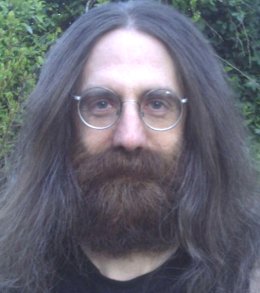
John Campbell previously wrote the generally excellent book Universal Darwinism. Darwin Does Physics looks set to be a small step for John Campbell but a large leap for most of the rest of the evolution comminity. Let's hope that some people actually read it.
John has posted an excerpt on his blog: Bayesian and Frequentist probability.
|
|






 Posts
Posts

