Monday, 23 January 2012
I'll Have What She's Having - the video
Authors Mark Earls and Alex Bentley explore how ideas, behaviour and culture spread through the simple means of doing what others do.a
Listen to the audio file of the full event here.


Selection terminology problems
 I generally use "selection" terminology. However, this terminology has some problems, and in this post we will take a look at them - and then consider whether better terminology is available.
Selection implies a selector
One problem with using the term "selection" is that it fairly strongly implies a selector.The "selection" terminology arose from generalising "artificial selection" to "natural selection". Artificial selection makes reasonable sense - because there's a human selector doing the selecting, but with natural selection there's often not a selector. Talking about "natural selection" represents a kind of "agentification" of nature.
Of course sometimes there really is a selector. In female choice, agents do literally select their mates. However, if an asexual bacterium divides, there's not really any selecting agent - the environment.
Agentifying nature is not a dreadful problem.
Survival or death?
The selection terminology seems kind-of ambiguous about whether individuals are being selected for survival or death. In some respects this is appropriate: sometimes mates are selected for sex, sometimes they are selected for rejection - and natural selection is often selection for death. However the use of selection coefficients makes it plain that selection is a positive force - indicating what is retained. However, the grim reaper obviously doesn't work that way. Death has a blacklist - not a whitelist. This mixture of ambiguity and wrongness seems rather confusing.
Is nature even choosing?
The term "selection" pretty strongly implies choosing between alternatives. However it is not always clear that that is what is going on. Nature doesn't so much choose organisms as score them, expressing its approval with a certain number of offspring. A score can be represented by a series of selections, but it's a bit painful. Also, when generalising Darwinism, more problems along these lines arise. New genomes can be made by extrapolating or interpolating. Consequently, the next thing to try may be something not tried before. Such cases are poorly described as being "selections".
Organism disempowerment
It has been said the idea of nature "selecting" makes the organism seem impotent. Rather than the organism being rated by its environment, organisms rate their environments, and if they don't like them they migrate to new ones. This perspective puts the organism more in charge - rather than picturing organisms as being at the mercy of their environment.
Alternatives
Those are the alleged problems that I have heard about. I expect most readers will find at least some points to sympathise with.John Wilkins has proposed "sorting" and "filtering" as alternatives that avoid agentifying nature.
"Culling" is a term that could be used to refer to "selection by death".
None of these really provide a term suitable for use in a generalised version of Darwinism. Generalised Darwinism still normally features gradualism, but there, it seems difficult to go far beyond vague terms like "modification" or "adjustment" - e.g. "the heritable information was slightly modified". Such vagueness may be accurate, but it isn't very catchy.
The other thing to say is that "selection" terminology has huge inertia - and a failure to use it would probably hamper communication with many readers.
Sunday, 22 January 2012
RationalWiki on memes
 For those unfamiliar with it, RationalWiki covers a range of scientific and political topics, providing commentary on them.
They have a large Pseudoscience section. It is rather like a version of QuackWatch oriented towards scientific topics.
The site features articles on numerous "fringe" subjects such as cryonics - which apparently is never going to work - and Transhumanism - which they characterise as "people assuming that because it can be imagined, it must be possible".
They have a section on memetics. As might be expected, it is pretty awful.
They start by approvingly citing the "criticism" of memetics from semiotics. To quote from my response here:
The semiotics students are correct to say that memes are signs - provided we use the definition of the term "sign" from within semiotics - which is - pretty confusingly - different from the usual English usage of the term. However, they don't seems to have any kind of coherent case against memetics. It seems to be more that they would prefer to use the terminology of semiotics to describe memes - even though the evolutionary biologists got there decades before them, and have a far more relevant discipline behind them.They cite the mostly-daft criticisms of Luis Benitez-Bribiesca - focussing particularly on the issue of whether cultural evolution features sufficiently-high copying fidelity to support cultural evolution. I give this criticism a few sentences here.
This has not been a viable criticism for decades now. The bibles and languages (and their associated phylomemies) prove conclusively that the critique is mistaken. Among serious students of cultural evolution apparently only Dan Sperber ever took this critique at all seriously.
They also have a brief section on memetics in their section about "Scientific mysticism". It is positioned in the midst of a rant about abuses of "selfish genes". This section on memes is pretty awful as well.
They complain that in the internet era few memes go extinct - apparently unwaware of the facts that much evolution merely involves changes in frequency of traits, and that plenty of data loss still goes on on a regular basis - as computer hard drives crash and people fail to save their work.
They repeat the daft objection that:
Thus, the high rate of "memetic mutation" should predict mostly evolutionary noise with little room for natural selection"They say that:
Memetics ignores the evolved cognitive architecture of the human mind and other models of cultural evolution such as gene-culture co-evolution.Really. Dawkins cited the work of a number of existing cultural evolution theorists in The Seflish Gene - and was plainly inspired by some of their work. Dennett and Blackmore cite the work of these other theorists too. Indeed, practically every memetics author I can think of since 1976 has done the same. Perhaps these folks should go and read my book on memetics - which clearly places memetics in the context of other theories of gene-culture [sic] co-evolution.
They finish by saying that memes provide:
an intuition pump built on circular reasoning that generates unfalsifiable nonsense that happens to sound very pretty.It remains unfortunate that people get into such silly muddles over memetics. Many of those in the field of cultural evolution are doing a spectacularly poor job of helping with public understanding of their own field. More explanatory material targeted at laymen seems to be urgently needed.
The article goes on to say:
One of this cult's prophets, Ray Kurzweil, seems to almost willfully misunderstand biological evolution to posit technological "evolution" as its outgrowth.Ray Kurzweil gets it - but the RationalWiki editors plainly don't have a clue what they are talking about in this case.
Saturday, 21 January 2012
Criticism of selfish memes
 One thing that critics of Richard Dawkins have repeatedly identified as problematical is the notion of "selfishness".
Some - OK, Mary Midgely - just didn't get the metaphor:
Genes cannot be selfish or unselfish, any more than atoms can be jealous, elephants abstract or biscuits teleological.Others apparently propose that these concepts should be ditched. Here is David Sloan Wilson:
Saying goodbye to selfish genes and memes involves questioning everything that has been associated with these concepts and reviving what they seemed to deny: the concept society as organism.I think the concept of "selfishness" is just fine in this context:
The term "selfishness" means promoting your interests without concern for the interests of others. So: "selfish genes" refers to genes promoting their own interests without concern for the interests of other genes - and "selfish memes" refers to memes promoting their own interests without concern for the interests of other memes. If you don't think genes have "interests", recall that referring to "gene interests" is just a shorthand for referring to the propensity of genes to catalyse their own reproduction. Similarly if you don't think that genes can be "concerned" about the interests of other memes, recall that that is just shorthand for actually promoting them.
This raises the issue of to what extent genes and memes are actually selfish. Some genes and memes fail to promote their own interests. Those aren't selfish because they aren't even active - so not all genes and memes are selfish. Most of the mechanisms promoting altruism to others don't apply to genes. Looking at the list of viable explanations for why humans-cooperate most of them don't apply to such entities. Genes and memes could potentially be manipulated into being nice to others of their kind - but it is not easy to come up with cases where this actually happens.
So, is looks as though most selectively-maintained genes and memes are indeed selfish. We could engineer genes or memes that promoted the interests of other genes or memes at their own expense. They could arise by chance mutations. However, such genes and memes are rare. So: the concept of selfishness in this context seems to be both clear and useful.
Another critic is Dan Agin - writing in an aricle entitled Goodbye Selfish-Gene: A New Upheaval in the Science of Human Behavior.
Neither Dan Agin nor David Sloan Wilson seem to have much of a handle on what it means for genes or memes to be "selfish". This is despite David Sloan Wilson's article purporting to unravel the mystery of "What Do Selfish Genes, and Memes, Really Mean?"
Richard Dawkins' idea is fine. David Sloan Wilson fails to articulate a coherent case against the concept - apparently through not groking its intended meaning.
David Sloan Wilson wants to link the concept to group selection. If genes benefitted groups at their own expense they would be behaving less than 100% selfishly. Wilson promotes the idea that group selection is common or important - and so apparently thinks not all genes are 100% selfish. I don't think that was ever the claim in the first place, though. Unselfish genes can arise from mutations - or through the environment changing unexpectedly. The idea is that selfishness is common, not that every single gene is selfish. Anyway, this certainly doesn't a reason for ditching the concept of gene-level selfishness.
It is worth noting that group selection simply doesn't tend to result in "unselfish" genes. While one can imagine genes that are good for groups rather than themselves, group selection would produce genes that are good for themselves that also happen to promote the interests of groups. The crusade against selfish genes in the name of group selection appears to be simply misguided.
Lastly, here is Peter Godfrey-Smith. Peter is the author of a book-length rant against Darwinian agenthood: "Darwinian Populations and Natural Selection". He says "selfish genes" are a "paranoid narrative":
Agential description of evolution can accompany real theoretical progress. This language can be used to quickly express contrasts between theories and models that can then be described more precisely. It can be used to steer the listener away from one family of models and explanations, to another. I don't deny its communicative role, and perhaps a heuristic role in exploring options quickly. In the mid to late 20th century, a change in the application of agential terms to evolution accompanied shifts in evolutionary thinking that were important. Some mid 20th century biology had seen an uncritical treatment of high-level entities, such as groups, species, and ecosystems, as evolutionary units. The reaction against that tendency featured close attention to evolutionary change at the level of individual genes (Hamilton 1964, Williams 1966). Genes became new objects of agential description – tiny and invisible strategists. Two kinds of agential narrative have a special psychological potency. The first is a paternalist schema. Here we posit a benevolent agent, often a large one, who intends that all is for the best. This category includes various Gods, the Hegelian "World Spirit" in philosophy, and stronger forms of the "Gaia" hypothesis, according to which the whole earth is a living organism. The second schema is a paranoid one. Now we posit hidden agents, often small, pursuing agendas that cross-cut or oppose our own interests. Examples include demonic possession narratives, the sub-personal creatures of Freud's psychology (superego, ego, id), and selfish genes and memes. And while it is true that sometimes there are large and kind agents or small and nefarious ones at work, the psychological appeal of these ideas means that we tend to take up such stories too readily and run with them too far. The account of evolution in terms of "selfish genes" (Dawkins 1976) is a paranoid narrative of this kind. It relegates other entities in evolution, such as whole organisms, to the role of mere "vehicles."Dennett wrote a lengthy critique of this kind of material in his book review: Homunculi rule: Reflections on Darwinian populations and natural selection by Peter Godfrey Smith.
I don't have a lot to add to that - though you can see my own review of Darwinian Populations and Natural Selection here
Massimo Pigliucci is another critic of memetic agency - writing in "Memes, selfish genes and Darwinian paranoia":
I must say that I am rarely struck by a novel enough idea that my first reaction is “wow.” This is one of those instances. There is something profoundly intellectually satisfactory in suddenly seeing disparate phenomena like Augustine’s god and Dawkins’ memes as different aspects of an all-too human tendency to project agency where there is none.Alas, many philosophers seem to delight in persistently misundersanding this idea.
References
Friday, 20 January 2012
Tim Tyler: Lumsden and Wilson, Genes, Mind and Culture
Transcript:
Hi! I'm Tim Tyler, and this is a review of this book: Genes, Mind and Culture by Lumsden and Wilson.
Genes, Mind and Culture was one of the first books published by scientists on the topic of cultural evolution. It came out about five years after Richard Dawkins had published The Selfish Gene - in 1976.
The book is pretty dated, and most people buying it will probably be doing so in order to get a historical perspective on the topic.
The book has over 400 pages. These are pretty densely packed with mathematical models, which render much of the book pretty unreadable by most of its audience. The models are not well presented. In some cases they may be acting partly to create a veneer of respectability.
Lumsden and Wilson make the case for a scientific study of culture based on biology. The book introduced the concept of a "culturegen". They define this as follows:
A culturegen is a relatively homogeneous set of artifacts, behaviours or mentifacts (mental constructs having little or no direct correspondence with reality) that either share without exception one or more attribute states seelcted for their functional importance or at least share a consistently recurrent range of such attribute states within a polythetic set.
From this you might begin to detect something of Lumsden and Wilson's style. While their own definition of a culturegen is awful, readers can understand its usage in the rest of this review by considering it to refer to memes or meme products - in the form of socially transmitted behaviours or artefacts.
The book then focused heavily on the epigenetic rules by which genes influenced what culturegens were adopted by their hosts. Like modern evolutionary psychologists, the authors were interested in the factors that make cultures similar everywhere. However, they did try to go beyond these commonalities and account for cultural differences. Their approach is based largely on population genetics.
One thing their book became known for is its "leash" metaphor. They write on page 13:
genetic natural selection operates in such a way as to keep culture on a leash.
In a subsequent section titled "Can culture have a life of its own?" they claimed that the establishment of deleterious culturgens in the population for extended periods of time could be demonstrated to be impossible - suggesting that epigenetic rules favouring the adoption of beneficial culturgens would be violated and that they would exert some kind of pressure which would alter the culturgens into a more favourable form. This idea was subsequently identified by some opponents as pinpointing where Lumsden and Wilson had gone wrong in their analysis. The authors also wrote: "Culture slows the rate of genetic evolution". We now know that this is not correct either.
In one of the best parts of the book, the authors offer an analogy for understanding cultural evolution based on island biogeography. In this analogy, islands represent human minds and archipelagos represent societies. Culturgens act like organisms colonising the islands. The reader is thus invited to transfer their knowledge of the dynamics of island biogeography into the cultural realm. This idea is an excellent one - although picturing brains as islands makes them seem rather passive and picturing ideas as colonising organisms makes them seem perhaps too active and agent-like.
Island biogeography might seem as though it is an esoteric subject - but many students of evolutionary biology pick up a smattering of knowledge about the topic as part of the process of learning about evolution. Islands represent natural evolutionary experiments, and so are of particular interest to evolutionary theorists. Darwin's famous visit to the Galápagos islands has also helped to put island biogeography in the limelight.
However, although they do have a chapter devoted to it, Lumsden and Wilson don't do very much with this (excellent) analogy. Had they based more of their work on it, their book might have been a lot better.
Part of the book's problem involves failure to apply the principles of reductionism. Lumsden and Wilson obsessively pursue the idea of a gene-cultural cycle - corresponding to a series of cycles of ontogenetic development followed by acculturation. Only by looking at this complete cycle can the whole process be understood, Lumsden and Wilson apparently believed. Most others divided cultural evolution from organic evolution and treated these as two separate but partly-interacting processes. Because Lumsden and Wilson don't divide the topic up in this way, they get rather bogged down with the enormity of trying to understand everything all at once. The result is that they make relativelty little progress in actually understanding how cultures evolve.
Another way of looking at the book is as an attempt to shore up sociobiology against its critics. Sociobiology seemingly tried to explain everytrhing in terms of genes. Of course, that approach doesn't work too well for culture, which is not inherited via DNA genes - and culture is an important determinant of behaviour. So: sociobiology needed fixing, by applying a patch to deal with culture. However, the authors attempted to apply standard sociobiology strategies to the topic - by tracing how everything was affected by genes. While this approach is not a totally unreasonable one, it seems like a rather biased research strategy. Instead of looking at culture and considering how best to explain it, the researchers used their existing sociobiology toolkit and attempted to apply it to culture. While it is perfectly possible to ask after the basis of social learning in DNA genes, it turns out that there's another highly-productive approach to studying how culture evolves = which involves considering culture as a partially independent instance of an evolutionary process, following the rules of universal Darwinism. Lumsden and Wilson totally missed this approach - apparently through their eagerness to apply their existing sociobiology toolkit and look at the genetic basis of cultural phenomena. Much the same approach was used by Cosmides and Tooby a decade later, with much the same messed-up result.
These problems put Lumsden and Wilson's work off the main path that lead to the modern understanding of how cultures undergo Darwinian evolution and coevolve with human genes. The models Lumsden and Wilson presented did not do much useful work. Most subsequent authors have not built significantly on their efforts - and those that did mostly went off the rails in a similar way.
This review will stop here. If you want a more in-depth review than this one, the late John Maynard-Smith wrote a good review of this book in 1982, which was republished in his book "Did Darwin Get It Right?" You can probably find his review online.
Enjoy.
Thursday, 19 January 2012
Figs and their wasps
I wrote about the figs and their wasps in my book on Memetics.
Figs show how symbiotic visitors can transform a flower into something rather different - a swollen enclosed garden. The inside of a fertile fig typically looks like this:
Over evolutionary time, coevolution with the enclosed wasps has transformed the fig's flower. This transformation acts as a parable for what has been happening with the human cranium for the last three million years.
The story of the fig and its wasp is told in a relatively recent documentary "The Queen of Trees". A preview is available - in the form of these videos:
It may well be pirated, but currently the whole documentary is available on YouTube here.
Domatia corridors
I've previously drawn a connection between the enlarged human crainum and the domatia created by ant plants - here and here.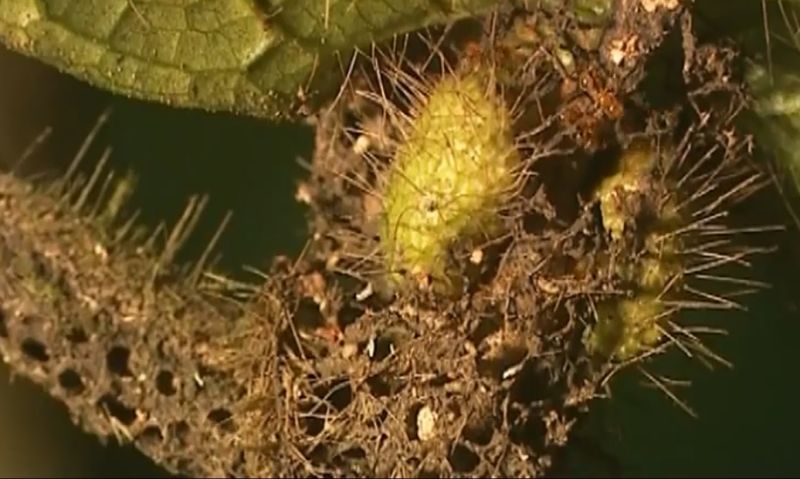


In memetics, the enlarged human cranium is a type of hollow whose primary "purpose" is accomodating symbiont visitors (memes). As such it resembles the plant swellings known as ant domatia - which are built by the host plants to provide accomodation for ants.
Domatia resemble human skulls, and ants resemble out cultural symbiots - with genetic material composed of memes.
Interestingly, ants of the species Allomerus decemarticulatus create artificial corridors between the domatia of their host plant (Hirtella physophora) to allow them to safely move between them.
What lets ideas move safely from brain to brain? Why: books, telecommunications and the internet! So: here we have the ant equivalent of the internet - based on the crainum-domatia analogy.
The highways are fiercely defended - and the native ants can trap and kill marauding insects that alight upon them.
Pictures
Video
The defence of the highways is shown in the following video:
This is an amazing ant domatia story - I plan to see if I can milk it.
Lord Immolation's meme videos
I haven't posted LordImmolation's meme videos here before - so here they are:
The last video starts off talking about The Naked Ape and The Moral Animal - but gets onto the topic of memes towards the end.
Like many critics of evolutionary psychology, LordImmolation points out that the "environment of evolutionary adaptedness" is best thought of as being a spatially-diverse patchwork of many different environments - which is true, but doesn't seem to be a show-stopping criticism.
The real problem with evolutionary psychology so far has been its focus on human universals - and its near-complete neglect of cultural evolution. This makes it into a kind-of joke science of psychology and human behaviour - since it misses out so much of the topic it is supposed to be studying.
As LordImmolation says, evolutionary psychology looks fixable - just add memetics.
Wednesday, 18 January 2012
The big brain with no meme nest
In memetics, the enlarged human cranium is a type of hollow whose primary "purpose" is accomodating symbiont visitors (memes). As such it resembles the plant swellings known as ant domatia.
I've previously written about this here and here.
Here's evolutionary psychologist Steven Pinker attempting to explain the same phenomenon of an enlarged cranium without mentioning symbiosis:
Pinker does invoke technology, language, and "division into cultures" - but these are just assumed, and there's no mention of how they fit into a biological or evolutionary framework.
Symbiosis had a hard time being accepted by biologists. Cultural symbiosis is similarly facing a struggle for recognition that mirrors the way it was widely ignored by biologists until the 1960s.
In the 1960s, it was mostly raw evidence (the evidence that mitochondria contained DNA) that finally got the theory of symbiosis accepted into the mainstream, and killed off the dogma that Fisherian bean-bag genetics could account for living systems - which had dominated evolutionary theory up to that point.
The analogous development in the realm of cultural evolution would consist of the discovery for the neuromeme.
However... this isn't the 1960s. We already know about symbiosis. We have an enormous quantity of data, and huge machines with which to analyse it. There is no good reason why symbiosis in the cultural realm should be a neglected idea.
There is really no good reason why the study of cultural evolution should continue to lag so far behind the study of organic evolution. People should just not still be proposing theories of cultural evolution that don't include basic phenomena - such as symbiosis and recombination.
The reasons why such phenomena are currently neglected boil down to ignorance and stupidity. Scientists in the field who are unaware of these phenomena should just wake up.
Raymond Tallis - resources
Raymond Tallis is a critic of memes and "biologism". He thinks they are a symptom of "Darwinitis".
He wrote a book called Aping Mankind: Neuromania, Darwinitis which ignorantly bashes memetics. Here's a video of Raymond in action:
The criticism of memes starts at 53:50. The whole thing is really too ridiculous to comment on. I'll just quote:
Dennett complains that Aping Mankind caricatures a controversial idea he develops: cultural memes. The Darwinesque concept originates in Dawkins's 1976 book, The Selfish Gene. Memes are analogous to genes, Dennett has said, "replicating units of culture" that spread from mind to mind like a virus. Religion, chess, songs, clothing, tolerance for free speech—all have been described as memes. Tallis considers it absurd to talk of a noun-phrase like "tolerance for free speech" as a discrete entity. But Dennett argues that Tallis's objections are based on "a simplistic idea of what one might mean by a unit." Memes aren't units? Well, in that spirit, says Dennett, organisms aren't units of biology, nor are species—they're too complex, with too much variation. "He's got to allow theory to talk about entities which are not simple building blocks," Dennett says.The video has a Q&A here. Memes are discussed 19 minutes in.
Subscribe to:
Posts (Atom)




 Posts
Posts

