 Language should always have been the king of the subjects studied by
students of memetics and cultural evolution. Speech and writing have
built-in error correction mechanisms. They are some of the things which are
most likely to be copied with high fidelity - and thus to exhibit
cumulative adaptations as they evolve. However linguists have
not been very prominent in the field of cultural evolution.
Famous students of language evolution - such as Steven Pinker and Noam Chomsky -
are apparently clueless newbies when it comes to the topic.
I checked for books on the topic of the cultural evolution of language. There are:
This is a pretty small list. Also, all the books on it are very recent.
When I became interested in cultural evolution, there was practically nothing.
This post asks: what happened? Why weren't linguists early adopters of
memes and cultural evolution?
Though I think this is a good question, I don't have a terribly good answer.
What follows are my speculations:
I think that many of the cultural evolution pioneers had backgrounds in evolution
and population genetics. Most linguists would have lacked this background. They
would have found much of the primary the literature hard to follow or irrelevant.
Also, until recently, cultural evolutionists were few and far between. Only in the last few years have supporters been coming out of the woodwork in large numbers. The dates on my book list reflect this. However, I think if I made corresponding lists for the cultural evolution of science, technology and religion, the 'science' and 'religion' lists would have more items on them - though the 'technology' list might have fewer.
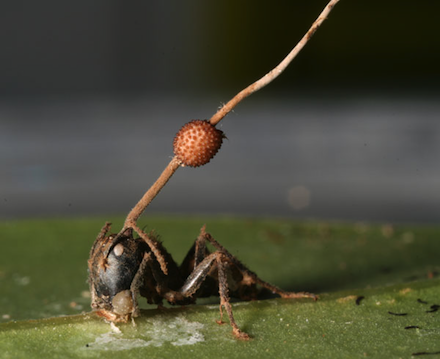 The eusociality
symbiont hypothesis relating to the evolution of eusociality
pictures a positive feedback loop of interactions between hosts
and symbionts, with each new symbiont pulling the colony tighter
together as the symbionts manipulate their hosts into coming into
contact with each other in order to reproduce.
The positive feedback loop involved in the hypothesis is counteracted
by negative interactions involving hosts and symbionts - in other
words by parasitism. As hosts interact more closely parasites can also
spread horizontally between them. Since horizontal transmission promotes
misalignment between host genes and parasite genes, after a certain point,
parasites start to dominate more helpful symbionts - and then the hosts
start to behave as though they want to live further apart from one another.
The significance of parasites is evident in most social insect colonies.
These are vulnerable to parasitism - due to the close proximity of the
members - and it is not uncommon to see nests obliterated by parasites.
On the other hand, because of the parasite threat, the nests themselves
are often policed by cleaning squads. Disease eradication is a big theme.
Sick individuals are exiled and everything is kept remarkably clean.
Humans are a case study for the eusociality symbiont hypothesis. Our
symbionts are typically cultural, but the basic dynamics are much the
same - the cultural symbionts manipulate the humans into coming into
contact with each other in order to reproduce. The result is human
ultrasociality.
We know that humans living in close proximity are
more vulnerable to horizontal transmission of genes. We can see this
by comparing sick city dwellers with their more healthy country cousins.
Parasite transmission favors situations where humans are crowded together.
We have institutions to deal with this - such as hospitals.
Close proximity also favors horizontal memetic transfer. Assuming that
humans want to avoid exploitation by deleterious memetic parasites, we
are going to need organizations and institutions that promote epistemic
hygine. These will involve schools, as well as other types of training
more focused on the memetic immune system.
The negative effects of memetic parasites are clearly evident today.
We have an obesity epidemic driven by fast food advertising. There
are smoking, drinking and caffination epidemics which are widespread.
Over the counter drugs are widely abused. Paranoia epidemics are
fostered by the news media with resulting scares about terrorism,
global warming, vaccination, resource depletion, and so forth.
Epistemic hygiene can reasonably be expected to become a big focus.
Not necessarily the 'thought police' pictured by George Orwell - but
other government-level infrastructure to protect populations against
the negative effects of bad
memes.
 Momme von Sydow has a 2012 book titled:
From Darwinian Metaphysics towards Understanding the Evolution of Evolutionary Mechanisms - A Historical and Philosophical Analysis of Gene-Darwinism and Universal Darwinism. The book is freely available to read online. At almost 500 pages, it's the longest critique of Universal Darwinism I've ever seen.
It's a fairly sympathetic critique - the author makes a serious effort to understand the topic before explaining where the perceived flaws lie. As the following quotation indicates, the author regards the blindness of variation as a key tenet of Darwinism:
the Darwinian tenet of the blindness of variation is challenged. It is argued that one should interpret biological evidence in a way that allows for a kind of directed and adapted process of variation – though this process is of course fallible and not omniscient. Paradoxically, this follows from pursueing a Darwinian approach up to its limits. Darwinism thus again demonstrates that it contains the seeds of its own destruction.
It is neo-Darwinism that got dogmatic about variation being undirected. Darwin himself was fairly agnostic about this topic - and indeed proposed a mechanism by which variation was directed by the experience of organisms.
This point revolves around a debate about what the term 'Darwinism' means. Personally, I see no compelling reason to attach Darwin's name to the more useless and out-dated theory - especially when Darwin himself had nothing to do with it.
The author also seem to think universal Darwinism is incompatible with the evolution of evolutionary mechanisms, saying:
Moreover, although it cannot be questioned that we can learn very much from Darwinism, it is claimed that Universal Darwinism as an interpretative framework can and should be replaced by an account of the evolution of evolutionary mechanisms – both in biology and in metaphysics.
...and...
I think the biological trial-and-error theory of Darwinism might also be urged to drop its universalism and acknowledge a certain evolution of evolutionary mechanisms.
The evolution of evolutionary mechanisms seems like a flat fact to me. Particularly the mechanisms that produce selection and introduce variation have complexified over time. Mutations produced inside minds can be a bit different from those produced inside cells. However, as far as evolutionary theory goes, the mechanism of production of mutations can be treated like a modular block box - with specific theories from genetics being plugged into it. A new mutational mechanism needs no changes to evolutionary theory itself - rather it's just a new mutation module. Much the same goes for selection. These days, selection can be produced by intelligent agents - for example by intelligently choosing compatible mate. Darwinism is big enough to include a variety of sources of selection. I think we can have a universal Darwinism while still leaving some space for the evolution of evolutionary mechanisms.
A critic might complain that, with these dependencies on other theories of mutation and selection, Darwinism barely qualifies as a theory in its own right. This has always been true, though. For example, to predict the fitness of a bat genome, Darwinism relies on theories of development, theories of aerodynamics and theories relating to radar. Dependencies on other theories has always been a fundamental part of Darwinism. Evolutionary theory doesn't stand alone.
These are some of the main criticisms in the book. I think that universal Darwinism survives these attacks just fine.
 Some students of semiotics seem to be irritated by the success of the meme.
(e.g. Kilpinen, E. (2014)).
Semiotics seems to be much more popular than memetics, and the term 'sign'
seems to be much more popular than
the term 'meme'. However, the term 'sign' does appear to have lost some
important ground to the term 'meme'. Here's my take on how the meme
managed to get a foothold.
Semiotics claims to be older than memetics. Semiotics became popular
in the 1970s and 1980s - but claims roots going beck centuries.
However, until the 1970s there wasn't very much in the way of
semiotics publications. The founders of the various schools of cultural
evolution may have ignored semiotics, because it had yet to become
popular at that time.
By the 1970s, semiotics had basically failed to produce a school of
cultural evolution. There was no explanation of how signs evolved
based on broadly Darwinian principles.
As Terry Deacon put it:
Until now, classic semiotic theories have not had much to say about why certain signs persist and others do not, or why certain semiotic systems evolved the forms they now exhibit.
...and...
The meme concept has generated recent excitement precisely because it seems to offer hope of providing something that other theories of social and semiotic processes have not succeeded in providing. It addresses the process of semiosis, i.e., the dynamical logic of how the symbolic and concrete constituents of culture arise, assume the forms they assume, and evolve and change over time.
Retrospectively, we can see that application of evolutionary biology to human communication mostly arose outside of semiotics - mainly from those trained in evolutionary biology and population genetics.
Perhaps the bypassing of the term 'sign' by cultural
evolutionists was inevitable. The term 'sign' - in common parlance -
comes with an associated object that is signified by the sign.
Culture contains many signs - for example, letters, words and ideograms.
However there are also non-signs: for example, knots, cups and fire. These have no obvious referents - they just are. For the concept of 'sign' to be useful as a unit to cultural evolutionists all culture would need to be signs.
However, that violates the common dictionary definition of 'sign'.
The tpyical semiotics solution to this problem is to expand the definition
of 'sign' to include knots, cups and fire - and indeed, practically
anything. This is sometimes called 'pansemiotics'. If you do this, then semiotics becomes very general. Of course the problem is then that the original meaning of the term 'sign' has got lost. It is
sometimes permissible to give common language terms counter-intuitive
technical meanings. However, here, I think it just leads to pointless
confusion.
As for the claim that the concept of 'meme' misses out the concepts of
semantics and observation: this is just sour grapes on the part of
the semiotics folk. One might reply that meaning and observers
aren't part of the meme because they are context-dependent.
The domain of Darwinian evolution has expanded dramatically over the last 150 years.
Darwinian evolutionary theory is now frequently applied to cultural evolution, the
development of individuals and individual learning. More speculative extensions of
Darwinism include ones that cover quantum physics, complex adaptive systems,
cosmological natural selection and observation selection effects.
It is natural for observers of this expansion to ask: how far can the Darwinism
go? Where is the the edge of evolutionary theory? What are the limits of Darwinism?
The questions relating to "Darwinism" might be criticized as being a bit vague - but we
can replace these with similar questions about the domain of concepts such as fitness
selection and adaptation - and have some more rigorous questions that more people are
likely to be able to form a consensus about.
I think that the lesson of history is that the edge of evolution is farther out than
we think. People are inclined to say that the edge of Darwinism lies at the outer
edge of their personal understanding of it. However, we can see historically that
Darwinism has repeatedly pushed into new domains, covering new phenomena.
Another possible position is that there's no real "edge" - instead evolutionary
theory gradually breaks down as more and of its axioms are progressively broken.
I think that it is clear that there's some truth to this perspective. However,
evolutionary theory is fairly simple - and there aren't very many axioms to
break. Nonetheless, we should not necessarily expect to find a single
precipice at the edge of evolution - but rather a gradual disintegration
in the form of some steps or a slope. This complicates the issue - but
doesn't fundamentally alter the problem.
To finish this article, I have a characterization of where I think the edge
of evolution is to offer. I think evolutionary theory applies to macroscopically
irreversible systems. This gives it roughly the same domain as
maximum entropy thermodynamics - which
I claim
it is very similar to. Part of the intuition behind this involves the link between selection
(from evolutionary theory) and destruction (which leads to many macroscopic entropy increases).
This relationship is probably wrong in detail. There's nothing in evolutionary
theory that forbids its application to macroscopic reversible systems. Selection
need not necessarily be linked to destruction. However, this is the best, short
characterization of the edge of evolution that I have. Without it, I am reduced
to offering a laundry list of phenomena that I think that evolutionary theory applies to.
Alex Flint has some excellent quality meme criticism in his essay titled:
The problem
with memes.
If only all meme criticism was of this standard. Alex makes several points - here I will focus
on just one of them. He says:
If evolution amongst memes really was responsible for, say, Rick Rolling, then we should
expect to see a relatively continuous sequence of memes in historical records, analogous
to the fossil record.
Maybe. The fossil record is patchy - and not always accessible - and much the same is true of culture.
In practice, it's often possible to make valid inferences even if you have no fossils. If you see an organism, you
can validly assume it has an evolutionary history - even if you have no fossils - simply because
of common descent. We can often do much the same thing with memes.
Alex says:
The term “meme” has found widespread use in contemporary discourse, especially when discussing
the public mindset, since the constitution of that mindset is what memetic evolution is supposed
to explain. It is often used to refer to particularly catchy or trendy ideas, but I have argued
that in many such cases there is little justification for assuming that an evolutionary process
was responsible. Questioning whether the term “meme” should be applied in such cases process is
dangerously close to a vacuous quibble over semantics; however, a few cautions do bear mentioning.
First, it is a mistake to think that a deeper understanding has been reached just by calling
something a meme. In the absence of evidence for an evolutionary process, calling something a
“meme” is no different to calling it an “idea” or “phrase”. No greater understanding of its
nature or origin has been reached by invoking the term, nor does the term suggest any new
ways that it might be manipulated, magnified, or minimised.
Alex seems to think that you shouldn't call some aspect of culture a 'meme' if you can't
back up your assertion with a memetic fossil record - showing competition and selection
between memes. That goes to the definition of a meme - and I don't think the dictionary
agrees with Alex. Here's what one
dictionary says for "meme":
an idea, behavior, style, or usage that spreads from person to person within a culture .
Another defintion:
an element of a culture or system of behavior that may be considered to be passed
from one individual to another by nongenetic means, especially imitation.
These definitions don't rule out memes that pop into existence by chance, or memes that
are intelligently designed. The whole idea that the term "meme" implies an origin involving
competition and selection between a series of evolutionary precursors seems to be contrary
to how the word is commonly defined.
Alex is correct to say that calling something a 'meme' doesn't imply that it
wasn't intelligently designed. However, that's simply a matter of definition.
I don't see how it is a 'problem' - and I don't see why Alex calls it a 'problem'.
Alex closes with:
In this essay I have argued that although memetic evolution is a coherent concept, applying it as an explanation for specific phenomena requires extra evidence to corroborate its causal role in producing those phenomena. In the absence of such evidence we should be careful about using the term “meme” too liberally since we may make unjustified assumptions about the nature of the ideas we are dealing with.
The "unjustified assumptions" Alex is referring to is the assumption of an evolutionary history involving variation and selection. However, this assumption seems to be coming from Alex - not from memes or memetics. It is OK to have intelligently-designed memes - indeed the internet is full of them.
In summary: we can legitimately use the term "meme" liberally - if we simply adopt the standard definition of the term. I think Alex's concerns about "unjustified assumptions" are themselves unjustified.
 I notice that Peter Godfrey-Smith has a section in Darwinian Populations and
Natural Selection denigrating the significance of positional inheritance. He writes (on page 55):
Parent and offsping often correlate with respect to their location.
It is possible to inherit a high-fitness location; one tree can inherit the
sunny side of the hill from another. But the significance of this inherited
variation is limited. A population can near-literally 'explore' a physical
space, if location is heritable and is linked with fitness. It may move along
gradients of environmental quality it may climb hills, or settle around water.
But to the extent that reproductive success is being determined by location per se
it is not being determined by the intrinsic features that individuals have. If
extrinsic features are most of what matters to realized fitness — if intrinsic
character is not very important - then other than this physical wandering,
not much can happen.
What can happen is that adaptations can develop. Lightning strikes can find the
shortest path to the ground, propagating cracks can locate weaknesses in materials
and drainage patterns can develop structures that efficiently drain basins.
The idea that concepts like 'fitness' and 'adaptation' apply to these kinds of
simple inorganic systems is a big deal for physics - and a big deal for Darwinism.
Of course in these kinds of system more than position is inherited. For
example, in electrical discharges, charge is also inherited. However position
is important - it is copied with high fidelity, it can often vary considerably
and many other properties can depend on it.
Godfrey-Smith attempts to draw a distinction between "intrinsic" and "extrinsic"
traits - and then claims that this affects the "Darwinian character" of processes.
However, traditional Darwinism has no use for such a distinction - all it cares about is
whether traits are inherited. If you look at axiomatic expressions of Darwinian
evolution, "intrinsic" and "extrinsic" don't get mentioned. That's because they
don't matter. They are irrelevant to most evolutionary theory. Heredity of traits
is what matters - not whether those traits are "intrinsic" or "extrinsic".
It's true that "intrinsic" traits can be more numerous than "extrinsic" ones.
However, that's no reason to single out "extrinsic" traits and exile them from
Darwinism. Darwinism makes no distinction between "intrinsic" and "extrinsic" traits.
The exact same rules about copying with variation and selection apply equally to both
types of trait.
Peter says "the significance of this inherited variation is limited". It seems to me that
the significance of this inherited variation is huge. It it wasn't for positional inheritance,
we would all have been born in the vacuum of space and died instantly. It may be
only "physical wandering" that means that we were born on the surface of a planet -
rather than in interstellar space - but it makes the difference between life and
death for all of us. Location is actually a very important property
that affects fitness. We should study how it evolves using good old-fashioned
evolutionary theory - it absolutely does apply.
 This post is about the work of Henry Jenkins. Henry is interested in marketing and advertising. Here are some of his blog posts on this topic:
There's a PDF document with much of this content collected in it: If It Doesn’t Spread, It’s Dead.
Here's a book he wrote:
Spreadable Media: Creating Value and Meaning in a Networked Culture by Henry Jenkins, Sam Ford, Joshua Green
In the PDF I mentioned, Henry criticizes memes, writing:
Use of the terms “viral” and “memes” by those in the marketing, advertising and media industries
may be creating more confusion than clarity. Both these terms rely on a biological metaphor
to explain the way media content moves through cultures, a metaphor that confuses the actual
power relations between producers, properties, brands, and consumers. Both have been used so
loosely they can refer to everything from word–of–mouth marketing
efforts to remix videos to popular content in ways that don’t help us understand the nature of these different
activities and the potential relationships between them. Both terms seek to explain the process of cultural
transmission but do so in such a way they strip aside the social and cultural contexts in which ideas
circulate, and the human choices which determine which ideas get replicated.
The terms 'viral' and 'memes' refer to a range of things. The term 'culture' does so too. This
criticism of the terms 'viral' and 'memes' applies equally to the widely-accepted and useful term 'culture'.
For me that illustrates the vacuousness of this critique. Saying something is 'cultural' doesn't help
distinguish between the different aspects of culture. That's not the point of the terminology. Instead
it highlights how it is copied and passed on - for example by imitation or teaching.
I fail to see how the terms “viral” and “memes” strip aside the social and cultural contexts in which ideas
circulate. Those are environmental factors that act as selective forces. This is surely cultural evolution 101.
Perhaps Henry has been confused by the specialized nature of memetics. Just as genetics is quite focused on
how genes mutate and recombine, so memetics is focused on how memes mutate and recombine. However, these disciplines
do not stand alone - there are other folk looking more at things like development, the nature of selective
forces and interactions with the surrounding ecology.
However, I'm speculating here. Henry doesn't explain where he gets his conception from. To me this criticism seems
to be unsubstantiated.
Henry also writes:
Talking about memes and viral media places an emphasis on the replication of the original idea,
which fails to consider the everyday reality of communication — that ideas get transformed, repurposed,
or distorted as they pass from hand to hand, a process which has been accelerated as we
move into network culture. Arguably, those ideas which survive are those which can be most
easily appropriated and reworked by a range of different communities. In focusing on
the involuntary transmission of ideas by unaware consumers, these models allow advertisers and
media producers to hold onto an inflated sense of their own power to shape the communication process, even
as unruly behavior by consumers becomes a source of great anxiety within the media
industry.
Talk of memes does not "place an emphasis on the replication of the original idea" at the expense of
transformation. In biology, there are copying, recombination and mutation. Saying that
biological models emphasize copying at the expense of recombination and mutation seems as though
it would be silly to me. Evolution depends critically on both copying and mutation.
Recombination is very important too. A copying-only version of evolutionary theory would be
impotent indeed - but there's no such thing - except as a straw man in the minds of critics.
I do like the "If It Doesn’t Spread, It’s Dead" slogan, though. To many memeticists, myself included,
culture is alive, "not just metaphorically but technically".
 The
term " Holocene extinction event"
refers to the currently ongoing extinction of species.
It is apparently largely caused by the impact of humans on the environment. This makes it
the first extinction event caused by a proliferation of memes.
At the moment, the Holocene extinction fails to meet the criteria for a mass extinction.
In a mass extinction 75% of species go extinct in a short space of time. However,
knowledge of memetics suggests the possibility of a
memetic takeover -
in which the substrate of the heritable medium of biology changes - and the era of
the DNA molecule comes to an end. Such an event could be accompanied by a
large mass extinction. In such circumstances, many DNA-based creatures would
probably be preserved in nature reserves or historical simulations - and thus not
technically go extinct. However, it is far from clear what fraction of
the currently-known species would survive.
One problem with extinctions is that things of value get lost. Assuming that preventing
this is desirable, we can ask what steps could be taken to help prevent species loss.
I think a slower memetic takeover
would result in a reduced chance of things getting lost by accident.
Technological determinism
probably means that we can't do much to slow progress by machines down. However, what we
probably can do is speed up our own progress - and that of our companion creatures. The aim
would not be to keep up with the machines - which does not look feasible - but rather to
prolong the period of our usefulness - and prevent us from becoming an early casualty of
the current extinction.
 This post is about Darwinian physics. In optimization theory, for evolutionary approaches to
work as effective search algorithm, the fitness landscape must not be too rough.
If fitness at nearby points in the fitness landscape are unrelated, an evolutionary
search will do no better than a random search.
In positional
inheritance the domain of fitness landscape maps corresponds to
a two or three dimensional physical space. Fitness usually depends
significantly on the location within that space.
It is pretty clear empirically that
fitness
at nearby locations is often correlated - i.e. fitness is heritable in cases of positional inheritance. However this leads to the question of: why is fitness heritable?
That question goes to the smoothness of nature. If you look at the world, nearby parts are often similar to each other. It isn't just neighbouring fitness that is similar - all neighbouring properties tend to be similar. Why is that the case? Here are three significant reasons:
- Entropy increase causes many lumpy and rough phenomena to become more smooth and uniform.
- Copying also causes like to associate with like. In a forest, the trees are similar because of genetic copying
processes.
- Gravity causes air to associate with air, water to associate with water and rock to associate with rock.
It is a major force causing like to associate with like.
It's possible to argue that copying is the fundamental phenomena here -
and that gravity and entropy increases are the result of copying. Entropy
increase can also plausibly claim to be fundamental. Gravity cannot
claim to be fundamental.
I like the explanation in terms of entropy. Nature might not exactly abhor a gradient, but it isn't terribly keen on edges. There are a bunch of dissipative processes that gradually scuff, dissolve and erode them out of existence.
|
|






 Posts
Posts

