Tuesday, 26 October 2010

Memetics compendium

As part of the "military memetics" project, Dr. Robert Finkelstein has apparently used some of the dollars the department of defense sent his way to compile a huge body of existing scientific papers on memetics into an enormous volume, and publish it "for free" on the internet - in the form of the Memetics Compendium.

It runs to 14Mb - and 1680 pages!!!

The release notes say:
The basic purpose of the Compendium is to provide an indication of the prospective value of memetics to the U.S. military for conventional and asymmetric operations, including counter-terrorism.
Whoah! The next time someone tells me memetics isn't a science - and hasn't produced anything of value - I think I'll tell them to go and read the Memetics Compendium - and to tell me that again when they have finished it.

The Compendium apparently pays scant attention to international copyright law. For instance it has the entire text of chapter 11 of The Selfish Gene.

So - it may not stay up forever - but for the moment, you can download your copy now!

Military memetics

It had to happen one day! The US military have their own memetics project!

One Dr. Robert Finkelstein has been apparently been running the project since 2006 under the sponsorship of the department of defense.

Perpare to have all your memes weaponised!

They have a web site and a presentation document, ...which explains their mission. The presentation style of this is rather zany. To quote from it:
PURPOSE OF A MILITARY MEMETICS PROGRAM
  • To develop a new approach to
  • Countering terrorists and insurgents beforeand afterthey become terrorists and insurgents: influencing beliefs in a scientific way
  • Preventing irrational conflict and promoting rational solutions to national and international problems
  • Strengthening the U.S. military in

    • Peacekeeping missions
    • Psychological operations
    • Recruitment
    • Training

  • To make new discoveries concerning the human brain, cognition, and social networks
The web site also says:
The attempt to establish a scientific basis for memetics is critically important. For example, within a suitable memetics framework could be the means to prevent irrational conflict and promote rational solutions to endemic national and international problems. Of course, without safeguards memetics can become a double-edged sword.
Right on.

References

Sunday, 24 October 2010

Meme poster

Here's a "meme poster" which I found down the back of the internet. Enjoy,

Saturday, 23 October 2010

Animated GIFs

I have noticed that quite a few online RSS readers pass animated GIFs through - including popular ones like Netvibes. Many common blog feeds pass them through as well. However, so far, I haven't seen too many people using animated GIFs in my RSS news feeds.

They are probably pretty attention grabbing. Advertisers have a long history of using them - and using animation has been shown to attract a larger percentage of user clicks. So maybe more people will be using them to promote their content via RSS feeds in the future.

For most of this year, this page has been one of the most popular pages on this blog. Since there isn't very much here - besides that animated GIF - that seems to add support to the hypothesis.

Wednesday, 20 October 2010

The evolution of the term "meme"

Richard Dawkins coined the term "meme" in his 1976 book, The Selfish Gene. He defined it to refer to a "unit of cultural transmission".

However, these days, for many people, the term "meme" has taken on a narrower meaning. It has come to be used as an abbreviation for "internet meme" - which is a term most frequently used to refer to a piece of highly viral (but usually rather frivolous) culture which is shared frequently on the internet.

As Tom Michael put it:

It's ironic that the term "meme" has spread much more widely as a term relating to internet silliness than as a general unit of cultural exchange. It had to mutate into a faster-reproducing form in order to be widely known about.

Sometimes the frivolous internet culture is described as being a "meme", as it is being passed around. In such cases, the term "meme" has become a kind of meta-meme - which spreads due to its association with the viral culture which it is associated with.

In biology, there is the concept of "linkage". This causes the fate of genes to be associated with the fate of their neighbouring genes. Some genes can us this effect to spread - because they are near other genes which are favourably selected for. This is commonly known as genetic hitchhiking.

The term "meme" is doing some hitchhiking of its own these days, spreading by virtue of its association with the highly-viral content which it has come to be associated with.

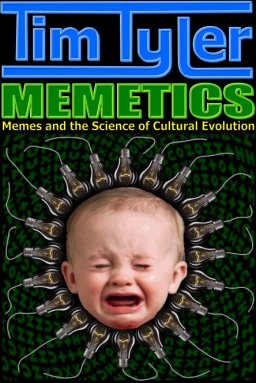
Tim Tyler - Memetics


I've put together a prototype cover for my proposed 2011 book.

The title and subtitle are provisional - and the artwork isn't anywhere near finished - but it illustrates the kind of thing I am considering.

For the second prototype cover, see: here

For the third prototype cover, see: here

Saturday, 16 October 2010

Matt Ridley - Ideas having sex

Ridley writes that "whole economies evolve by natural selection", that "ideas have sex" and he talks explicitly about "cultural evolution".


More videos from Matt are collected on this group.

Friday, 15 October 2010

Introduction to memes video


15 minutes of the basics. Gets a few points from me for mentioning the possibility of a memetic takeover.

The rise of the meme

"Meme" is by far the most popular name for a contagious idea.

Today, the Memetic Explosion continues to gather pace. In fact, memes are exploding!

Here is a graph from Google Trends which illustrates its progress so far:


History of "Meme" searches [Current image]


History of "Meme" searches [Current image]

Archived images - from 2010:


History of "Meme" searches [December 2010]


History of "Meme" searches [source]

Ray Scott Percival lectures on memes

Ray Scott Percival lectures on memes:


This is a bit on the boring side, and has a fair bit of philosophical mumbo-jumbo.

The author tries to knock down memetics and present his own "anti-materialistic" theory of cultural inheritance. This is not an approach which I am very sympathetic towards.